










For most registered nurses (RNs), the transition to graduate school—whether pursuing an MSN, DNP, or PhD—feels like a homecoming until the first major writing assignment is due. In the clinical world, communication is defined by brevity. We are trained to think in “SBAR” (Situation, Background, Assessment, Recommendation), to document in “charting by exception,” and to use shorthand that conveys maximum clinical data with minimum fluff.
However, the very skills that make an RN exceptional at the bedside are often the same ones that cause them to stumble in a graduate-level seminar. The “clinical brain” is optimized for rapid-fire, real-time data processing. The “scholarly brain,” conversely, requires synthesis, long-form argument, and deep theoretical application.
This disconnect is where traditional nursing note-taking fails. If you are still using the same methods you used to pass the NCLEX or survive a 12-hour shift in the ICU, you aren’t just working harder—you’re likely hurting your GPA.
The Cognitive Gap: Clinical vs. Academic Synthesis
In a hospital setting, a note is a legal document. Its purpose is to record what happened. In graduate school, a note is a cognitive tool. Its purpose is to explain why something happened through the lens of evidence-based practice (EBP).
When graduate students rely on traditional note-taking, they often end up with a “laundry list” of facts. They have the patient’s vitals, the drug’s mechanism of action, and the study’s sample size. What they lack is the Synthesis.
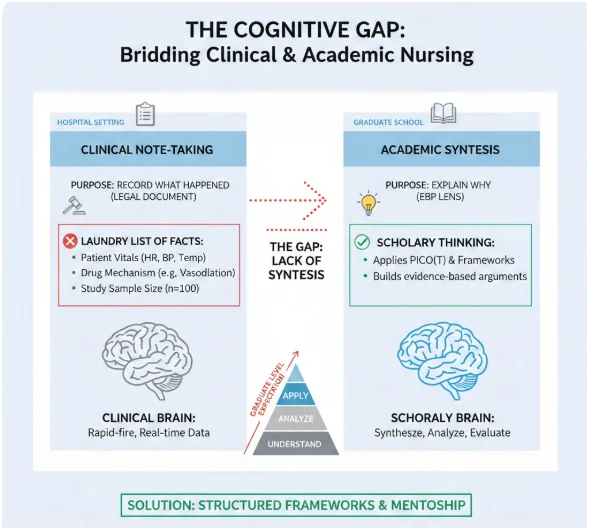
As shown in the hierarchy of learning, graduate students are expected to move beyond “Remembering” and “Understanding” into “Analyzing” and “Evaluating.” Traditional bulleted notes keep you stuck at the bottom of that pyramid. To move up, you need a system that forces you to connect the dots between a clinical observation and a theoretical framework.
Why Your Current System is Raising “Red Flags” in Your Writing
If you find yourself staring at a blank screen when trying to draft a 15-page paper, your note-taking is the culprit. Common symptoms of “Clinical Brain Overload” in academic writing include:
- Fragmented Sentences: Your essays read like a nursing shift report—staccato and lacking flow.
- Lack of Critical Analysis: You describe the patient’s condition perfectly but fail to argue why a specific nursing theory (like Peplau’s Theory of Interpersonal Relations) applies.
- APA 7th Edition Fatigue: Because clinical notes don’t require citations, graduate students often treat references as an afterthought rather than the foundation of the argument.
To overcome this, students often need to see a “gold standard” of what a synthesized clinical argument looks like. Examining a high-quality nursing case study writing example can be eye-opening. It demonstrates how to take those fragmented clinical notes and weave them into a narrative that satisfies both a medical director and a PhD professor.
The “Questionable” Fix: Why Radical Transparency in Study Aids is Growing
There is a growing debate in US nursing schools about the “hidden curriculum”—the set of academic skills (like scholarly writing) that students are expected to know but are never actually taught. With the rise of the Next-Gen NCLEX and more rigorous DNP requirements, the pressure is immense.
Many students are now turning to specialized academic support to learn these nuances. While some old-school educators might find it “questionable,” the modern reality is that nursing students are often working full-time in high-stress environments while completing their degrees. Utilizing professional nursing essay writing help isn’t about avoiding the work; it’s about having a mentor or a template to understand how to bridge the gap between “nursing shorthand” and “scholarly excellence.”
Three Modern Note-Taking Frameworks for Graduate Nurses
If you want to fix your note-taking and improve your academic output, you need to move away from linear lists and toward associative mapping.
1. The PICO(T) Integration Method
Instead of taking notes on a research paper by summarizing the abstract, organize your notes by the PICO(T) elements (Population, Intervention, Comparison, Outcome, Time).
- The Benefit: When it comes time to write your Literature Review, your notes are already categorized by the variables you need to compare.
2. Concept Mapping for Pathophysiology
Graduate-level pathophysiology requires you to understand the “cascade.” A linear note cannot capture the systemic impact of a cytokine storm or heart failure.
- The Benefit: Using visual maps allows you to see the “why” behind the “what,” which is the hallmark of a doctoral-level clinician.
3. The Theoretical Cross-Walk
Every time you take a note on a clinical intervention, force yourself to write one sentence on which Nursing Theory it aligns with. Is this an example of Orem’s Self-Care Deficit? Or Watson’s Theory of Human Caring?
- The Benefit: This eliminates the “Red Flag” of writing a paper that is too “medical” and not “nursing” enough—a common critique from graduate faculty.
The Impact of the Next-Gen NCLEX and AACN Essentials
The American Association of Colleges of Nursing (AACN) recently updated its “Essentials,” moving toward competency-based education. This means graduate students are no longer just tested on what they know, but on their Clinical Judgment.
Clinical judgment requires the ability to prioritize and synthesize. If your notes are a mess, your judgment on paper will appear uncoordinated. This is why many US graduate students find that their first-semester grades are lower than expected. They are being graded on their ability to think like a scholar, but they are still taking notes like a student nurse.
Conclusion: Evolving Beyond the Bedside
The transition from a “working nurse” to a “scholar-practitioner” is one of the hardest professional shifts you will ever make. It requires unlearning the habits that kept you safe on the floor to adopt the habits that will make you a leader in the boardroom or the classroom.
Your note-taking is the foundation of your scholarship. By moving away from traditional, fragmented lists and toward synthesized, theory-driven frameworks, you prove that you aren’t just a clinician who can follow orders—you are an expert who can lead the conversation.
Whether you are looking at a nursing case study writing example to understand the expected flow or seeking nursing essay writing help to master the complexities of APA 7th Edition, remember that the goal is the same: to communicate nursing excellence with the authority it deserves.
About The Author
Georgia Taylor is a Senior Nursing Education Specialist and lead consultant for advanced clinical scholarship at MyAssignmentHelp. With over 15 years of experience in US-based healthcare education, Aria specializes in helping graduate students translate complex clinical data into high-level academic narratives.
READ MORE ARTICLE ON BLOOKET.