Every retail store has to manage pricing. It sounds simple until you are running dozens of SKUs across a busy floor and a supplier changes a cost on a Tuesday morning. At that point, how your labels work becomes a real operational question.
Two primary systems exist: traditional paper-based labels and electronic shelf labels (ESLs). Neither is universally superior. The right choice depends on store size, pricing frequency, staff capacity, and budget. This guide walks through how each system performs in practice so retail operators can make an informed decision.
What Traditional Price Tags Actually Involve
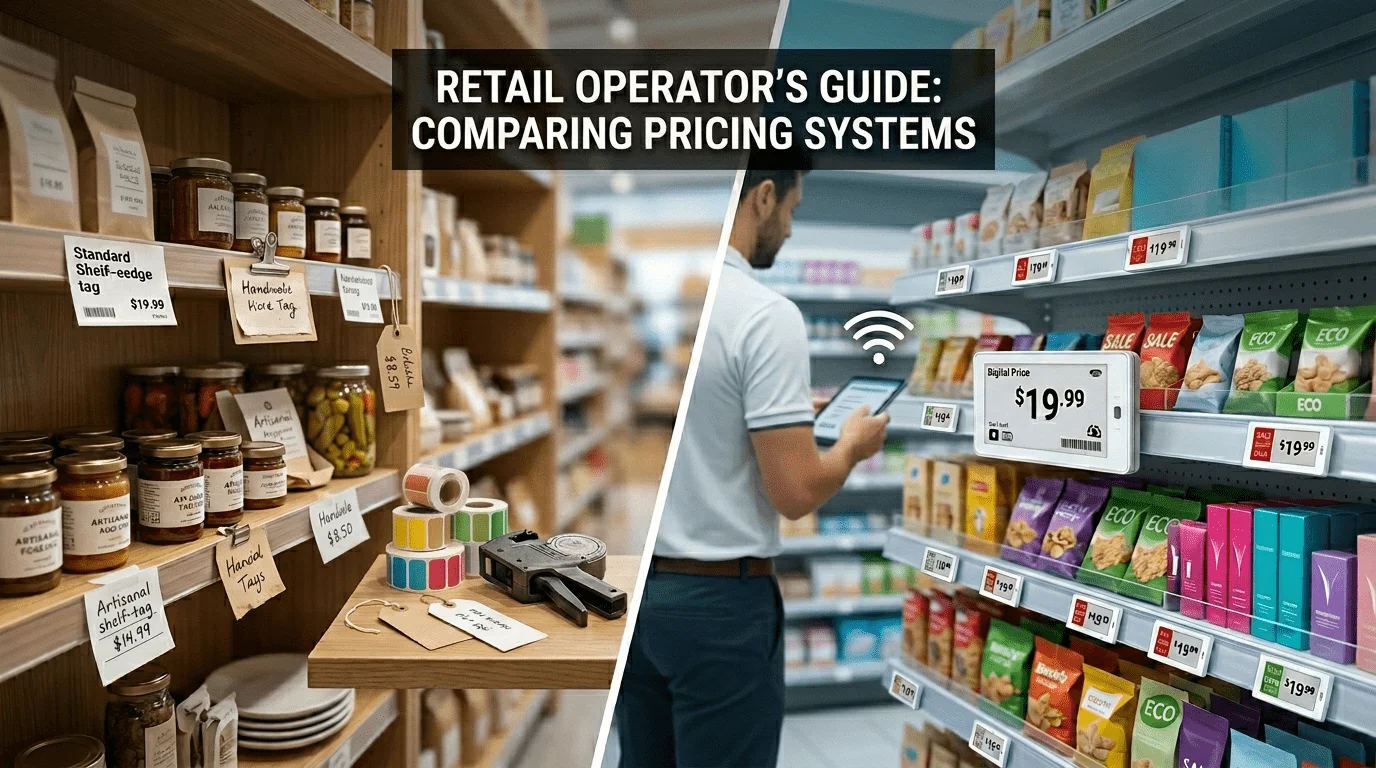
Traditional pricing covers label guns and paper rolls, hang tags, shelf-edge label strips, sign holders, and clip-on ticket holders. Staff print labels, walk the floor, and manually replace each tag. No technology integration is required.
The appeal is straightforward: low upfront cost, no software, no learning curve. For a small format store with a stable product mix and infrequent price changes, this workflow is fast and entirely manageable. The supplies are inexpensive and universally available.
The limitation shows up at scale. Every price change is a labor event. Print, walk, find the item, replace the tag, move to the next. Multiply that by 200 SKUs and a weekly flyer cycle, and the hours accumulate quickly. Manual processes also introduce errors. An unupdated tag creates a mismatch between shelf and POS, a friction point that erodes customer trust and can lead to compliance issues at the register.
What Electronic Shelf Labels Actually Do
ESLs are digital displays that replace the paper label on the shelf edge. Each unit connects wirelessly to a central management system. A price change made in the back office pushes to every affected label simultaneously.
Integration options include a direct POS or ERP connection, an API, or a spreadsheet upload. No infrastructure overhaul is required to get started. Beyond price, ESL displays can show promotional callouts, stock levels, and operational data, making them a shelf-edge communication tool, not just a pricing mechanism.
Modern ESL units use e-paper technology, which draws power only during updates. Battery life on current models typically ranges from 5 to 10 years, depending on update frequency, and batteries are replaceable without swapping the unit. Freezer-rated models are available for cold storage environments, with specialized displays, batteries, and mounting hardware designed for low-temperature use.
Where Each System Wins
Traditional labels hold a clear advantage in specific contexts. Stores with small SKU counts and infrequent price changes will find manual updates quick and manageable. Tight startup budgets make the upfront ESL investment harder to justify. Temporary retail formats and pop-up environments do not require permanent infrastructure. Some product categories also benefit from handwritten or custom tags as part of the brand experience.
ESLs deliver the clearest return in different conditions. Stores with frequent price changes, such as grocery, pharmacy, beauty, and promotional-heavy retail, see an immediate reduction in labor cost per update. Multi-location operators gain the most: one system updates labels across all stores simultaneously from a single interface. Promotional environments benefit from instant color-coded updates without printing and distributing signage. Pricing accuracy improves structurally because centralized control eliminates the gap between what is on the shelf and what is in the system.
The Real Cost Comparison
Traditional labels have a low upfront cost but incur recurring supply and labor expenses: paper rolls, ink, tag stock, and staff time per update. These costs are real but rarely tracked as a line item, which makes them easy to underestimate.
ESL costs are front-loaded. Hardware, integration, and installation require capital. After that, ongoing costs drop significantly. The break-even point depends on SKU count, pricing frequency, number of locations, and the current fully loaded labor cost per update. For high-frequency retailers, the payback period is often shorter than operators expect when they run the actual numbers.
Fixture Compatibility Is Worth Checking Early
One practical consideration that gets overlooked: ESL units mount to the shelf edge, and compatibility depends on the dimensions of the rail and label holder in your existing fixtures. Gondola, slatwall, and gridwall profiles all have different specifications. Confirming compatibility before ordering avoids delays and rework. A supplier that carries both fixture systems and ESL hardware can answer that question in a single conversation.
A Note on the Canadian Market
Most ESL content is written for US or European audiences, with vendor networks and support structures to match. Canadian retail operators should confirm they are working with a supplier who delivers across Canada, responds within a reasonable service window, and can support multi-store rollouts without routing through international logistics. Lead times and local support availability matter more than they appear when a system issue surfaces mid-promotion.
Making the Decision
The comparison comes down to a few core variables. How frequently do prices change in your store? How many SKUs are affected? Do you operate more than one location? What is the current labor cost per manual update, fully accounted for?
Stores where the answers to those questions involve low frequency, small SKU counts, and a single location will generally be well served by traditional labels for the foreseeable future. Stores where the answers involve frequent changes, large SKU counts, multi-location management, or promotional complexity will find ESL pays for itself faster than the upfront number suggests.
Both systems are valid. The goal is to align the system with the store’s actual operational reality.
Displetech is a Canadian retail fixture supplier serving commercial retail accounts since 1986, with showrooms in Montreal and Quebec City and a fabrication facility in Granby. Displetech carries electronic shelf labels through a partnership with SES-imagotag alongside a full range of traditional labeling supplies, gondola shelving, slatwall, gridwall, and custom metal fabrication. Delivers across Canada with a 24-hour response time. Visit displetech.com.
Disclaimer
The information provided in this article is for general informational and educational purposes only. It does not constitute professional business, financial, or operational advice. Every retail store has unique requirements; pricing system decisions should be made after evaluating your specific store size, budget, and operational needs. Displetech makes no warranties regarding third-party products, including SES-imagotag ESL systems. Battery life, fixture compatibility, and software performance should be verified directly with the supplier. Readers are encouraged to consult a qualified retail solutions provider before making any purchasing decisions.
Learn without the headache — explore simple, powerful ideas you can actually use right now.