


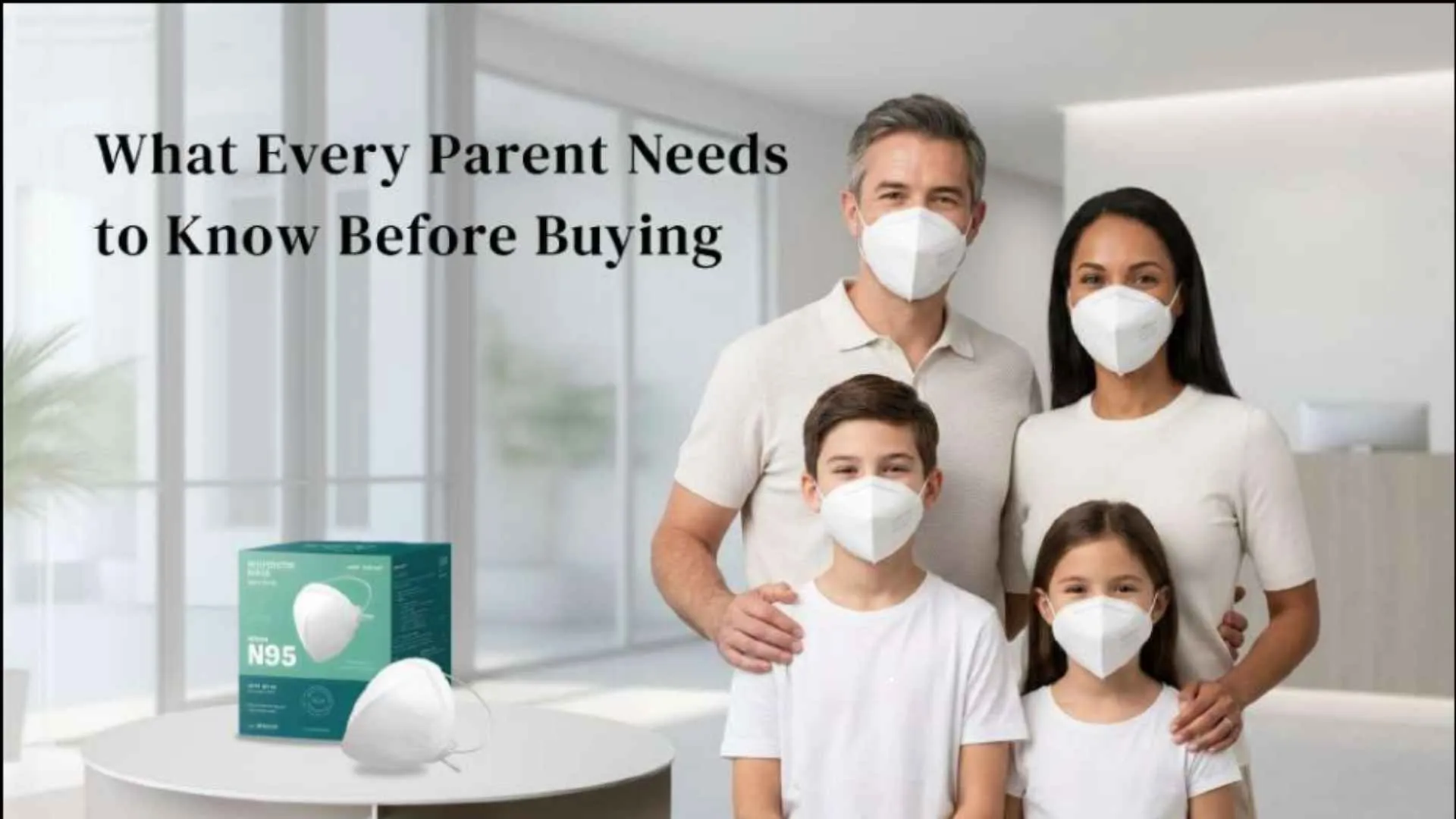
If you’ve spent any time trying to figure out which masks are actually worth buying for your family, you already know how confusing it gets. Surgical masks, cloth masks, KN95s, N95s, some with ear loops, some with head straps, some claiming 99% filtration. The options are overwhelming, and the labeling on most products doesn’t make it easier.
For parents, especially, this confusion carries real consequences. Putting the wrong mask on your child during a wildfire smoke event, a respiratory illness outbreak at school, or a visit to a healthcare facility means the protection you think they have isn’t the protection they’re actually getting.
Here’s a straightforward breakdown of what N95 masks are, why they’re the standard parents should know about, and how to make sure you’re buying the real thing.
What N95 Actually Means for Masks?
The N95 designation for masks isn’t a marketing term. It’s a classification created by the National Institute for Occupational Safety and Health (NIOSH) and cleared by the Food and Drug Administration.
To earn this designation, a respirator must filter out at least 95% of non-oily airborne particles greater than 0.3 microns. That includes airborne water droplets, bacteria, viruses, fine particulate matter from wildfire smoke, and other contaminants.
The construction behind that filtration matters too. A genuine N95 respirator is built with multiple layers of nonwoven synthetic polymer fibers, typically polypropylene, that create a dense filtration barrier.
Unlike a cloth mask or surgical mask that simply sits across your face, an N95 is designed to form a proper seal, so the air your family breathes is actually passing through the filter rather than around it.
That seal is the whole point. Without it, you lose most of the protection the mask is supposed to provide.
N95 vs. Surgical Mask – Which Mask Is More Protective?
A surgical mask does one thing reasonably well: it reduces the spread of larger droplets from the wearer.
It’s a barrier, not a filter. It sits loosely on the face, which means air flows around the edges constantly, and it provides minimal protection against fine airborne particles.
An N95 respirator is in a different category entirely. Its tightly woven synthetic layers are specifically engineered to capture fine particles, and its design creates the tight facial seal that surgical masks can’t achieve. For high-risk situations like wildfire smoke days, crowded indoor spaces during flu season, or visits to medical facilities, the difference in protection between a surgical mask and a properly fitted N95 is significant.
This is why healthcare workers use N95s for airborne infectious diseases and aerosol-generating procedures, not surgical masks. The same logic applies to families in situations where airborne exposure is a genuine concern.
KN95 vs. N95: What Parents Should Know?
You’ll often see KN95 masks presented as equivalent to N95s, and in terms of filtration, they’re comparable. Both are designed to capture 95% of tiny 0.3-micron particles, and both use multiple layers of nonwoven polymer fibers.
The difference is certification.
N95 respirators are NIOSH-certified and FDA-cleared for use in healthcare settings in the United States. While the KN95 masks follow a different certification process and are not approved for use in US healthcare environments.
For everyday family use, a well-made KN95 from a reputable source is a reasonable option.
But if you want the highest standard of verified protection, particularly for healthcare visits or high-risk situations, a NIOSH-certified N95 is the benchmark.
The Counterfeit Problem Parents Need to Know About
Here’s the part most buying guides skip. During the height of the pandemic, counterfeit and substandard masks flooded the market on a massive scale.
Studies found that a large percentage of masks being sold as N95s were failing basic filtration tests. Many of those products are still circulating through third-party online marketplaces today. A mask labeled N95 without NIOSH certification is not an N95. It’s packaging. The certification is the only thing that guarantees the filtration claims on the box have actually been tested and verified.
Before buying any mask for your family, confirm the NIOSH approval.
Legitimate N95 products carry TC approval codes that can be verified directly on the CDC website. If a product doesn’t list one clearly, that’s reason enough to look elsewhere.
Where Families Can Find Certified N95 Masks?
Families looking for certified N95 masks can purchase them from trusted medical suppliers like WellBefore, a US-based, medical-grade PPE company that focuses on authentic health and safety products.
Their collection of N95 Masks includes NIOSH-approved, FDA-cleared respirators sourced from reliable manufacturers that uphold rigorous testing and manufacturing standards. Every mask is individually wrapped to maintain safety and sterility, which matters both for hygiene and for verifying you’re receiving a product that hasn’t been compromised in storage or transit.
What makes WellBefore practical for families specifically is the range they carry.
Their N95 selection includes multiple styles, including ear loop and head loop options, adjustable designs for extra comfort during longer wear, and N99 masks with up to 99% filtration efficiency for situations that demand an extra margin of protection. That variety means you can find the right fit for different family members rather than forcing everyone into the same style.
They also offer bulk pricing for families, schools, and organizations, which makes stocking up ahead of wildfire season or flu season significantly more affordable. Orders ship within 24 to 48 hours, so you’re not waiting a week when air quality warnings are already climbing.
For parents who want to complete their household PPE setup, WellBefore also carries hand sanitizer, disinfecting wipes, gloves, and other protective supplies alongside their mask range.
Practical Fit Tips That Most Parents Skip
Buying the right certified mask is step one.
Wearing it correctly is step two, and it’s where a lot of the protection gets lost.
Press the metal nose clip down firmly along the bridge of the nose before putting the mask on fully. Once it’s on, do a quick seal check: inhale sharply. The mask should pull slightly inward toward your face with no air leaking around the edges. If you feel air rushing in at the sides or across the nose, adjust the fit or try a different size.
N95 masks are not washable. Washing or sanitizing them with water, bleach, alcohol, or any chemical degrades the filtration material and renders them ineffective. Replace them when they become visibly soiled, difficult to breathe through, or damaged.
For children, standard adult N95s won’t create a proper seal on smaller faces. Look specifically for child-sized options or well-fitted KN95s designed for smaller face shapes. For older teenagers, adult small sizes typically work well.
When Should Families Actually Use N95 Masks?
You don’t need an N95 for every outing, but there are situations where the upgrade is clearly worth it.
During wildfire smoke events, when the AQI rises above 150, surgical masks and cloth masks won’t protect your children from fine particulate matter. During respiratory illness outbreaks at school, particularly for immunocompromised family members or young children. For any visit to a hospital, clinic, or urgent care facility where airborne exposure risk is higher. For parents working in healthcare, caregiving, or essential worker roles who need reliable protection during long shifts.
Building a household supply before these situations arise means you’re not scrambling when the sky turns hazy or a health alert comes through. Having NIOSH-certified masks from a trusted source like WellBefore already at home is the kind of low-effort, high-return preparation that genuinely pays off.
Disclaimer
This article is for informational purposes only and should not be considered medical advice. The effectiveness of N95 masks depends on proper usage and fit. Always consult healthcare professionals for guidance on respiratory protection, especially for children. Product availability and certification may vary, so verify authenticity before purchase. The author is not responsible for any misuse or health outcomes related to the information provided. Always follow local health guidelines and recommendations.
Explore content that inspires action—start your journey today.