Blooket game modes turn the same question set into completely different classroom experiences. This guide walks through every active mode on the platform, explains how each one plays, and shows when to pick it for review, assessment, or pure engagement.
The platform includes more than 15 modes across live hosting, solo play, and seasonal rotations. Some reward accuracy, others reward speed or strategy, and a few lean on luck. Your mode choice shapes student behavior more than the questions do.
After hosting every mode across mixed classes and testing payouts head-to-head, I built a practical breakdown for teachers, students, and anyone learning the platform.
This is an independent guide to Blooket, not the official site. For account access and hosting, head to the official Blooket platform at blooket.com.
What are Blooket game modes and how do they work?
A Blooket game mode is the gameplay layer that decides how students earn points, spend rewards, and interact with each other while answering the same set of questions. Modes overlay your question set with a different theme, mechanic, and win condition. Classic quizzes, tower defense, chest-picking, and racing all pull from the same content.
The question set is the fuel; the mode is the engine. You build one set of 20 math questions, then run it as Classic on Monday, Tower Defense on Wednesday, and Gold Quest on Friday. Students get the same content review three times without noticing the repetition, because each mode changes what they focus on.
That is the biggest misunderstanding I see with new Blooket users. They treat modes as visual skins. They are not. Each mode has its own scoring system, its own risk-reward loop, and its own optimal strategy, which means the mode you pick trains a specific behavior.
The core mechanic behind every mode
Every mode runs on the same loop. A student sees a question, picks an answer, and receives a mode-specific reward for accuracy or speed. The reward might be coins, tower cash, race speed, fish weight, or gold in a treasure chest. That reward feeds into the mode’s larger goal, which is how you win.
Why the mode you pick changes student behavior
Modes with steal mechanics like Gold Quest and Crypto Hack create tension because students watch each other’s scores. Cooperative modes like Monster Brawl reduce that pressure and encourage teamwork. Accuracy modes like Classic reward focus over reflex. Choose the mode that matches the classroom energy you actually want, not just the one students beg for.
How many Blooket game modes are there?
The platform includes more than 15 active game modes across free, Plus subscription, and seasonal categories. Free users get access to most core modes for live hosting and solo play. Plus adds extra hosting options, higher player caps, and detailed reports. Seasonal modes rotate in during Halloween and winter, then disappear until the next year.
The exact count shifts as the platform adds and retires modes. A handful of older modes have been retired due to low use, while a few new ones have been added through updates. What stays consistent is the range. You will always have accuracy modes, strategy modes, speed modes, luck modes, and cooperative options in the roster.
Free game modes anyone can play
Most of the popular modes are free. Classic, Battle Royale, Gold Quest, Tower Defense, Factory, Cafe, Racing, Fishing Frenzy, Crypto Hack, Deceptive Dinos, Pirate’s Plunder, and Blook Rush are all available without a subscription. Free accounts can host live games with a solid player cap and assign homework using any of these modes.
Plus-only game modes
Blooket Plus is a paid subscription that unlocks extras like early access to new modes, higher player caps, priority hosting, and detailed post-game reports. Some newer modes launch as Plus-only for a period, then move to free. Plus is optional. You never need it to teach or play the essentials.
Seasonal and limited modes
Seasonal modes replace or add to the roster during specific times. Candy Quest appears around Halloween as a themed version of Gold Quest. Santa’s Workshop and other winter modes arrive in December. Monster Brawl runs during Halloween as a cooperative mode. If your keyword search returns a mode you cannot find, check whether it is a seasonal release.
All Blooket game modes explained by category
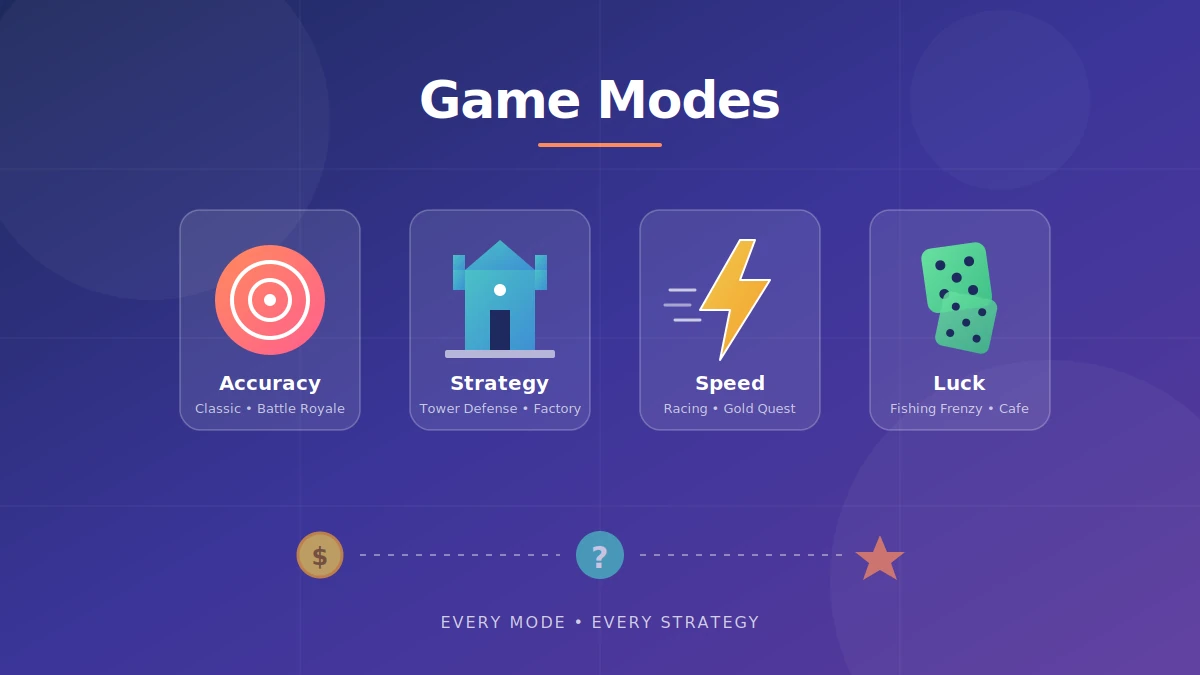
Blooket organizes its modes around four core drivers: accuracy, strategy, speed, and luck. Grouping them this way makes it easier to pick the right one for the outcome you want. What follows is every active mode organized by what it emphasizes and how it plays.
Accuracy-first modes
These modes reward correct answers most heavily. Speed still matters, but consistent accuracy wins.
Classic: Straight timed multiple choice, one question at a time. Students answer individually and earn points for correct responses, with a small bonus for faster answers. No sabotage, no power-ups, no random events. Use it when you need clean data on individual mastery. Twelve to fifteen minutes is the sweet spot before excitement drops.
Battle Royale: Head-to-head elimination pairs students against each other in one-vs-one rounds. The faster correct answer advances to the next round, and the loser drops out. It builds real tension in the final rounds but can be tough on slower processors, so pair it with a re-entry rule for anxious students. For a deeper look, see the full Battle Royale guide.
Read more: How to add images to Blooket questions
Strategy and resource management modes
These modes reward planning, upgrades, and long-term thinking over pure recall speed.
Tower Defense: Answer questions to earn in-game cash, then spend it between rounds building towers that fend off waves of blook enemies. Different tower types have different strengths, so upgrade decisions matter. Tower Defense holds attention for 20 to 30 minutes and works well for extended review sessions.
Tower Defense 2: A newer take with updated art, different maps, and refined mechanics. The core loop is the same as the original, but strategic depth is deeper because tower placement matters more. Students who love the original usually prefer this version once they try it.
Factory: Students earn coins per correct answer and invest them in automated blook production lines. Faster and rarer blooks generate more coins per second. Factory visualizes compound growth in a way that clicks for older students learning about efficiency and reinvestment.
Cafe: Players run a small cafe, unlocking food items with correct answers and serving customers to earn coins. Upgrade the espresso machine, oven, and register in that order for the best flow. Cafe is one of the calmest modes and works well when you want learning to stay front and center. The expert guide to Cafe mode has upgrade paths and full strategy.
Crypto Hack: A cryptocurrency simulation where correct answers mine coins and players can attempt to hack each other’s wallets by guessing a password. Successful hacks steal coins; failed hacks cost time. Great for lessons about risk, probability, and cyber-hygiene concepts.
Crazy Kingdom: A solo-first management mode where correct answers earn gold and random events force trade-offs, from famine to invasion to disgruntled citizens. Students prioritize which crisis to solve first. Available in homework and solo modes only. It is not hostable live.
Speed and reflex modes
Fast recall wins here. Accuracy still matters, but processing speed is the deciding factor.
Gold Quest: Correct answers open three chests, and picks are random. Chests give gold, take gold, or steal gold from another player. Speed does not guarantee victory because luck and steal timing play huge roles. Gold Quest is probably the highest-engagement mode on the platform and is almost always requested by students.
Racing: Blook characters race across a track, and each correct answer moves them forward. Power-ups mid-race can slow opponents. Pure speed wins, which makes Racing ideal for fluency practice like math facts, sight words, and vocabulary drills.
Fishing Frenzy: Correct answers cast a fishing line. Reeling in fish takes a burst of clicking, and heavier fish are worth more points. Younger students love this one, and it holds middle-school attention when framed competitively.
Flappy Blook: A single-player arcade-style mode where students answer questions and pilot a blook through obstacles. Flappy Blook is a fun break mode but gives no tokens or XP, so use it as a warm-up or cool-down rather than a review tool.
Luck, bluffing and social modes
Random elements and player interaction take center stage.
Deceptive Dinos: A social-deduction mode where students earn fossils and can extract DNA or steal from other players. The bluffing element makes it a great debate warm-up because it forces students to think about deception and honesty in a low-stakes setting.
Pirate’s Plunder: Similar chest-picking loop to Gold Quest but with a map-based twist. After each correct answer, students choose a route on a treasure map that leads to gold, a trap, or an attack. Encourages spatial planning and pairs nicely with geography or map-reading lessons.
Blook Rush: A capture-the-flag variant where correct answers let students assault or defend bases. Encourages collaboration on defense and coordinated attacks. Works best with mid-sized classes of 15 to 30 students.
Seasonal and holiday-themed modes
These rotate in during specific times of the year.
Monster Brawl: A cooperative Halloween mode where the whole class fights a classroom monster together. Class effort measured by total correct answers determines whether you defeat the boss. Best used to build morale before a big test or after a tough week.
Santa’s Workshop: A winter mode where correct answers build toys, and completed gifts convert to points. Cooperative-competitive hybrid, best used for December review sessions when you want a themed but still productive lesson.
Candy Quest: A Halloween-themed reskin of Gold Quest that replaces it during October. Same mechanics, different visuals like trick-or-treat baskets instead of gold chests. Younger students especially love the theme swap.
Solo and homework-only modes
These cannot be hosted live but work well as assigned practice.
Plushie Panic: A single-player collection mode where correct answers earn plushies. Available as homework or solo play only. Good for independent review or as a Friday reward assignment.
Some modes exist only in solo or homework format, and Blooket occasionally rotates modes between hostable and homework-only status. Check the mode selector before you plan a live session.
Comparison table of Blooket game modes
This table compares the most-used Blooket game modes across best classroom use, average session length, coin payout tier, and difficulty for struggling students. Use it to match a mode to your lesson goal quickly instead of testing them one by one.
| Mode | Best for | Session length | Coin payout | Struggler-friendly |
|---|---|---|---|---|
| Classic | Assessment | 10-15 min | Low | Yes |
| Battle Royale | High-focus review | 5-10 min | Low | No |
| Gold Quest | Engagement | 10-15 min | High | Medium |
| Tower Defense | Extended review | 20-30 min | Medium | Yes |
| Tower Defense 2 | Extended review | 20-30 min | Medium | Yes |
| Factory | Long strategy | 20-30 min | High | Yes |
| Cafe | Calm review | 15-20 min | High | Yes |
| Crypto Hack | Risk-lesson tie-in | 10-15 min | Medium | Medium |
| Racing | Fluency drills | 5-10 min | Low | Medium |
| Fishing Frenzy | Younger grades | 10-15 min | Medium | Yes |
| Deceptive Dinos | Social warm-ups | 10-15 min | Medium | Medium |
| Pirate’s Plunder | Map lessons | 10-15 min | Medium | Yes |
| Blook Rush | Team building | 10-15 min | Medium | No |
| Monster Brawl | Class morale | 10-15 min | Low | Yes |
| Crazy Kingdom (solo) | Homework | 15-20 min | High | Yes |
Which Blooket game mode gives the most tokens?
Cafe and Factory consistently give the highest token payouts among live-hosted modes. For solo play, Study is widely regarded as the fastest token earner per session. If you want to grow your token balance quickly through legitimate play, Cafe is the fastest live option and Study is the fastest solo option.
Highest token payouts by mode
Cafe wins for live hosting because upgrades multiply your coin output as the session goes on. Factory is a close second and scales even higher over longer sessions. Gold Quest can produce huge single-session gains through chest luck, but the average is lower than Cafe or Factory because unlucky picks eat into your total.
Fair play matters more than farming
Blooket’s Terms of Service prohibit cheating, bot spam, and token-farming scripts. Accounts caught using them can be reset or banned, and any tokens gained through hacks get wiped. Stick to legitimate play. Consistent daily sessions across a couple of high-payout modes will grow your token balance faster than any shortcut over the long run.
How to choose the right Blooket mode for your goal
Match the mode to the outcome you want, not to student preference. Assessment needs Classic. Extended review needs Tower Defense or Factory. Pure engagement needs Gold Quest or Fishing Frenzy. Fluency drills need Racing. Getting this alignment right is the biggest lever you have as a teacher.
For diagnostic assessment
Use Classic. It measures individual accuracy cleanly without steal mechanics or luck skewing the scores. Battle Royale is a decent secondary option if you want to see who freezes under pressure. Avoid modes with theft or random elements when the goal is real assessment data.
For content review and mastery
Pick Tower Defense, Tower Defense 2, or Factory. These stretch time on task and get students through more questions per session than any other modes. Cafe works too, though it is slower per question because of the customer-serving loop.
For engagement and culture building
Pick Gold Quest, Fishing Frenzy, or Deceptive Dinos. These are high-fun, high-noise modes. Skip them if you need clean grade data. Use them as reward sessions, before-break reviews, or as the second half of a longer lesson.
Matching modes to student age
Younger students in kindergarten through grade 4 do well with Fishing Frenzy, Cafe, and Racing because the mechanics are simple and the visuals are friendly. Older students in grades 5 through 12 can handle strategy modes like Tower Defense, Crypto Hack, and Crazy Kingdom that require multi-step planning. Battle Royale suits confident middle and high schoolers.
Time management by mode
Racing and Battle Royale run fast, wrapping in 5 to 10 minutes for a full round. Classic, Gold Quest, and Fishing Frenzy sit in the 10 to 15 minute range. Tower Defense, Factory, and Cafe need 20 to 30 minutes to feel complete. Set a visible timer for longer modes to prevent scope creep.
Common mistakes when using Blooket game modes
The most common mistakes are using engagement modes for grades, picking modes that punish struggling students, and skipping the pre-game rules explanation. Each has a simple fix that saves you and your students a lot of frustration.
Using Gold Quest or Crypto Hack for graded assessments: Steal mechanics and random chest picks distort accuracy data. A student can answer 90 percent correct and finish fourth because they got robbed on the last two questions. Use Classic when the score counts.
Ignoring mode duration: Racing burns out in about 8 minutes. Tower Defense needs 25. Setting a 15-minute timer for both creates chaos with one and boredom with the other. Match the timer to the mode’s natural rhythm.
Picking modes that punish struggling students: Battle Royale and Blook Rush eliminate or expose students who cannot keep up. If you have IEP students, students with processing delays, or students still learning English, pair these modes with a re-entry rule or use a different mode entirely.
Skipping the rules explanation: Every new mode needs a 60-second rules recap on the projector. Blooket assumes players know how each mode works. Students who do not know they can steal in Gold Quest will feel confused and singled out when it happens to them.
Chasing hacks and bot spam: Any tutorial that promises free tokens through code injection or bot flooding will get the account banned. Blooket’s anti-cheat systems catch these routinely. Stick to legitimate play. The Blooket hacks explainer covers why these shortcuts are risky and what the real alternatives look like.
Read more: How to create a question set in Blooket
FAQs about Blooket game modes
What is the most popular Blooket game mode? Gold Quest is the most-requested mode in classrooms, followed by Tower Defense and Cafe. Its combination of random chests and the ability to steal gold from other players creates high engagement. Teachers often pair it with Classic, using Classic for the graded round and Gold Quest for the fun round.
How many Blooket game modes are there in total? Blooket has more than 15 active game modes across live hosting, solo play, and seasonal rotations. The exact number shifts as the platform adds new modes and retires unpopular ones. All the core modes like Classic, Gold Quest, Tower Defense, Factory, Cafe, Racing, and Fishing Frenzy stay in the free tier for everyone.
Can I create my own Blooket game mode? No. Players can build unlimited custom question sets, but the game modes themselves are built by Blooket’s development team. If you have an idea for a new mode, the official feedback channel on blooket.com is where the team reviews suggestions from users and educators.
Which Blooket mode gives the most coins? Cafe and Factory give the highest coin payouts for live hosting because their upgrades compound over time. Gold Quest can produce big single-session wins through lucky chests but averages lower. For solo play, Study is widely regarded as the fastest coin earner per session for homework-style play.
Are seasonal Blooket modes always available? No. Santa’s Workshop and other winter modes appear in December. Monster Brawl and Candy Quest run through October. They disappear when the season ends and return the following year. Plan your hosting calendar around the rotation if you want to feature them in class.
Which Blooket mode is best for math fact fluency? Racing. The pure-speed mechanic rewards quick recall, which is exactly what fluency practice needs. Fishing Frenzy is a solid second choice for K-3 fluency drills. Avoid Tower Defense and Factory for fluency because their strategy layer slows the question pace considerably.
Do all Blooket game modes work for homework? Most do. Tower Defense, Factory, Crazy Kingdom, Cafe, and Fishing Frenzy adapt well to solo homework play. Battle Royale and Blook Rush lose most of their fun without live opponents. Assign homework in modes that keep students engaged even when they are playing alone.
Which Blooket mode is best for building teamwork? Monster Brawl is fully cooperative. The whole class fights one enemy together. Blook Rush encourages team behavior around base defense. Both modes shift focus away from individual scores and toward group outcomes, which is exactly what team-building sessions need.
Final thoughts
The strength of Blooket is not the question engine. It is the mode layer. Start with Classic for baseline data. Add Gold Quest for engagement. Introduce Tower Defense or Factory when you are ready for longer strategic sessions. Rotate seasonally so students do not burn out on any single mode.
Pick one new mode each month and watch student behavior in the first two minutes. If incentives match your learning goal, keep it. If they do not, retire it. This simple test will build a reliable core rotation of 4 to 5 modes that fit your classroom culture.
Action step: open your next review set, host it in Tower Defense for 15 minutes, and note how many questions students actually answer. That number is your baseline. Beat it in the next session with a different mode and you will know which one works best for your class. Browse more Blooket guides on blooket.it.com to explore individual mode deep dives and classroom setup tips.
Turn ordinary moments into learning sparks — dive into quick, powerful reads that inspire action.