Fishing Frenzy consistently ranks among Blooket’s most requested modes for one simple reason: the luck element keeps every player invested until the final question. A student who answers every question correctly can still get edged out by a rare catch on the last cast. That unpredictability drives engagement in a way that straightforward trivia formats rarely achieve.
This guide covers exactly how Fishing Frenzy works, what the fish rarity tiers mean for your coin total, and which strategies give students and teachers the best results. Everything here comes from direct gameplay observation and classroom testing—practical detail, not the obvious.
What is Blooket’s Fishing Frenzy mode?
Fishing Frenzy is a Blooket game mode where correct answers earn fishing casts, and each cast lands a fish worth a certain number of coins. The player with the most coins when the timer runs out wins. It is one of the few Blooket modes where a luck layer sits on top of the knowledge layer—and understanding exactly how those two interact is the key to playing it well.
The core loop
The rhythm is simple: answer a question → correct answer → cast your line → catch a fish → see its coin value → next question. Wrong answers don’t eliminate you—they loop you back to the same question until you answer correctly or time runs out on that prompt. The mode is designed for speed: fishing animations are short, transitions are quick, and pace stays high throughout.
The role of luck
Every fish catch is drawn from a weighted pool of rarity tiers. You might land a common fish worth a modest number of coins, or you might reel in something rare that jumps you up the leaderboard in a single cast. What prevents this from being a pure lottery is that you have to earn each cast with a correct answer. Knowledge and speed control how many chances you get; luck determines what each chance delivers.
How Fishing Frenzy differs from other Blooket modes
In Gold Quest, players can steal gold directly from competitors. In Tower of Doom, every correct answer is a combat round. Those modes tie knowledge output tightly to competitive outcomes. Fishing Frenzy separates the two: knowledge earns casts, the catch is random. This makes it the most accessible Blooket mode for mixed-ability groups because a student answering slightly fewer questions can still win on a strong streak of catches—and a top student can feel the pressure of a late legendary fish appearing on someone else’s screen.
How to set up and join a Fishing Frenzy game
The setup process is identical to any other Blooket mode. Mode-specific mechanics only activate once the game begins.
Hosting as a teacher or creator
Log into your Blooket account and navigate to the question set you want to use. Click “Host,” scroll through the mode list to Fishing Frenzy, select it, and review your session settings before launching. The settings screen is where most hosting decisions actually happen, so don’t skip it.
Joining as a student
Students join using the standard game code—they go to blooket.com/play, enter the code the host provides, and choose a nickname. No student account is required. Once the host starts the session, every player enters the mode simultaneously.
Settings worth reviewing before you launch
Question randomization: Shuffling questions means no two players see the same question in the same order, which reduces the advantage of sitting near a classmate who just answered. For classroom use, this is almost always the right call.
Time per question: If your question set contains longer reading passages or multi-step problems, build in more time per question. Rushing difficult questions drives error rates up, and errors in Fishing Frenzy cost casts—not just accuracy percentage in a report.
Session length: The timer is the single setting with the highest impact on how competitive and skill-reflective the session turns out. More on this in the strategy section below.
The in-game mechanics explained
Once a game launches, every mechanic flows from the question-and-cast cycle. Understanding each component helps both students and teachers make better decisions in real time.
Answering questions and earning casts
Each correct answer earns one cast. There is no way to bank casts or save them—you go straight to fishing immediately after every correct answer, then return to the question screen. This means the game’s pace is almost entirely self-directed: the faster you answer, the faster you fish, the faster you return to the next question.
Speed bonuses exist in many Blooket modes. In Fishing Frenzy, a faster correct answer often earns a small extra coin reward on top of the base cast. The bonus is modest per question, but it compounds over a full session.
The fishing mini-game
After a correct answer, a fishing screen appears. Your line drops into the water and a fish is revealed through a brief animation. The sequence takes only a few seconds—designed to deliver the satisfaction of a catch without slowing the session’s overall pace. Once you see your fish and its coin value, the game moves you directly back to the next question.
There is no skill element inside the fishing mini-game itself. The catch is a randomized outcome delivered through animation. Your entire job is to reach that screen as often as possible.
Reading the live leaderboard
Blooket displays standings throughout the session. Knowing you’re a few hundred coins behind first place can sharpen your focus. The risk is spending too long on it—every second watching the leaderboard is a second not spent answering. Glance at it once or twice to calibrate effort, then redirect your attention to the question screen.
Fish rarity tiers and how they affect your coin total
Understanding the rarity system is the clearest way to set realistic expectations before a session and make sense of results after one.
The rarity breakdown
Fish in Fishing Frenzy follow Blooket’s standard rarity ladder. From most common to rarest, the tiers work like this:
| Rarity tier | How often it appears | Relative coin value |
|---|---|---|
| Common | Very frequently | Low |
| Uncommon | Frequently | Slightly higher |
| Rare | Occasionally | Noticeably higher |
| Epic | Infrequently | Much higher |
| Legendary | Rarely | Very high |
| Chroma | Extremely rarely | Highest |
Exact coin payouts vary and Blooket adjusts them over time, so treat this table as a guide to proportions rather than a fixed schedule. Common fish make up the majority of catches in any session; legendary and chroma fish are the outliers that create sudden leaderboard shifts and moments of genuine drama.
What determines each catch
Each cast is an independent, weighted random draw. The weighting favors lower rarities—that is what makes higher-rarity fish feel like an event when they appear. Critically, there is no streak mechanic. Catching five common fish in a row has zero effect on the probability of the sixth cast. Every draw resets from the same baseline weights.
This matters for strategy: you cannot wait for the “right moment” to cast, and past bad luck does not make future luck more likely. The only reliable lever is cast volume.
How luck and skill interact over time
Over a short session, a single legendary catch can decide first place. Over a longer session, the player who answered the most questions typically ends up near the top—because more casts generate more chances at rare fish, and averages start to assert themselves.
In classroom sessions running fifteen minutes or more, the students with the highest cast totals almost always finish near the leaderboard’s top, regardless of individual lucky catches along the way. In short sessions, the winner is harder to predict. This is useful information for teachers setting timers and for students deciding how much review is worth doing beforehand.
Strategies that actually change your results
No strategy guarantees a win in Fishing Frenzy. Good strategy increases cast volume and reduces wasted time—both of which improve expected outcomes over a session.
Treat speed and accuracy as a combined target
The goal is not maximum speed. It is accurate answers delivered quickly. A wrong answer doesn’t end your turn, but it delays your next cast. If you’re cycling through multiple wrong answers on a question that should have taken one attempt, that’s dead time that could have been fishing time.
The practical rule: answer immediately on questions you know with confidence, and take an extra second on questions where you’re genuinely unsure. Panicked guessing on hard questions is almost always slower overall than pausing briefly to think.
Review the material before the session
The effect of preparation is larger in Fishing Frenzy than in many other modes. Because you fish after every correct answer, faster recognition of correct choices translates directly into more casts. Students who spend five to ten minutes reviewing content before a session accumulate noticeably more casts than those who go in cold—and more casts mean more exposure to rare fish.
Calibrate your effort to session length
In sessions under five minutes, maximum answer speed is the right approach because there is little time to recover from any slow spell. In longer sessions, moderate speed with high accuracy tends to produce more total casts than bursts of fast wrong guesses. Over a twelve-to-fifteen-minute window, sustainable accuracy outperforms frantic clicking.
Ignore what other players are doing
Fishing Frenzy is not a real-time action mode. What another player catches has no direct effect on your result, unlike modes where stealing is a mechanic. The leaderboard shifts based on other players’ catches, but you cannot influence those catches. The only thing worth your attention is the question in front of you.
Set expectations before the game, not after
If you lose by a small margin to someone who landed a chroma fish on the final question, that outcome is within the expected range of this mode. Fishing Frenzy is deliberately designed so luck can produce that result. Adjusting your mindset before a session—rather than trying to recalibrate after a loss—prevents frustration from bleeding into focus during the next game.
How teachers can use Fishing Frenzy effectively
Fishing Frenzy works best in specific classroom contexts. Knowing when to use it and when to reach for a different mode makes sessions more effective and easier to manage.
The best scenarios for this mode
This mode performs well as a low-stakes review before a test, a warm-up activity at the start of a unit, or a reward session at the end of a class period. The luck element reduces the pressure students feel in competitive quiz formats, while keeping genuine competition alive throughout.
It works less well as a formal assessment. Coin totals reflect both knowledge and luck, so using them as a graded outcome can feel unfair—and in some cases actually is unfair. For graded activities, modes like Classic or Tower Defense tie outcomes more directly to accuracy and are more defensible as assessment tools.
Session length recommendations
Ten to fifteen minutes balances engagement with meaningful outcome distribution. Below five minutes, luck dominates strongly enough that even the best-prepared student has no reliable advantage. Above twenty minutes, most class groups start losing focus regardless of mode.
Twelve minutes is a practical target for most class periods. It fits within a broader lesson without consuming the whole hour, and it’s long enough to let knowledge show through the randomness.
Question set design for Fishing Frenzy
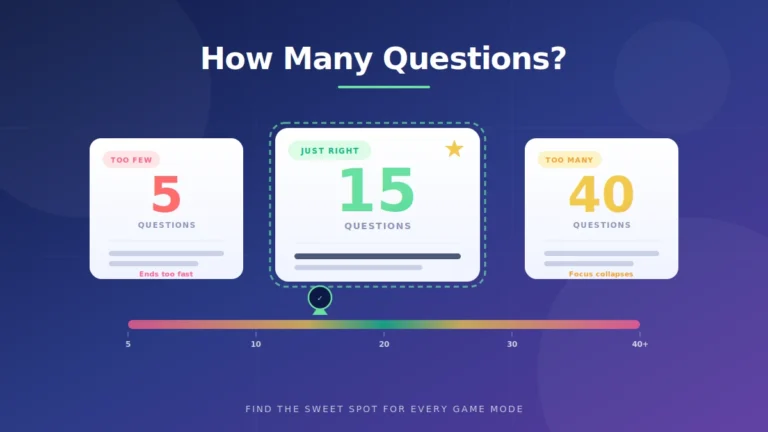
A set of 20 to 40 questions works well for most sessions. With fewer than 20, students loop through the same questions repeatedly, which reduces both the review value and the sense of novelty. With more than 60, a standard session won’t cover the full set, leaving some content unreviewed.
A useful calibration: aim for a question count that is roughly double the number of minutes in your session. A 12-minute session works well with a 25-to-30-question set; a 15-minute session pairs cleanly with a 30-to-40-question set.
Framing the luck element for students
One sentence before the game prevents a lot of noise after: “luck is part of how this mode works by design, so the final leaderboard doesn’t always show who knew the most.” This framing sets honest expectations and, in the right class, opens a natural conversation about probability that connects to math or statistics content without any additional setup.
Using the post-game report
After a session, Blooket generates a per-student accuracy report showing which questions each player answered correctly. The coin leaderboard reflects Fishing Frenzy performance—a combination of knowledge, speed, and luck. The accuracy report reflects content mastery more directly. For any instructional follow-up decision—which concepts need reteaching, which students need extra support—use the accuracy data, not the coin total.
Common mistakes and how to avoid them
Treating every loss as a luck problem
Students often conclude after a loss that the game is “just luck” and that preparation doesn’t matter. This is understandable after a session where the winner landed a late chroma fish, but it’s not accurate over repeated sessions. In most Fishing Frenzy games, the top scorers answered more questions than anyone else. Luck determines the payoff per cast; volume determines how many chances you get.
Hosting sessions that are too short
Three-to-five-minute games are appealing because they fit neatly into transition periods, but they produce outcomes with very little relationship to who knows the material. If skill expression is any part of the goal, extend the timer. Short sessions are fine for pure entertainment—just don’t use the results to draw conclusions about student knowledge.
Skipping pre-session review as a student
Students who know the material answer faster. Faster answers mean more casts. More casts improve expected catch outcomes. This chain is simple, but students who treat Fishing Frenzy as a luck game rarely bother reviewing—then find it puzzling that the students who studied consistently end up near the top.
Watching the leaderboard instead of answering
The live standings update visibly after every rare catch, and it’s genuinely dramatic to watch. Every moment spent following the leaderboard is a moment not spent earning a cast. Check it briefly twice per session—once to orient yourself early, once to calibrate effort near the end—and focus on questions the rest of the time.
Using Fishing Frenzy for graded assessments
The luck component makes final coin totals an unreliable measure of content mastery. A student who knew the material but caught only common fish can score lower than a student who guessed through half the questions and landed two legendary fish. Reserve Fishing Frenzy for review and engagement; use the accuracy report or a different mode for anything graded.
FAQs
Can you steal fish from other players in Fishing Frenzy? Some builds of Fishing Frenzy include a steal mechanic as a possible fishing outcome. When present, this can reassign fish from another player’s total to yours. It is typically low-probability, so it adds drama without overriding skill entirely. Check Blooket’s current release notes for the most up-to-date behavior, as mechanics can change between versions.
Does answering faster give bonus coins in Fishing Frenzy? Speed bonuses apply to the base coin reward per question in most Blooket modes, including Fishing Frenzy. The bigger speed advantage, though, is in cast volume: faster answers mean more fishing opportunities before time runs out. Over a full session, this cast difference outweighs any per-question speed bonus by a significant margin.
Is Fishing Frenzy available without a Blooket Plus subscription? Fishing Frenzy is available on the free Blooket plan. Blooket Plus is a paid subscription tier that unlocks additional hosting features and customization options, but the core mode itself is accessible to all registered users at no cost.
Are the fish rarity odds truly random? Each cast draws from a weighted probability table independently. Higher-rarity fish have lower probability weights. There is no streak tracking, no catch history that adjusts future outcomes, and no hidden multiplier. Every cast starts from the same baseline weights regardless of what was caught before.
What is the ideal question set size for a Fishing Frenzy session? A set of 20 to 40 questions works well for most sessions. This range provides enough variety to avoid repetitive looping while keeping coverage focused on the content you want to review. A rough calibration: aim for a question count roughly double the planned session length in minutes.
Can teachers see individual student accuracy data after a Fishing Frenzy game? Blooket provides a post-game report showing correct answers per student and per question. This data is separate from the final coin leaderboard and is significantly more useful for any instructional follow-up. For understanding content mastery, use the accuracy report rather than coin standings.
Is Fishing Frenzy suitable for younger students? The mode works well across a wide age range. The fishing animation is visually intuitive and immediately understandable. For younger students, shorter sessions of five to eight minutes tend to maintain attention better than longer games. The luck element also reduces frustration for younger players who might otherwise disengage from a competitive quiz format they’re losing.
How many fish does a typical student catch in a session? This depends on session length, question difficulty, and individual answer speed. In a ten-to-twelve-minute session with moderately familiar material, most students earn somewhere between 15 and 35 casts. Students who know the material well and answer quickly tend toward the higher end of that range, which is exactly the skill-to-cast connection that makes preparation worth doing.
Conclusion
Fishing Frenzy works because it wraps a familiar knowledge-check structure in something that feels genuinely unpredictable. The luck element does not remove the value of preparation—it adds a layer that keeps every player invested, not just the students who dominate every quiz format. That is harder to design well than it sounds, and it is why this mode earns its popularity.
For students: more casts come from faster, more accurate answers, and faster answers come from knowing the material. Reviewing content before a session is the single most reliable lever you have.
For teachers: use Fishing Frenzy for review, engagement, and warm-ups. Keep sessions in the ten-to-fifteen-minute range, pair them with question sets in the 20-to-40-question window, and check the accuracy report afterward for any real instructional decision.
Browse the rest of bloket.blog for guides on every other Blooket mode, classroom strategies, and question set tips—all written for players and teachers who want practical advice.