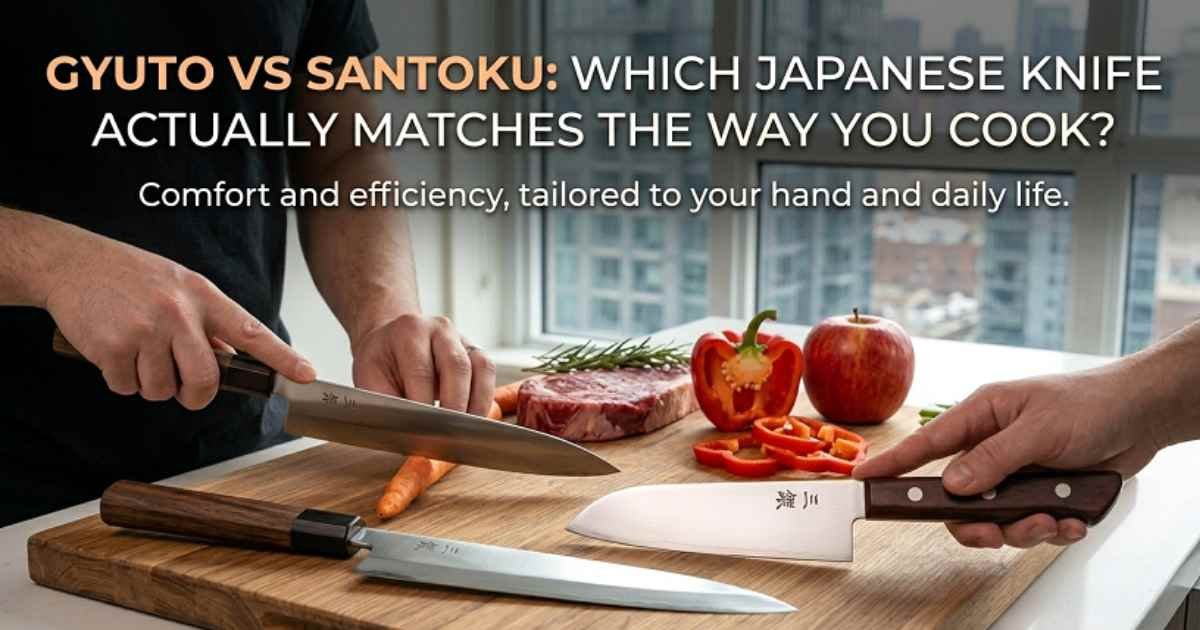
You’ve decided to make the jump to Japanese knives. Good call. But now you’re staring down a question nobody frames honestly: gyuto or santoku? Both are versatile, both are artisan-made, and on paper they seem to do roughly the same job. So why choose one over the other? The answer isn’t in the technical specs. It’s in your hand.
What Your Natural Cutting Motion Already Tells You
Before you look at a single blade, run a simple test. Grab your current knife and chop a carrot the way you normally would, without overthinking it. Watch what happens.
If the tip of the knife stays in contact with the cutting board while the heel pivots upward in a smooth rocking motion, you’re naturally doing a rock chop. That’s the classic Western chef’s knife motion, and it’s the motion the gyuto is built for.
If you lift the entire blade between cuts and bring it straight down or slightly forward, you’re doing a push cut. That’s the santoku’s motion.
Neither one is superior. But using a santoku with a sustained rocking motion, or a gyuto with a strict push cut, means working against the blade’s geometry. The knife becomes less efficient, and you tire out faster.
The Gyuto: The Long Blade That Follows Your Rock
The gyuto is the versatile Japanese kitchen knife by definition. The name comes from the Japanese for “beef sword.” It was originally designed for meat before becoming the reference blade in both Japanese and international professional kitchens.
The blade runs between 210 and 240 mm in standard format. It’s curved, which lets the edge maintain continuous contact with the board throughout a rocking motion. That curve creates a natural pivot surface: the tip stays down, the heel lifts, the blade comes back, over and over, quickly, without raising your arms.
The gyuto is for cooks who regularly handle large cuts of meat or fish, who cook in high volumes, or who are coming from a Western chef’s knife and want to move to Japanese without changing their core technique. For anyone looking to explore this category, the gyuto knives available in Canada cover a spectrum from entry-level artisan pieces to high-performance steels.
The Santoku: Precision and Agility for Everyday Cooking
The word santoku means “three virtues”: meat, fish, and vegetables. It’s the quintessential home kitchen knife in Japan, designed specifically for home kitchens and everyday prep.
The blade is shorter, between 165 and 180 mm, with a different profile. The spine curves down toward a low tip, creating what’s known as a sheepfoot profile. The edge is nearly straight. This design favours the push cut, the vertical or slightly angled downward motion that produces clean, precise cuts on vegetables, herbs, and fish fillets.
The santoku is also lighter than the gyuto, which makes it less tiring during long prep sessions and more intuitive for someone who has never used a Japanese knife. It’s the recommended format for a first purchase in the artisan category. Our collection of artisan santoku knives available in-store and online covers beginner through advanced levels, with models from the Sakai and Sanjo forges.
Four Questions to Ask Before You Decide
If the natural-motion test hasn’t fully convinced you yet, here are four practical questions that clarify the choice in 95% of cases.
What do you cut most often?
If you mainly prep vegetables, herbs, and smaller portions of fish or meat, the santoku is better suited. If you regularly handle large cuts, whole roasts, or you cook for a crowd, the gyuto pulls ahead on efficiency.
How much counter space do you have?
The gyuto needs more surface to deploy its full rocking motion. In a compact kitchen or on a small cutting board, the santoku feels more at home.
Are you coming from a Western chef’s knife?
If yes, the gyuto will feel immediately familiar. If you don’t have a strong prior reference point, the santoku is the most intuitive entry.
Do you want one knife to do everything?
Both cover the majority of tasks. But if you have to pick just one to start with, the 170 mm santoku is the format that handles the widest range of situations without constraint.
The Real Answer Lives in Your Kitchen
There’s no single best Japanese kitchen knife. There’s the knife that matches your motion, your space, and your habits. The gyuto and the santoku are two different tools for two different profiles, and understanding that difference before you buy is the one thing that keeps you from regretting your choice.
Have you used either one already? Or are you still on the fence between the two? Tell us in the comments what you prep most often day to day. The community can help you make the call.
Author bio
This article was written with the expertise of the team at Stay Sharp, a specialist retailer of artisan Japanese knives with locations in Montreal and Quebec City. Every knife in the catalogue is selected by Olivier Caza-Berthelet, a professional chef with 14 years of restaurant experience, according to a single criterion: real-world cutting performance. In-house whetstone sharpening service available in-store and by mail across Canada.
Find solutions, tips, and strategies to help you thrive — start reading today!