On the afternoon of 21 May 1650, a man of thirty-seven walked up the High Street of Edinburgh to be hanged, and the crowd that had come to jeer at him fell silent.
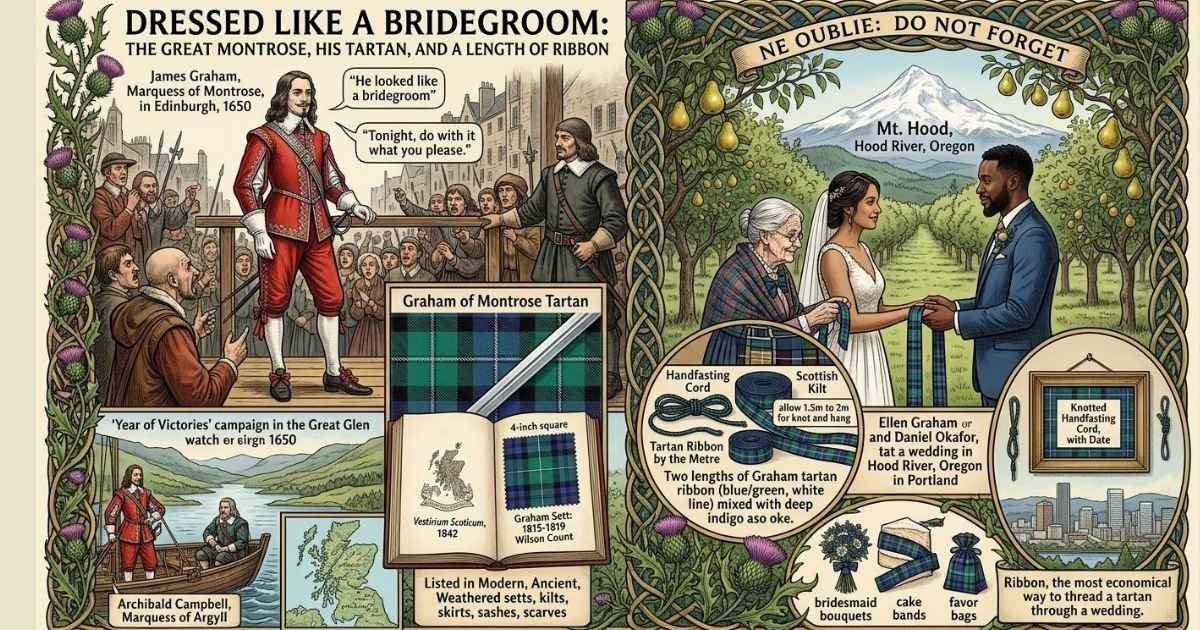
They had been told to expect a traitor. What they saw was a slim, upright figure in a suit of fine scarlet laced with silver, a beaver hat in his hand, white gloves, silk stockings the colour of carnations, and ribbons on his shoes. One who was there wrote that he looked more like a bridegroom than a criminal. His hair had been carefully dressed that morning. When one of his gaolers sneered at him for it, he replied: “My head is still my own. Tonight, when it is yours, do with it what you please.” The man was James Graham, Marquess of Montrose, whose name would later be woven into the distinctive Graham of Montrose tartan.
He was James Graham, Marquess of Montrose, and for one astonishing year he had been the most successful general in Britain.
The year of victories
Montrose had begun on the other side. As a young nobleman he signed the National Covenant of 1638 and fought for the Scottish Parliament against King Charles I. But he came to believe that the men who led the Covenant wanted power and not liberty, and chief among them he distrusted Archibald Campbell, Marquess of Argyll. When civil war came, he declared for the King.
In August 1644 he crossed the border into Scotland disguised as a groom, leading a spare horse behind two companions. He had no army, no money and no guns. At Blair Atholl he unfurled the royal standard and found his army waiting: sixteen hundred Irish and Hebridean veterans under a giant MacDonald warrior named Alasdair MacColla, together with the men of Atholl. It was all he ever had, a few thousand Highlanders who came and went as they pleased.
With them he won six battles in twelve months. Tippermuir, where his men were so short of ammunition that he told them to use stones. Aberdeen. Then, in the dead of winter, Inverlochy. Argyll had brought the whole strength of Clan Campbell north to trap him in the Great Glen. Montrose did what no one thought possible. He turned off the road and led his army over the mountains in deep snow, thirty miles across the shoulder of Ben Nevis in a day and a half, with nothing to eat but oatmeal mixed with cold water. At dawn on 2 February 1645 he came down on the Campbells from a direction they had believed impassable. Argyll watched the destruction of his clan from a galley on the loch.
Auldearn followed, and Alford, and Kilsyth. By the autumn of 1645 Scotland was his. Then the Highlanders went home with their plunder, as Highlanders did, and he was surprised by a regular army at Philiphaugh with a fraction of his force. He escaped abroad.
He came back five years later for the young Charles II, was routed in the far north, wandered starving in the hills, and was handed over for a reward. They brought him into Edinburgh tied to a cart driven by the hangman. Argyll was at a wedding party in a house on the Canongate. The guests came to the balcony to look. Montrose looked back, and it was Argyll who turned away.
The night before his death he wrote a poem on the window of his cell. But the lines everyone remembers are older, from a love poem of his youth:
He either fears his fate too much, Or his deserts are small, That puts it not unto the touch To win or lose it all.
Eleven years later the King was restored, and Montrose’s scattered remains were gathered and buried in St Giles’ Cathedral with all the honours the kingdom could give. Argyll was beheaded the same month.
The gallant Grahams
The Grahams were one of the great houses of the Lowland and Highland border, with lands in Menteith, Strathearn and at Mugdock, north of Glasgow. They had been at the centre of Scottish history since Sir John de Graham died beside Wallace at Falkirk in 1298. Their motto is Ne oublie, do not forget, and the old ballads call them the gallant Grahams. The Duke of Montrose is chief of the name today.
The clan has two principal tartans, Graham of Menteith and Graham of Montrose. The Montrose sett is the better documented. A sample labelled simply “Graham” survives from about 1815, and the pattern is in the books of the Bannockburn weavers William Wilson & Sons by 1819. It was first published in 1850. A scrap only four inches square is kept in the collection of the Highland Society of London.
It is a cool, clean cloth: broad bands of green and dark blue divided by black, with a single fine white line running through the green. The tartan archives note that Wilsons wove the same design in other colours, so that with yellow it becomes the Breadalbane and with red the MacCallum. In the Graham version the white line on the dark ground has the effect of a drawn sword.
Anyone shopping for Graham of Montrose tartan will usually find it listed with the Menteith sett, in Modern, Ancient and Weathered colours, as kilts, skirts, sashes and scarves, or by the yard. It is a fine tartan for a kilt. It is also, because of that white line, unusually good in small pieces, where busier patterns turn to mud.
A word about handfasting
Which brings us, by way of those ribbons on a condemned man’s shoes, to weddings.
In old Scotland, to be handfasted was to be betrothed. The couple joined hands before witnesses and pledged themselves, and in a country where priests were few and parishes vast, that joining of hands was for centuries enough to make a marriage in the eyes of the law. The word means exactly what it says.
The ceremony that now goes by the name, in which the couple’s clasped hands are bound together with cord or ribbon while they make their vows, is largely a modern revival. It should not be passed off as an unbroken ancient rite. But it grows from a real root, it is where the phrase “tying the knot” is popularly said to come from, and it has become one of the most loved parts of Scottish and Scottish-descended weddings all over the world. It is also the one part of the day where a family’s tartan can appear in its simplest form.
Hood River, Oregon, a Saturday in September
Ellen Graham is marrying Daniel Okafor in her parents’ orchard, with Mount Hood behind them and the pears not quite ready to pick.
Nobody is wearing a kilt. Daniel’s family are Nigerian-American, from Houston, and Ellen’s father has never owned anything Scottish beyond a bottle. But Ellen’s grandmother, who was born in Stirling and is ninety, asked for one thing, and it is lying on a small table beside the celebrant: two lengths of tartan ribbon, green and blue with a fine white line, each about two metres long.
Ellen had found them at Scottish Kilt, which sells tartan ribbon by the metre and, separately, a handfasting ribbon made for exactly this purpose. The guidance on the page was practical. The plaid ribbons are meant for crafts, gifts, cake bands, hair work and handfasting, and for a handfasting cord you should allow at least a metre and a half per length, and two metres is better, because the ribbon has to go round two wrists several times and still leave ends long enough to knot and hang. She ordered more than she needed, which turned out to be wise.
A second colour was Daniel’s mother’s idea. She brought a strip of aso oke, the handwoven Yoruba cloth from her own wedding, in deep indigo. So there will be three strands: two of the Graham, one of indigo.
The celebrant asks them to join hands, right to right and left to left, so that their arms make a figure of eight. Ellen’s grandmother comes forward on her son’s arm and lays the first tartan ribbon over their wrists. Daniel’s mother lays the indigo. Ellen’s father lays the second tartan. The celebrant winds the three together, over and under, and ties them loosely, and the couple make their vows with their hands bound. Then, carefully, they draw their hands out without undoing the knot, so that it stays tied, which is the point.
The ribbon did other work that day too. Shorter lengths were tied round the stems of the bridesmaids’ bouquets. A band of it ran round the base of the cake. The little bags of favours were closed with it, and the grandmother wore a bow of it pinned to her jacket with a silver brooch. Ribbon is the most economical way there is to thread a tartan through a wedding. It needs no measuring and no tailoring, only a pair of scissors, and it lets a family that does not wear Highland dress bring its cloth into the day without anybody feeling they are in costume. A sett like this one, dark with a single clear white line, stays legible even at an inch wide.
The knotted cord went into a box frame afterwards, with the date. It hangs in their hall in Portland. Visitors ask about it.
“The tartan’s from my side,” Ellen tells them. “Graham of Montrose. He was a general. He won six battles in a year and then lost everything, and they hanged him, and he went to the scaffold in his best clothes with ribbons on his shoes. My grandmother says that’s the only way to go to anything.”
Ne oublie
Montrose has been dead for close to four centuries, and people still leave flowers at his tomb in St Giles’. He is remembered less for the battles than for the manner of him: the mad march through the snow, the verse about putting it to the touch, the scarlet and silver on the last day. He understood that how you present yourself at the great moments of life is a kind of statement, and that small things, a glove, a ribbon, can carry a great deal.
His clan’s motto asks only that people do not forget. Two metres of green and blue ribbon with a white line through it, wound round two pairs of hands in an orchard five thousand miles from Edinburgh, is one way of keeping that instruction.
Disclaimer: The information provided in this article is for general informational and historical storytelling purposes only. It does not constitute professional historical, genealogical, or wedding planning advice. Historical accounts, tartan patterns, and handfasting traditions vary and may be interpreted differently. Readers should verify historical and cultural details independently. The mention of Scottish Kilt or any specific vendor is illustrative and does not imply endorsement. The author and publisher disclaim all liability for decisions or outcomes arising from reliance on this content. Always consult qualified professionals for wedding planning and genealogy research.
Unlock new ways to solve old problems—browse our creative solutions and think outside the box.