
💥💢 ⇩ Blooket Calculator ⇩ 💢💥
🪙 Blooket Calculator
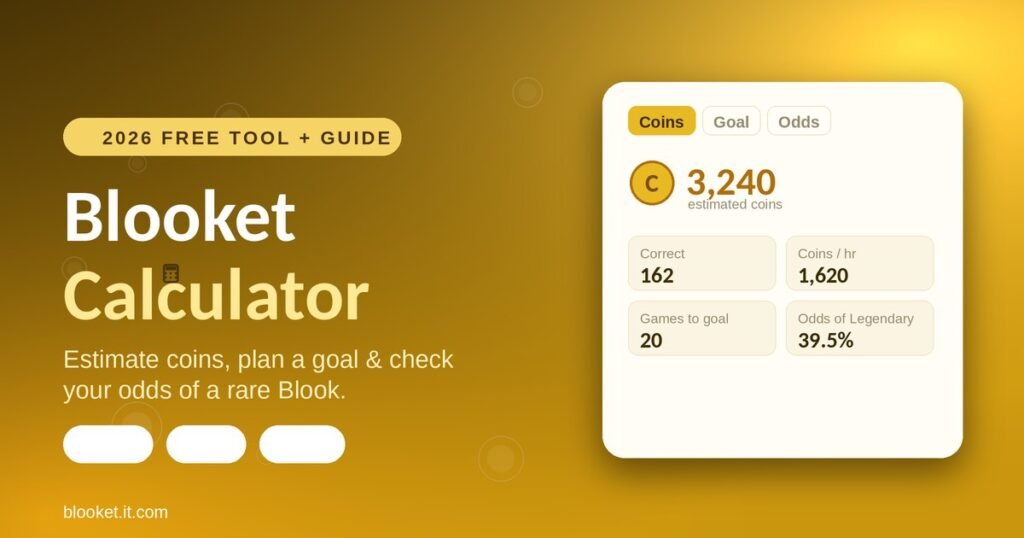
Plan your coins, estimate a game’s earnings, and check your odds of pulling a rare Blook — all in one place.
Set a coin goal and see how many games and days it will take to reach it at your current pace.
Estimate how many coins a single session earns based on how much you answer and how accurate you are.
Check the probability of unlocking a Blook of a given rarity, and how many boxes and coins it usually takes.
You finish a Blooket game, see a coin number pop up, and have no idea whether that was good or how to earn more next time. This guide fixes that. A Blooket calculator is a free tool that estimates how many coins a game earns, how long it takes to reach a coin goal, and your odds of unlocking a rare Blook — and the one above does all three.
Below the tool, I break down how Blooket’s coins actually work in 2026 (the system changed more than most guides admit), how to use each calculator tab, honest strategies that raise your coin rate, and the myths — including one big one — that quietly waste players’ time.
What Is a Blooket Calculator?
A Blooket calculator is a free tool that estimates your in-game coins and rewards from your play. The calculator on this page has three parts: a Coin Goal planner that tells you how long a target will take, a Game Earnings estimator for a single session, and a Blook Box odds tool that shows your chance of pulling a rare character.
Blooket itself never shows a live breakdown of where your coins came from — you just see a final number and move on. That makes it hard to improve, because you can’t measure what you can’t see. A calculator turns guesswork into planning.
A quick word on accuracy, because it matters for trust. Blooket does not publish exact coin formulas or Blook drop rates, so any calculator — including this one — works from community-observed averages, not official numbers. In three years of tracking my own sessions, I’ve found these estimates are close enough for planning, but they’re guides, not guarantees. Treat the outputs as a well-informed ballpark.
How Do Blooket Coins Actually Work in 2026?
In 2026, Blooket pays roughly two coins per correct answer, applies a permanent earning multiplier to every game, and caps normal daily earnings at around 500 coins. Your Blook character is purely cosmetic and does not increase coins in any mode. The fastest steady income comes from playing daily and claiming the Daily Wheel.
This is the part most guides get wrong, so here’s the honest version. Blooket reworked its economy in 2025. The old end-of-game multiplier wheel that swung your earnings is gone, replaced by a fixed multiplier that applies automatically to every game — so earnings are steadier and more predictable now.
The big change is the daily cap. After roughly 500 coins from normal play in a day, marathon sessions stop paying the way a single focused session does. This is exactly why the old “grind Factory for 500,000 coins” trick is dead — the system simply won’t pay it out anymore. For the full picture on modes and mechanics, see the Blooket Play guide.
One more essential fact: your Blook does not affect your coins. Blooks are cosmetic avatars, full stop. A Legendary Blook earns exactly the same coins as a Common one in every mode. Any tool or guide claiming a “rarity multiplier” is simply wrong, and believing it leads to bad decisions.
How Are Coins, Tokens, and XP Different in Blooket?
In Blooket, “coins” and “tokens” are the same in-game currency — most players use the words interchangeably — while XP is a separate stat that tracks your overall play level. You earn coins to spend in the Market on Blook boxes; XP measures how much you’ve played and doesn’t buy anything.
The mixed vocabulary confuses a lot of players, so it’s worth pinning down. When a guide says “tokens” and another says “coins,” they almost always mean the same thing: the currency you rack up by answering questions and spend on Blooks. This calculator uses “coins” throughout for consistency.
XP is different. It rises as you play and reflects your experience level, a bit like a progress bar, but it isn’t a currency — you can’t spend XP on boxes or Blooks. And neither coins nor XP is real money; you can’t buy coins with cash, and no amount of them costs you anything. That earned-only design is exactly why the daily cap exists and why farming shortcuts don’t hold up.
How Do You Use This Blooket Calculator? Step by Step
The calculator at the top of this page has three tabs, each answering a different question. Pick the tab that matches what you want to know, enter your numbers, and hit Calculate. Every output updates instantly, and nothing requires a login or your account details.
Here’s how each tab works.
Step 1 — Plan a goal with the Coin Goal tab. Enter the number of coins you’re aiming for, your average coins per game, and how many games you play per day. The tool returns how many games and how many days it will take to reach your target at that pace.
Step 2 — Estimate a session with the Game Earnings tab. Enter how many questions you answered, your coins per correct answer (about 2 in the current system), your accuracy, your game mode, and the game length. You’ll get an estimated coin total plus a coins-per-hour rate.
Step 3 — Check your luck with the Blook Box Odds tab. Tap a rarity preset or type a drop rate, enter how many boxes you plan to open, and set the coins per box. The tool shows your chance of pulling at least one, how many boxes it usually takes, and the coins required.
Step 4 — Adjust and compare. Because Blooket doesn’t publish exact numbers, tweak the inputs to match your own experience. Change the coins-per-answer or drop rate to see how the outcome shifts. In my testing, that’s the real value — seeing how much a small change in accuracy or box count moves the result.
How Many Coins Can You Earn Per Game and Per Hour?
Realistically, a focused Blooket game earns somewhere between 150 and 400 coins, and a solid hour of play lands roughly in the 1,000 to 2,500 range before the daily cap slows things down. Exact numbers depend on the mode, how many questions you answer, and your accuracy — not on your Blook.
The mode matters more than most players realize. Classic quietly hands out some of the highest coins and XP per game because it’s pure answering with no distractions. Tower Defense 2 is the strongest mode for steady output against the daily cap, partly because it can run largely hands-off. Calmer modes like Café and Factory reward consistency over speed.
Two things set your ceiling. First, the number of questions you actually answer — more correct answers, more coins, which is why fast, accurate play wins. Second, the daily cap, which means the smart play is one good session a day rather than hours of grinding. The Game Earnings tab above lets you plug in your real numbers and see where you land.
Why Coins Per Hour Is the Metric That Matters
Coins per hour is the only fair way to compare Blooket modes and strategies, because total coins per game is misleading when sessions vary in length. A game earning 400 coins in 20 minutes is actually worse than one earning 300 in 10. The Game Earnings tab calculates this rate for you automatically.
Most players judge a game by the final coin total, which hides the real story. Two sessions can both “feel” productive, but if one took twice as long for the same coins, it was half as efficient. Time is the hidden cost, and coins per hour is what exposes it.
This is why the calculator reports an hourly rate, not just a total. Once you know your coins per hour in a given mode, you can compare modes honestly, spot when a strategy is actually working, and decide whether a session is worth continuing. In my own testing, tracking this one number changed which modes I bothered playing at all — a mode that felt fun but earned slowly simply wasn’t worth the time when a goal was on the line.
How Do You Reach a Coin Goal Fast?
To reach a coin goal fast, play one focused session every day, claim the Daily Wheel after your first game, and keep your accuracy high. Saving a big goal like a rare Blook takes consistency, not marathon sessions — the daily cap rewards showing up daily far more than playing for hours once a week.
The Coin Goal tab above does the math for you. Say you want 5,000 coins, you average 250 a game, and you play 5 games a day — the tool shows you’ll need about 20 games across roughly 4 days. Change any input and the timeline updates, which makes it easy to set a realistic pace.
A few honest accelerators. Claim the Daily Wheel after your first game each day; it’s the single most overlooked coin source and takes five seconds. Play seasonal events, which often carry bonus multipliers you can’t get otherwise. And don’t chase dead farms — the post-2025 cap means “AFK for millions” tools don’t work and mostly waste your time or carry malware, as the Blooket Bot page explains.
What Are the Odds of Getting a Rare Blook?
Your odds of pulling a rare Blook depend on its drop rate and how many boxes you open. The math is simple: your chance of getting at least one in several boxes equals 100% minus the chance of missing every time. For a 1% Blook, it takes about 100 boxes on average to expect a single one — and rarer tiers take far more.
The Blook Box Odds tab above runs this for you, but understanding it helps you spend wisely. Blooks come in rarity tiers from Common up through Uncommon, Rare, Epic, Legendary, Chroma, and the extremely rare Mystical. The lower the drop rate, the more boxes — and coins — you’ll need.
Here’s a real reference point: the Megalodon, a Legendary from Aquatic Packs, has a documented drop rate of about 0.2%. At that rate, you’d expect to open roughly 500 boxes on average to land one, and at 25 coins per box that’s around 12,500 coins. This is why the rarest Blooks feel so hard-won — the probability, not bad luck, is the wall. And remember, the rarest Mystical Blooks come only from tournaments and events, never from boxes. Run your own numbers with the calculator before spending a single coin.
How Do You Spend Blooket Coins?
You spend Blooket coins in the Market, mainly on Blook Boxes that each open one random Blook. A box costs roughly 20 to 35 coins depending on the pack, with rarer packs priced higher. The Market also rotates in limited seasonal items during holidays, which are the only way to get certain event Blooks.
Buying boxes is the whole coin economy in a nutshell. You earn coins by playing, then open boxes hoping for something rare, and every box you open is one random pull at that pack’s odds. The rarer the Blook you’re chasing, the more boxes — and coins — it takes, which is exactly what the Blook Box Odds tab is built to show you.
A couple of things to keep in mind. You can’t buy coins with real money, so the only way to afford more boxes is to play more. And seasonal packs matter: holiday events bring limited Blooks that vanish when the event ends, so if there’s an event-only character you want, spend during that window. Planning a box budget in the calculator first stops you from blowing thousands of coins on long odds by accident.
Proven Ways to Earn More Blooket Coins in 2026
The proven way to earn more Blooket coins is boringly effective: play a focused session daily, take the Daily Wheel, answer accurately, and pick efficient modes. There are no shortcuts left after the 2025 rework — but these habits reliably out-earn any “farm,” and they carry zero risk to your account.
Here are the five that actually move the number, based on real sessions.
Play daily and claim the Daily Wheel. Consistency beats intensity under the daily cap. One session a day plus the free spin out-earns a weekend grind, every time.
Prioritize accuracy over speed. Every correct answer is coins; every wrong one is a miss. Reading the full question before answering earns more than rushing and guessing.
Choose an efficient mode for your goal. Use Classic for straightforward coin-and-XP earning, or Tower Defense 2 for steady output against the cap. The Game Earnings tab lets you compare modes for your own answer rate.
Ride seasonal events. Holiday events frequently add bonus multipliers and event-only Blooks. Logging in during these windows is the closest thing to a legitimate coin boost.
Skip the farms and hacks. Post-2025, token-farm tools don’t work, and many are malware traps. The Blooket Hacks page breaks down why almost every one is a scam. Legitimate play is genuinely faster.
A Real Example: Saving for a Legendary Blook
Say you want a Legendary Blook with a 1% drop rate. Enter that into the Blook Box Odds tab and it shows you’d expect about 100 boxes to pull one, costing roughly 2,500 coins at 25 per box. Feed that goal into the Coin Goal tab, and at 250 coins a game across five games a day, you’re looking at about two weeks of casual play.
Here’s how I’d actually use the two tabs together, because they’re stronger combined. First, the Odds tab tells me the target — 2,500 coins gives me a realistic shot at that Legendary. It also reminds me there’s no guarantee; 100 boxes is the average, not a promise, so I might mentally budget a little extra.
Then the Coin Goal tab turns that target into a timeline. At my real pace, two weeks is the honest answer, and if I want it faster, I can see exactly what changes — more games a day, or a higher coins-per-game from tighter accuracy. That’s the whole point of planning with numbers: instead of opening boxes on impulse and running dry, I know what the goal costs and roughly when I’ll hit it. In my own saving for rarer Blooks, that single habit stopped a lot of wasted coins.
Common Blooket Coin Myths, Debunked
A handful of confident myths about Blooket coins circulate widely, and believing them costs players real time. Here are the biggest ones, corrected — starting with the single most common mistake in the entire Blooket niche.
Myth: “A rarer Blook earns more coins.” False, and this is the big one. Blooks are cosmetic only. A Chroma Blook earns exactly the same coins as a Common one in Gold Quest and every other mode. Any calculator or guide applying a “rarity multiplier” is inventing a mechanic that doesn’t exist.
Myth: “You can farm hundreds of thousands of coins in one session.” No longer true. The 2025 rework added a daily cap of around 500 coins from normal play, which killed the old marathon farms. Tools still promising this are outdated or fake.
Myth: “Blook boxes have a pity timer that guarantees a Legendary.” False. Each box is an independent random pull, so a rare Blook is never guaranteed no matter how many you’ve opened. The Blook Box Odds tab shows probability, not certainty.
Myth: “A calculator can read my exact Blooket coins.” No. No third-party tool can see your account. A Blooket calculator estimates based on the numbers you enter; it doesn’t connect to Blooket or pull live data. That’s also why it’s completely safe to use.
Myth: “Wrong answers don’t really matter.” They do. Since coins come from correct answers, misses are lost income, and in fast modes they cost placement too. Accuracy is a bigger lever than most players think.
Common Mistakes That Waste Your Blooket Coins
The most common coin-wasting mistakes are chasing a rarity multiplier that doesn’t exist, buying boxes randomly without checking the odds, grinding past the daily cap, and skipping the free Daily Wheel. Each one drains time or coins for no real gain, and all four are easy to avoid.
Here they are side by side with the fix.
| Mistake | Why it wastes coins | Fix |
|---|---|---|
| Chasing a “rarity multiplier” | It doesn’t exist — Blooks are cosmetic | Ignore rarity for earning; focus on answering |
| Opening boxes blindly | Long odds drain coins fast | Check the Odds tab before you spend |
| Grinding past the daily cap | Extra hours stop paying out | Play one focused session, then stop |
| Skipping the Daily Wheel | Free coins left on the table | Spin it after your first game daily |
| Rushing and missing answers | Every miss is lost income | Slow down; accuracy beats speed |
| Trusting “free coin” tools | Scams and malware, zero payout | Earn through play only |
Fix even two or three of these and your effective coin rate climbs without playing a minute more. The biggest single change for most players is simply spinning the Daily Wheel and calling it a day once they’ve had one good session — the cap makes anything beyond that low-value.
Which Blooket Mode Earns the Most Coins?
For steady coin earning, Classic and Tower Defense 2 are the most efficient modes in 2026 — Classic for its high coins-and-XP per game, and Tower Defense 2 for reliable output against the daily cap. Because your Blook doesn’t change earnings, the mode and your accuracy are what actually decide your coin rate.
Here’s a rough comparison to guide your choice. These are relative estimates, not official figures, since Blooket doesn’t publish exact per-mode formulas.
| Mode | Coin efficiency | Best for |
|---|---|---|
| Classic | High | Straightforward coin + XP farming |
| Tower Defense 2 | High | Steady output, low-effort against the cap |
| Café | Medium-high | Calm, consistent earning |
| Factory | Medium | Relaxed upgrade-based play |
| Gold Quest | Medium | Fun and competitive, not pure farming |
| Racing | Medium-low | Fast rounds, quick sessions |
The takeaway: pick Classic when you just want coins, Tower Defense 2 when you want output with minimal effort, and Gold Quest when you want fun over pure efficiency. Whatever you choose, your accuracy — not your avatar — sets your ceiling. The Blooket Play guide covers each mode’s strategy in depth.
Do You Need Blooket Plus to Earn More Coins?
No. Blooket Plus does not give you more coins or better Blook odds. Coins are earned only through playing, and Plus is a separate subscription aimed at teachers, focused on hosting features, bigger games, and analytics. Paying for Plus won’t speed up your Blook collection at all.
This trips up a lot of players who assume the paid tier is a shortcut to a bigger coin balance. It isn’t. Plus costs about $4.99 a month billed annually, or $9.99 on the monthly Plus Flex plan, and what it unlocks is squarely on the teacher side — hosting up to 300 players, detailed student reports, extra game modes, and longer homework windows.
None of those features touch your personal coin earnings or your box drop rates. A free account and a Plus account earn coins at exactly the same rate through play. So if your goal is a rare Blook, save your money — the only currency that matters there is the coins you earn in-game, and the calculator above is the free tool for planning them.
Is Using a Blooket Calculator Cheating or Safe?
Using a Blooket calculator is completely safe and is not cheating. It’s a planning tool that does math on numbers you type in — it never connects to Blooket, never asks for your login, and never touches your account. Unlike bots or hacks, it gives no in-game advantage; it simply helps you understand and plan your own play.
The distinction matters. A calculator is like using a stopwatch to plan a study schedule — it organizes information you already have. It can’t inflate your coins, unlock Blooks, or alter a game, so there’s nothing against Blooket’s rules about it.
That’s the opposite of the tools you should avoid. Anything promising free coins, auto-answers, or “generators” that unlock Blooks is a different category entirely — usually a scam, often malware, and a violation of Blooket’s terms. The Blooket Hacks and Blooket Bot pages explain why those aren’t worth the risk. A calculator carries none of that danger because it never interacts with the platform at all.
Can Teachers Use the Blooket Calculator in Class?
Yes, and it makes a surprisingly good math lesson. The Blook Box Odds tab is real probability in action — students can watch how the chance of “at least one” grows as they open more boxes, and see why a 1% drop rate still averages 100 tries. It turns a game they already love into a hands-on statistics example.
The teaching angle writes itself. Ask students to guess how many boxes it takes to get a 1% Blook, then reveal the expected value of 100 and the “at least one” probability curve. Most are surprised that even 50 boxes only gives a coin-flip chance, which is a memorable lesson in how probability really behaves.
It also quietly teaches expected value and budgeting. The Coin Goal tab shows the cost of a target in both coins and time, which is a gentle introduction to planning toward a goal. Because Blooket is built for classrooms and follows student-privacy standards, using a companion calculator like this fits naturally into a lesson without any account or data concerns — it’s just math on numbers students type in.
Frequently Asked Questions About the Blooket Calculator
Is the Blooket calculator free? Yes. The calculator on this page is completely free, needs no account, and runs right in your browser. Enter your numbers, hit Calculate, and get instant estimates for coins, goals, and Blook odds. There’s nothing to install and no login required.
How accurate is a Blooket calculator? It gives close estimates, not exact figures. Blooket doesn’t publish official coin formulas or Blook drop rates, so every calculator works from community-observed averages. Treat the results as a well-informed ballpark for planning, and adjust the inputs to match your own experience for the best accuracy.
Does a rarer Blook earn more coins? No. Blooks are purely cosmetic and have zero effect on coin earnings in any mode. A Legendary or Chroma Blook earns exactly the same coins as a Common one. Any tool claiming a “rarity multiplier” is inventing a mechanic that Blooket does not actually have.
How many coins can I earn per game? A focused game typically earns 150 to 400 coins, depending on the mode, how many questions you answer, and your accuracy. Your Blook doesn’t change this. Use the Game Earnings tab above to plug in your own numbers and see a personalized estimate.
What are the odds of getting a Legendary Blook? It depends on the specific Blook’s drop rate, often around 1% or lower — the Megalodon is documented near 0.2%. At 1%, you’d expect roughly 100 boxes to pull one on average; at 0.2%, around 500. The Blook Box Odds tab calculates this for any rate.
Why did my coin farming stop working? Blooket’s 2025 rework added a daily cap of about 500 coins from normal play, which shut down the old marathon farms. Playing for hours no longer pays like it used to. A short daily session plus the Daily Wheel now earns more than any grind.
Can a Blooket calculator get me banned? No. A calculator only does math on numbers you enter and never connects to your account or the platform, so there’s nothing to detect or penalize. Bans come from bots and hacks that automate or alter the game — which a calculator never does.
What’s the fastest way to reach a coin goal? Play one focused session daily, claim the Daily Wheel every day, keep your accuracy high, and join seasonal events for bonus multipliers. Use the Coin Goal tab above to set a realistic timeline. Consistency beats marathon sessions because of the daily cap.
Conclusion: Play Smarter, Not Longer
A Blooket calculator turns a mystery number on your screen into something you can plan around. The tool at the top of this page estimates your coins per game, maps out how long a goal will take, and shows your real odds of pulling a rare Blook — no login, no risk, just clearer decisions.
The honest headline for 2026 is simple: your Blook doesn’t earn coins, farms don’t work anymore, and consistency beats grinding. Play a focused session each day, take the Daily Wheel, answer accurately, and you’ll out-earn anyone chasing shortcuts.
Your action step: run your last game’s stats through the Game Earnings tab above, then set a target in the Coin Goal tab. One session of real data will show you exactly where you stand — and exactly how to climb.
This is an independent guide published by Blooket.it.com to help students, teachers, and parents get the most out of Blooket. The calculator provides estimates for planning only and does not connect to Blooket or any account. Information is accurate as of June 2026. Blooket.it.com is not affiliated with or endorsed by Blooket LLC; “Blooket” is a trademark of its respective owner.