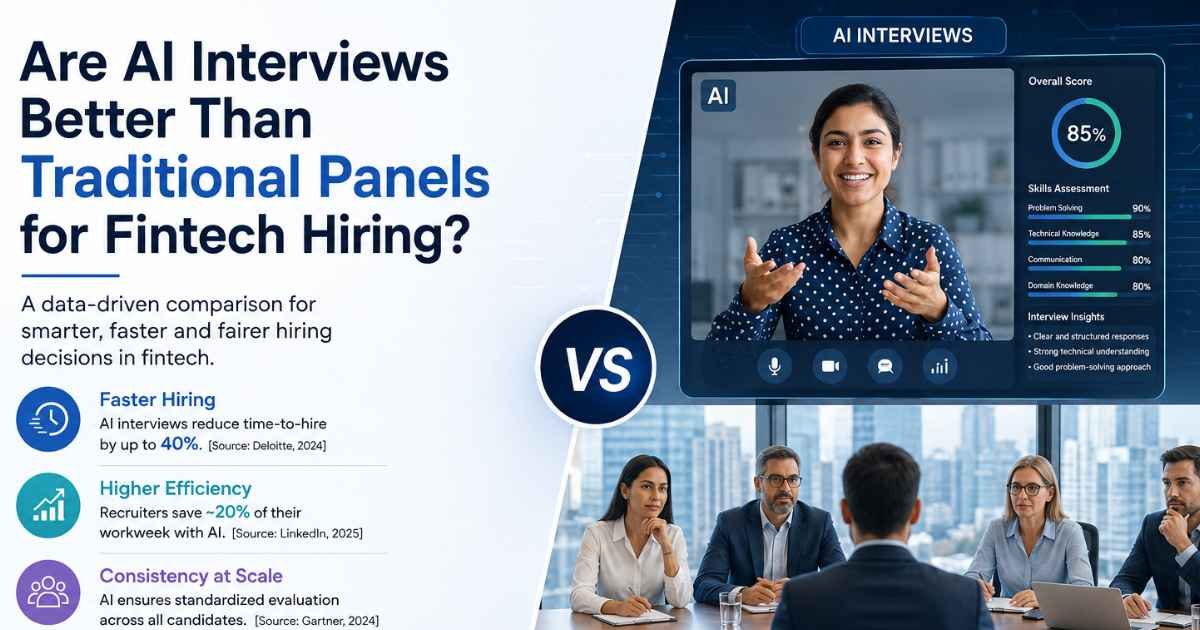
Fintech leadership teams are under two simultaneous pressures: hire specialized talent faster than competitors, and defend every hiring decision to regulators, auditors, and boards. This tension is why the “AI interviews vs. traditional panels” debate has moved from an HR discussion to a boardroom one.
This article gives C-suite and senior talent leaders a data-driven, decision-ready comparison, grounded in benchmarking data, academic validity research, and current regulatory requirements, rather than vendor marketing.
The Fintech Hiring Problem, By The Numbers
Before comparing formats, it helps to size the problem executives are actually solving:
- Global fintech investment reached $116 billion across 4,719 deals in 2025, and the sector is expanding roughly 3x faster than traditional banking, which is translating directly into headcount pressure.
- 85% of CFOs report finance talent shortages as a top operational risk.
- The average cost-per-hire for non-executive roles is $5,475, rising to $35,879 for executive roles, up 21% since 2022.
- Within finance specifically, cost-per-hire runs closer to $5,900, with time-to-fill averaging near 50 days for regulated or specialist roles.
- Median time-to-fill sits at 44 days nationally, and unfilled roles cost organizations $4,000–$9,000 per month in lost productivity.
- Tech and finance roles show the highest candidate resentment of any sector, at 25%, nearly double the 14% cross-industry baseline. This means a slow or poor process actively damages employer brand in the exact talent pool fintechs compete hardest for.
The financial case for speeding up hiring is clear. The question is whether AI interviews deliver that speed without compromising decision quality or regulatory exposure.
Traditional Panels: What the Evidence Actually Shows
Panel interviews remain the default at most enterprises, but their reputation and their evidence base don’t fully align.
Strengths, backed by research:
- Structured panel formats (standardized questions, consistent scoring rubrics) have a predictive validity of .51, versus .38 for unstructured interviews. That’s a 34% improvement in forecasting actual job performance, per the landmark Schmidt & Hunter meta-analysis.
- More recent research places structured interview validity at .42, and found structured formats carry nearly one-third less bias than unstructured ones, with roughly double the predictive power.
- When paired with a cognitive or skills assessment, composite validity rises above .60–.63, one of the strongest predictor combinations available in personnel selection science.
Where panels fall short:
- Most enterprise panels are not run as rigorously structured interviews. Inconsistent questioning, scheduling coordination across multiple senior interviewers, and subjective scoring are the norm. That is precisely the format that scores .38, not .51.
- Panel scheduling is a major contributor to the 44–50 day time-to-fill benchmarks cited above, particularly for roles requiring compliance, risk, or technical sign-off from multiple stakeholders.
- Human panels remain the primary source of legally actionable bias claims, since inconsistency in questioning is the exact condition under which interviewer bias enters the process.
The takeaway for executives: the panel format isn’t the problem; inconsistent execution of the panel format is. A well-structured panel is a strong predictor of performance, while an unstructured one barely outperforms chance-adjacent judgment.
What AI Interviews Actually Do (and Don’t Do)
“AI interview” is used loosely in the market. In practice, current deployments fall into three categories: AI-assisted scheduling and screening, one-way asynchronous video assessment with AI scoring, and live conversational AI interviewers. Enterprise fintech adoption today is concentrated in the first two.
Adoption data:
- 60% of enterprises (5,000+ employees) now use AI somewhere in recruiting, versus 33% of companies under 100 employees.
- 63% of job seekers globally report experiencing an AI-run interview step in the past six months.
- 99.8% of talent acquisition teams are already using, piloting, or planning to adopt AI agents in the hiring workflow.
- L’Oréal’s widely cited AI chatbot deployment produced a 600% increase in interview completions and a 35% increase in candidate satisfaction scores.
Where the data gets uncomfortable for AI-only advocates:
- Only 26% of candidates trust AI to evaluate them fairly.
- 74% of candidates still prefer human interaction for final hiring decisions, even when they’re satisfied with AI’s speed (76%) and answer accuracy (68%).
- 70% of hiring managers trust AI to make faster, better decisions, but only 8% of job seekers believe AI makes hiring more fair. That trust asymmetry is a retention and employer-brand risk, not just a candidate-experience one.
Head-to-Head: The Executive Comparison
Predictive validity: Structured panels reach up to .51 when properly run. AI interview tools are not yet independently benchmarked at comparable scale on their own; they perform best when paired with structured scoring logic rather than replacing it.
Speed: Panels typically run 44–50 days time-to-fill for finance roles. AI-assisted screening and scheduling reduce bottlenecks and have contributed to a benchmark drop from 67.7 to 63.5 days industry-wide.
Cost: Panel-driven hiring averages $5,475–$5,900 per hire. Among AI-using organizations, 89% report time savings, but only 36% report actual cost reduction. The two are not the same outcome, and shouldn’t be conflated in a business case.
Candidate trust: Candidates strongly prefer human interaction for final-stage decisions (74%), while only 26% trust AI to evaluate them fairly.
Bias exposure: Structured panels show meaningfully lower bias than ad hoc ones. AI tools face rapidly rising regulatory scrutiny (see below), independent of their actual bias performance.
Regulatory exposure: Panels sit on well-established legal precedent. AI interview tools carry new and expanding compliance obligations that are still being tested.
Regulatory Reality: This Is Not Optional for Fintech
Fintech sits at the intersection of two regulatory pressures that most industries don’t face simultaneously: financial-services compliance and AI-hiring regulation.
- The EU AI Act classifies recruitment AI as “high-risk,” with enforcement beginning August 2, 2026 and fines of up to €15 million.
- U.S. jurisdictions with AI-hiring disclosure laws (e.g., NYC Local Law 144) require bias audits and candidate notification when automated tools are used in decision-making.
- Enterprises are responding with three operational shifts: disclosing which stages use AI, adding identity verification and secondary human rounds for finalists, and moving toward blind-screening configurations that evaluate skills data only.
For a regulated industry already managing SOC 2, SOX, and financial-conduct obligations, an unaudited AI hiring tool is a new line item on the risk register, not a productivity shortcut.
The Model Enterprise Fintechs Are Actually Converging On
The data doesn’t support “AI interviews vs. panels” as a binary choice. It supports a staged hybrid model:
- Early funnel (screening, scheduling, initial skills assessment): AI-assisted, where completion-rate gains as high as 600% and time-to-fill improvements are realized with minimal decision-quality risk.
- Mid funnel (technical and competency evaluation): Structured, whether human-run or AI-assisted, using standardized rubrics to preserve the .51 validity advantage of structure itself, not the modality.
- Final funnel (offer-stage decisions for senior, compliance-sensitive, or client-facing roles): Human panel, structured, with documented scoring, matching both candidate trust preferences (74%) and regulatory expectations for high-stakes financial-services hires.
Executive Recommendations
- Audit your current panels before adding AI. If panels aren’t already structured and scored consistently, you’re leaving the .51-vs-.38 validity gain on the table regardless of what technology you add.
- Deploy AI where the ROI is proven: scheduling, screening, and early assessment, not final-stage decisions for regulated or senior roles.
- Budget for bias auditing and disclosure now. EU AI Act enforcement lands August 2026; retrofitting compliance under deadline pressure costs more than building it in from procurement.
- Track cost and time separately. 89% of organizations report AI saves time; only 36% report it lowers cost. Don’t approve AI hiring tools on a cost-reduction business case alone.
- Protect the finalist experience. With tech/finance candidate resentment already at 25%, keep human interaction at the offer stage regardless of how much of the funnel above it is automated.
Bottom Line
AI interviews are not “better” than traditional panels, and traditional panels are not inherently superior to AI. The evidence points to structure, not modality, as the real driver of hiring quality. The highest-performing fintech organizations in 2026 are the ones treating AI as a funnel-stage tool that removes friction from screening and scheduling, while preserving structured, human-led evaluation at the decision points that carry the highest regulatory and reputational stakes.
Disclaimer: The information provided in this article is for general informational and educational purposes only and does not constitute professional HR, legal, or hiring compliance advice. Hiring regulations, AI laws, and benchmarking data may change. Readers should consult qualified legal and HR professionals before implementing AI hiring tools. The author and publisher disclaim all liability for hiring decisions, compliance issues, or financial losses arising from reliance on this content. Always verify current regulatory requirements and conduct independent due diligence before adopting any recruitment technology.