On August 25, 2026, the National Telecommunications and Information Administration announced that all 56 state and territory Final Proposals for the BEAD program had been approved. BEAD is a $42.45 billion federal grant program meant to connect unserved and underserved locations. Construction is starting across dozens of states, and fixed wireless providers backed the technology-neutral rules that let them compete for many of those locations.
That means new radios, new backhaul links, and new towers in places where power is hardest to get. A rural site without a nearby grid line, or with a grid that drops for hours, turns into a fuel logistics problem fast.
This guide treats solar for telecom towers as a rural build-out tool. You will find out what a solar tower is, how telecom towers work at a remote site, and how to size a system with two fresh examples. You will also get a 25-year cost view, a multi-site rollout plan, and the 2026 tax deadline that many guides skip.
The short answer is that solar plus storage can carry a remote site for years with far fewer truck rolls. It works best when you size for winter, plan for maintenance, and keep a fallback source.
Why Remote Towers Are Harder to Power
Urban towers usually have a strong grid, easy access, and neighbors who notice problems. Remote towers have none of that.
GSMA defines a bad-grid site as one where grid outages run longer than six hours a day on average. An off-grid site has no grid at all. Both types tend to lean on diesel generators, which bring a familiar list of headaches. Fuel has to be trucked in, generators need regular service, and the fuel supply chain can break. Remote sites with fuel and equipment on hand also face theft and vandalism risk.
Costs pile up quietly. Vendor guides note that generator-only sites suffer from high fuel use, frequent maintenance, and mechanical wear from long runtimes. In parts of Africa, GSMA says diesel can account for 30 to 60 percent of operating expenses for some operators. That figure is not a U.S. benchmark, but it shows how fuel can dominate a budget.
There is also a policy angle. BEAD subgrantees must maintain risk management plans that account for infrastructure reliability and resilience, including natural disasters such as wildfires, flooding, tornadoes, and hurricanes. A power design that can ride through outages helps make that case.
I am not confirming what BEAD funds can pay for on the power side. Rules on eligible costs vary, so ask your state broadband office. BEAD projects also generally require matching funds of at least 25 percent of project costs, though states have some flexibility, so every dollar of lifecycle cost matters.
What Is a Solar Tower, and How Do Solar Towers Work?
The phrase means two things, and mixing them up sends readers to the wrong pages.
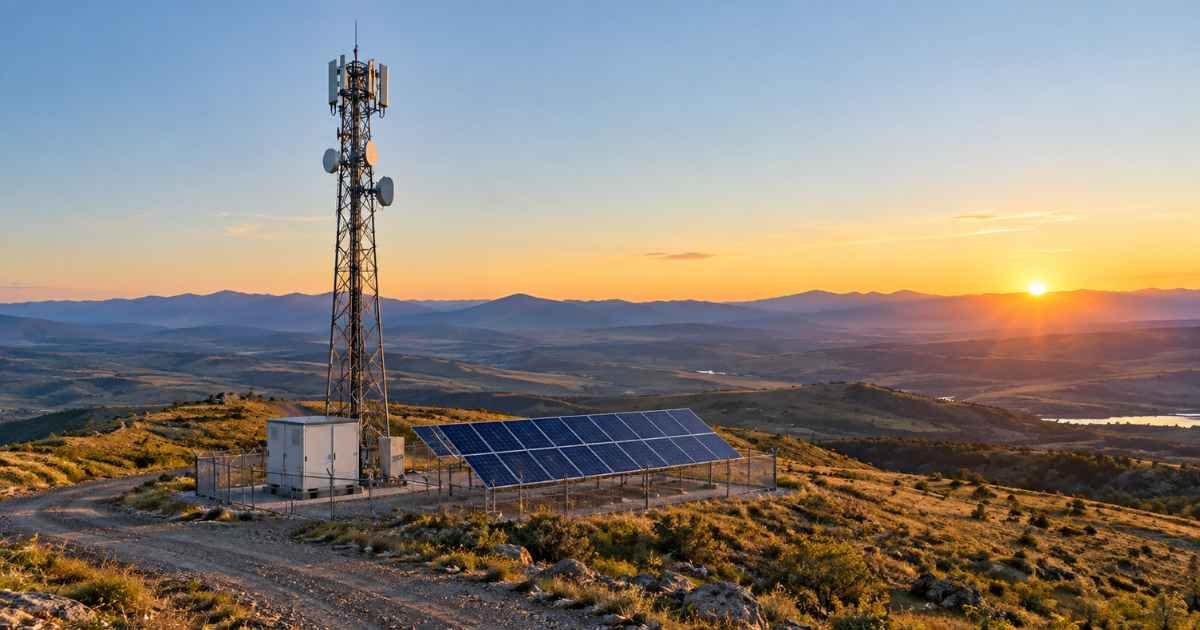
A solar tower in telecom is a cell tower or radio site that runs partly or fully on solar panels and batteries. Think of it as a small power plant inside the site fence. The tower itself is standard steel, and the solar gear usually sits on the ground beside the shelter.
A solar power tower in the utility sector is a different machine. The Department of Energy describes concentrating solar power plants that use sun-tracking mirrors, called heliostats, to aim sunlight at a receiver on top of a tall tower. The heat then runs a turbine. A 100 MW field can include more than 10,000 heliostats. This article covers the telecom kind.
So how do solar towers work at a remote base station? Picture three layers.
- Generation. Photovoltaic panels turn sunlight into DC electricity. There are no mirrors and no turbine.
- Storage. A battery bank holds energy for nights and overcast days.
- Control. A controller sends power to the radios from solar, battery, generator, or grid, depending on rules you set. Many telecom sites run on a nominal -48 V DC bus, so the equipment is built around that voltage.
That is the whole idea. The engineering lives in the sizing, the settings, and the maintenance plan.
How Do Telecom Towers Work at a Rural Site?
A macro tower holds antennas high so signals reach far. Radios convert digital traffic into radio signals, baseband gear handles the processing, and a backhaul link, either fiber or a microwave dish, connects the site to the wider network. A shelter or cabinet holds rectifiers, batteries, cooling, and monitoring.
The Wireless Infrastructure Association counted 154,800 purpose-built cellular towers and 248,050 macrocell sites in the U.S. at the end of 2024. Many of the newest additions under rural programs will be smaller and simpler than a big multi-carrier macro site.
Rural loads are lower, but still steady. One vendor guide says rural towers commonly run between 1 kW and 3 kW of continuous load, with larger stations going higher. Another vendor describes typical configurations of 500 W to 3 kW loads paired with 5 to 20 kWh of battery and 2 to 20 kW of solar. Treat those as sanity checks, not design inputs. Your own meter data beats any table.
New towers also face review. Building a new tower generally requires approval from the state or local authority and compliance with NEPA and the National Historic Preservation Act. Adding solar to an existing compound is usually simpler, but permits and landlord consent still apply.
Sizing a Remote Site in Four Steps
Every design starts with the same four steps.
- Find the daily load in kWh.
- Pick a design sunlight month.
- Divide load by sun hours and by a loss factor.
- Size storage for the outage or low-sun period you must survive.
Modeling based on the federal PVWatts tool puts the U.S. average at about 4.98 peak sun hours per day, with a default system loss factor of 0.77. Most states fall between 4.5 and 5.5 hours, while Arizona reaches about 6.54 and New Mexico about 6.42. Northern and high-elevation states swing more, so winter matters. For example, Wyoming’s annual range is often given as 5.5 to 6.5 hours, yet its December sunlight is far lower.
Two New Worked Examples
Sunlight values below are planning assumptions, not measurements.
| Site | Load | Design sun hours | Array | Storage | Takeaway |
| Wyoming Ridge fixed wireless hub, winter sizing | 1.5 kW | 3.0 | about 15.6 kW | about 45 kWh nominal | Winter sets the size |
| Same hub, shoulder-season sizing with generator backup | 1.5 kW | 4.5 | about 10.4 kW | about 45 kWh nominal | Design month changes cost |
| Texas weak-grid multi-tenant site | 4 kW | 5.0 | 10 kW gives about 38.5 kWh per day | about 60 kWh nominal | Solar trims about 40 percent of load |
The Wyoming hub. The load is 1.5 kW × 24 h, or 36 kWh per day. At 3.0 sun hours, the array is 36 ÷ (3.0 × 0.77), or about 15.6 kW, which is roughly 39 panels at 400 watts. Storage for 24 hours of autonomy is 36 kWh usable, or about 45 kWh nominal at 80 percent depth of discharge.
Now change one assumption. If a generator covers the darkest weeks and you size for 4.5 sun hours, the array shrinks to about 10.4 kW, or 26 panels. That is roughly one-third smaller. The design month is a budget lever, so decide it on purpose.
The Texas site. The load is 4 kW × 24 h, or 96 kWh per day. A 12-hour outage ride-through needs 48 kWh usable, or about 60 kWh nominal. A 10 kW array at 5.0 sun hours makes 10 × 5.0 × 0.77, or 38.5 kWh a day. That covers about 40 percent of the load, and the grid handles the rest.
Do Not Forget Aging and Dirt
Panels lose output slowly. NREL’s review of published field studies found median degradation of 0.5 to 0.6 percent per year for crystalline silicon panels, with averages of 0.8 to 0.9 percent. Over 20 years, a median panel loses roughly 10 to 12 percent. A system that barely covers the winter load in year one will fall short later, so build in margin.
Dirt adds up too. Global average annual power loss from soiling has been estimated at 5 to 10 percent. Dusty, snowy, or pollen-heavy sites need a cleaning plan, and the PVWatts calculator lets you model monthly soiling or snow losses.
The 25-Year Cost Picture
Upfront price is only part of the story. The rural twist is that every visit costs real money.
| Cost bucket | What drives it | Rural twist |
| Equipment and install | Panels, batteries, controllers, cabinet, civil work | Freight and crane access can add a lot |
| Fuel | Delivered price at the tower, not the pump price | Road condition and delivery size move the number |
| Maintenance | Cleaning, vegetation, inspections, repairs | Each trip may be hours long |
| Battery replacement | Temperature, cycling, calendar aging | Advertised cycle counts may not match real duty |
| Downtime | Lost traffic and repeat call-outs | A cheap design can be expensive if uptime falls |
| Security | Theft of panels, batteries, fuel, copper | Fencing and tamper detection matter |
Remote monitoring helps. Vendor guides say alarms and real-time data cut manual site inspections and let teams catch problems early. Monitoring does not replace physical maintenance, though. Trend the data instead of waiting for a low-voltage alarm.
Ownership models are changing too. GSMA notes a growing trend of outsourcing power supply at tower sites to energy service companies, since power at tower sites carries its own generation, delivery, and financing risks. For a small rural provider, an energy-as-a-service deal can turn a high upfront cost into a predictable monthly fee. Compare it against ownership before you sign.
The Federal Tax Clock
Under the One Big Beautiful Bill Act, solar facilities that begin construction after July 4, 2026 must be placed in service by December 31, 2027 to qualify for the Section 48E credit. The change does not affect related energy storage. That construction deadline has passed, so new solar projects have about 15 months. Projects that began construction in time keep a four-year window, which extends to the end of 2030. The base credit is 30 percent.
The law also made 100 percent bonus depreciation permanent. Projects that began construction after 2025 must avoid material assistance from prohibited foreign entities, so collect supplier documentation early. This is general information, not tax advice, so confirm details with a tax professional.
Choosing a Solar Panel for Telecom Towers at Remote Sites
At a remote site, placement and maintenance matter more than brand.
Ground mounting is usually the safer bet. Engineering guidance points out that tower height does not automatically improve production, because antennas and steelwork cast shadows, and tower-mounted panels add wind load and make cleaning risky. A ground array needs clear land, but it is easier to orient, inspect, and expand.
Tilt matters for winter. One U.S. maker sizes its kits using the worst month’s peak sun hours with panels tilted at 45 degrees, and it requires full sun from 8 a.m. to 4 p.m. with no shade to the south. Use that as a shading rule of thumb. Then plan vegetation control, because a row of panels that is clear at commissioning can be shaded a year later.
Also check cold-temperature string voltage, since panel voltage rises in the cold and can exceed controller limits. Use tamper-resistant fasteners and secure fencing at unattended sites.
For pilots, emergencies, or temporary coverage, look at factory-built containerized systems. One U.S. manufacturer describes foldable, plug-and-play units that need no on-site assembly and suit remote or disaster-response deployments.
Match the Architecture to the Site
The right solar power solution for telecom towers depends on grid quality and access.
| Site type | Common architecture | Main goal |
| Reliable grid, high rates | Grid-tied solar | Trim energy bills |
| Weak or outage-prone grid | Solar, battery, and grid | Ride through outages |
| Remote with generator backup | Solar, battery, and generator | Cut fuel runs |
| Off-grid mountaintop repeater | Solar and large battery | Run unattended |
| Temporary or emergency site | Containerized hybrid | Deploy fast |
Some designs add wind. One engineering table lists solar plus wind plus battery for sites with a complementary wind resource, since wind can produce at night and in winter. It only pays off where measured wind data supports it.
From a supplier’s view, the Solar Telecom Energy site lists design focus areas for a remote off-grid base station, including worst-season solar yield, autonomy, recovery time, low-maintenance storage, and secure outdoor integration. Its mountain microwave example adds access limits, wind and temperature, resilient DC power, remote alarms, and seasonal energy margin. That is a handy checklist for any remote project.
Storage and Safety Rules
Batteries carry the heaviest code burden. Lithium iron phosphate is common at telecom sites, but it brings fire code questions.
NFPA 855 governs lithium-ion systems above 20 kWh of aggregate stored energy. Telecom exemptions in some published code amendments focus on lead-acid and nickel-cadmium batteries under 50 V ac or 60 V dc in compliant communications installations. A lithium retrofit may therefore face a fresh review. Ask for UL 9540 listings and UL 9540A test data, since UL 9540A is the long-standing benchmark for thermal runaway testing. Then confirm with your local fire authority.
Temperature limits matter as well. Engineering guidance highlights low-temperature charge limits and high-temperature derating, so choose a cabinet and controller set for your climate.
Who Is Already Doing This
The National Laboratory of the Rockies, renamed from the National Renewable Energy Laboratory effective December 1, 2025, tested a Verizon cell tower power system prototype that uses direct current PV interconnection with batteries and DC cooling. It says it continues to support Verizon with photovoltaics projects at cell sites in the western United States.
American Tower and Swift Solar announced a collaboration to evaluate perovskite-silicon tandem panels for towers, aimed at squeezing more power from limited space. Verizon expects net-zero operational emissions by year-end 2035, and T-Mobile targets net zero across its full footprint by 2040.
Abroad, a Huawei solar-diesel hybrid rollout in Somalia reached a return on investment in less than three years, according to GSMA. Conditions differ in the U.S., but the pattern of fuel savings is the point.
Where Solar Falls Short
Solar will not fix backhaul. A remote site with great power and a single fragile fiber route is still one cut away from an outage. NTIA’s own discussions of leftover BEAD funds mention middle-mile investments to reduce backhaul costs in rural areas, which shows how central the problem is.
Solar is also a weak first move where shade is heavy, space is not secure, the lease is short, or load growth is uncertain. Sometimes the best first step is efficiency. Every continuous 100 watts you remove saves 2.4 kWh a day and shrinks both array and battery.
A Rollout Plan for Multi-Site Programs
If you are building many sites, do not design each one from scratch.
- Start with the worst sites. Prioritize towers with the highest diesel costs or worst grid reliability.
- Pilot three to five sites. Test real winter output, battery behavior, and maintenance access before scaling.
- Standardize. Build two or three reference designs, then adjust for site conditions.
- Set monitoring rules first. Decide who owns each alarm and how fast they respond.
- Stock spares. Keep controllers, fuses, and a battery module in a regional warehouse.
- Track the tax clock. Work backward from the December 31, 2027 placed-in-service date.
When you request proposals, ask every bidder to show load assumptions, worst-season solar data, usable battery window, and recovery rules in the same document. The proposal process at Solar for telecom towers from Huijue Group starts with a load profile and returns a preliminary system concept, then moves through design, factory integration, and commissioning. That is a fair template for comparing any vendor.
Frequently Asked Questions
How many peak sun hours should I design for?
Use the worst month you must survive, not the annual average. If a generator covers the darkest weeks, you can choose a milder design month, but you will run the generator more.
How long do panels and batteries last?
NREL’s review found median panel degradation of 0.5 to 0.6 percent per year. Battery life depends on temperature, cycling, and chemistry, so ask vendors for warranty terms tied to your duty cycle.
Can grants pay for solar at a tower?
It depends on the program and the state. BEAD requires resilience planning and generally requires matching funds of at least 25 percent, but eligible costs vary. Ask your state broadband office before you budget.
Is a wind and solar hybrid worth it?
Only where measured wind data shows a complementary resource. Otherwise, the added turbine, maintenance, and permitting rarely pay off.
Do I still need a generator?
Often yes. A generator or grid connection covers rare multi-day low-sun stretches that would otherwise force a much bigger array and battery.
Rural coverage is expanding, and every new remote tower needs a power plan. Size for winter, budget for maintenance, protect the backhaul, and watch the tax calendar. Do that, and solar can turn one of the most expensive parts of a remote site into one of the quietest.
Disclaimer: The information provided in this article is for general informational and educational purposes only and does not constitute professional engineering, financial, tax, or legal advice. System sizing, costs, tax incentives, and regulatory requirements vary by site and jurisdiction. Readers should consult qualified engineers, tax professionals, and legal advisors before designing or investing in any solar project. The mention of specific vendors, programs, or government initiatives is illustrative and does not imply endorsement. The author and publisher disclaim all liability for project outcomes, financial losses, or compliance issues arising from reliance on this content. Always verify current tax rules and eligibility requirements with a qualified professional.
Get inspired by ideas that feel genuinely new—our creative resources break away from recycled advice.