Over the past few years, UK agencies have watched a particular kind of enquiry become routine. A woman rings up, usually about Ramadan, and asks whether she can go on her own, or with her sister, or with three friends from the same mosque. A decade ago the answer was complicated. Now it is complicated in a different way, and the difference matters.
There are two separate questions here, and conflating them causes most of the confusion. One is regulatory: what Saudi Arabia currently permits at the border. The other is jurisprudential: what your school of law holds about a woman travelling. They have different answers, and the first does not settle the second. Women comparing all inclusive Ramadan Umrah packages need clarity on both before they book. This piece sets out where each stands and how the practicalities work.
The regulatory position
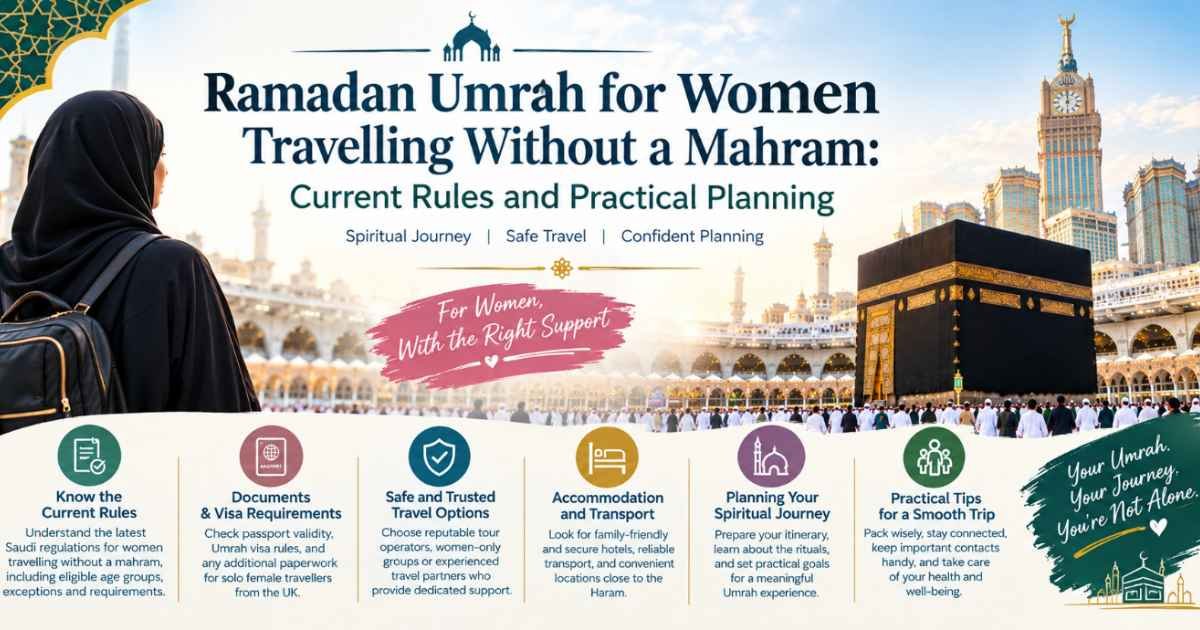
Saudi Arabia has, in recent years, permitted women aged eighteen and above to perform Umrah without a mahram. Visa applications and Nusuk registration are processed on that basis, and women travel individually and in groups from the UK regularly.
Two caveats worth stating. First, entry rules change, sometimes at short notice, and conditions have been attached and removed more than once. Confirm the current position with your agency at the point of booking rather than relying on what was true last season. Second, what an authority permits and what a traveller should do are different questions. A permission removes an obstacle. It does not constitute advice.
The scholarly position, and why it varies
This is where the honest answer is that scholars differ, and anyone telling you otherwise is flattening a real disagreement.
The classical discussion centres on narrations prohibiting a woman from travelling a specified distance without a mahram or husband. From there the schools diverge. The Hanafi, Hanbali and much of the Maliki tradition have historically required a mahram for the journey, with detailed discussion of what counts as travel and what exceptions apply. Elements of the Shafi’i school, and a number of contemporary scholars, have permitted a woman to travel for Hajj or Umrah in the company of trustworthy women or a safe group, reasoning partly from the conditions of the journey and the security available.
Contemporary scholars who permit it commonly point to how radically travel has changed: a supervised flight and a hotel booked through a licensed operator bears little resemblance to a months-long caravan journey. Those who maintain the requirement respond that the ruling attaches to travel as such rather than to its hazards.
Both positions are held by serious people. The practical upshot is straightforward: this is a question for your own scholar or imam, who knows your school and your circumstances. A travel agency can tell you what the visa allows. It cannot tell you what is permissible for you, and you should be wary of one that tries.
Group travel, which is how most women actually do it
Almost every UK woman travelling without a mahram goes with a group rather than genuinely alone, and there is a well-developed market for this.
Sisters’ groups are organised trips for women travelling together, usually with a female group leader, shared accommodation arrangements and a fixed itinerary. Many mosques and community organisations run them, and several agencies operate them as a regular product.
Family groups where a woman travels with a sister, mother or adult daughter are extremely common and often the most comfortable arrangement.
Mixed group trips with a designated leader, where a woman joins a larger party from her own community, sit somewhere between the two.
Questions worth asking before joining any of them:
- Is there a female group leader, and is she reachable throughout?
- What is the room arrangement, and who will you be sharing with?
- What happens if you become unwell or need to leave the group?
- Is there a UK contact available during the trip for family at home?
- How large is the group, and what is the ratio of leaders to travellers?
- Has this group run before, and can you speak to someone who went?
Practical planning
Choose your Ashra with care:
The last ten nights are the most crowded conditions of the year. Women travelling in a small group for the first time frequently find the first Ashra a considerably better introduction, with room to perform the rites at their own pace and a much easier walk to the mosque.
Hotel proximity matters more, not less:
Returning to a hotel late at night after Qiyam is far more comfortable over two hundred metres than over a kilometre. This is worth paying for.
Understand the prayer arrangements:
Women’s areas within Masjid al-Haram and Masjid an-Nabawi are designated and can fill early during Ramadan. Ask your group leader where they are and go early rather than discovering it at Isha.
Rawdah access in Madinah:
It is booked through Nusuk, with separate slots for women. Demand during Ramadan is heavy. Establish who is arranging this.
Menstruation:
It is worth planning for, because it affects tawaf and the timing of the rites, though not sa’i or the visit to Madinah. Some women speak to a doctor about delaying a period around the trip. That is a medical and religious question combined, and worth raising with both a GP and a scholar well in advance rather than in the week before departure.
Practical safety:
Keep your hotel name written in Arabic, keep a charged phone and a power bank, agree meeting points with your group before entering the mosque, and note that phone signal around the Haram in Ramadan is unreliable.
Packing and clothing, practically
Ihram garments are specific for men and not for women, which leads to a common misunderstanding: women are sometimes told there is nothing to prepare. There is.
Clothing needs to work for the conditions. Loose, breathable, modest, and comfortable enough to walk several miles a day in. February in Makkah is mild rather than hot, but the mosque is crowded and warm, and Madinah can be cool in the evenings. Layers work better than one heavy garment.
Bring more than you think. Laundry is available but slow during Ramadan, and pilgrims underestimate how often they will want to change.
Footwear decides your week. Comfortable, already worn in, and cheap enough that losing a pair at the shoe racks is an inconvenience rather than a disaster. Bring two pairs.
Unscented toiletries for any period in ihram, and check the ingredients rather than assuming.
A small bag you can keep on you in the mosque, rather than a rucksack that becomes an obstruction in a crowd.
Practical extras that women travelling in groups consistently recommend: a power bank, a lightweight prayer mat, sanitary products in sufficient quantity rather than relying on finding them, and any regular medication in original packaging with the prescription.
The same question, for Hajj
Everything above applies to Hajj, with one difference: the scholarly discussion has historically been more developed there, because Hajj is an obligation while Umrah is not.
Several classical positions that require a mahram for ordinary travel treat obligatory Hajj differently, and there is a substantial body of discussion about whether a woman’s obligation is conditional on a mahram being available. Views range widely, and this is emphatically a matter for a qualified scholar rather than for an article or an agency.
Practically, women considering UK Hajj packages options should be aware that places are capped by a national quota and allocated to licensed operators a long way ahead. Groups with female leadership and suitable accommodation arrangements are a specific product and tend to fill early. With Ramadan falling in February 2027, Dhul Hijjah is expected around early May, placing Hajj in mid-May, roughly ten weeks later.
One point that is often muddled: the narration that Umrah in Ramadan carries the reward of Hajj refers to reward, not obligation. A Ramadan Umrah does not discharge the duty of Hajj for a woman any more than it does for a man.
The short version
Saudi rules currently allow women aged eighteen and over to perform Umrah without a mahram, and UK women do so regularly, almost always as part of an organised group.
Whether it is permissible for you is a separate question with genuine scholarly disagreement behind it, and it belongs with your own imam rather than with a booking agent. Once that is settled, the practicalities are the ordinary ones: pick a group you have checked properly, travel early in the month if it is your first time, stay close to the mosque, and sort the Nusuk and Rawdah arrangements before you fly.
Unlock a simpler way to find what you need—browse our well-organized resources and stop wasting time searching.