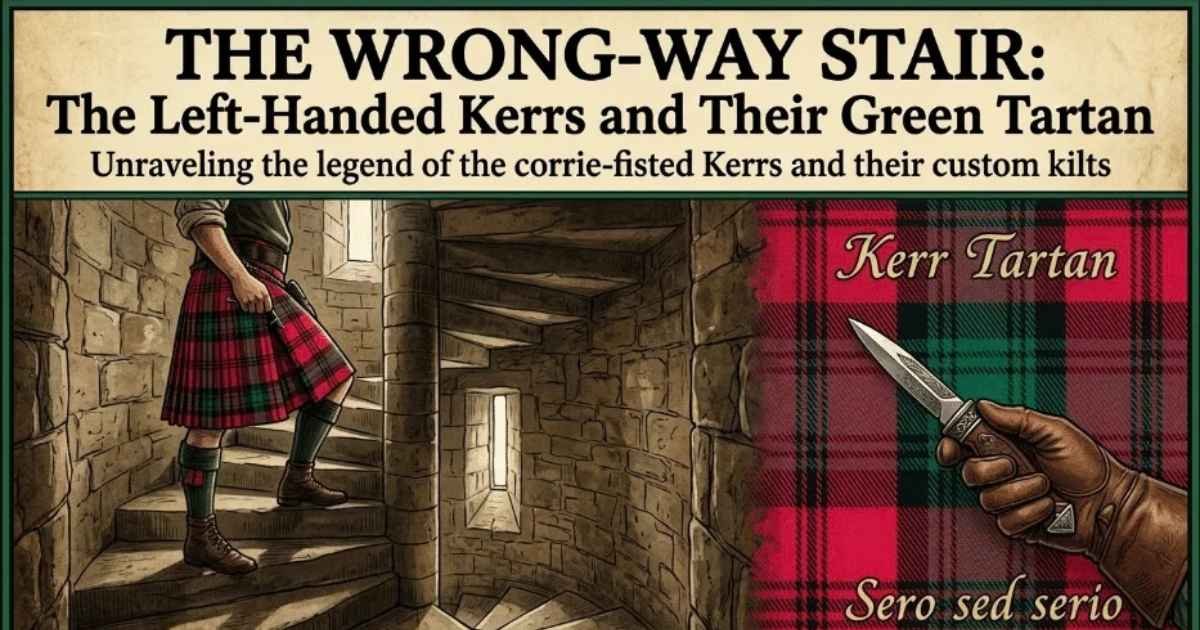
The story of the Kerr tartan is tied to one of the strangest legends of the Scottish Borders: that the Kerrs built their castle staircases the wrong way round because they were left-handed. Every castle in Scotland with a spiral staircase turns the same way. Go up, and the stair winds clockwise, so that a defender coming down has his right arm, his sword arm, free on the open side, and an attacker coming up has his right arm jammed against the central pillar. It is one of the oldest tricks in military architecture, and it depends on one assumption: that both men are right-handed.
At Ferniehirst Castle, in the woods above the Jed Water two miles south of Jedburgh, the stair turns the other way.
The Kerrs built it. And the story that the Borders have told for four hundred years is that they built it the wrong way round on purpose, because the Kerrs were left-handed, and a left-handed man defending a stair that winds anticlockwise has every advantage that a right-handed man has on an ordinary one. The legend adds that Andrew Kerr of Ferniehirst, in the early sixteenth century, trained his men to fight left-handed whether they were born that way or not, so that the whole family could use its own stairs.
Corrie-fisted
Is it true? Nobody can say for certain. The stair at Ferniehirst really does turn anticlockwise, and visitors can climb it. There are other left-turning stairs in Scotland, in castles that had nothing to do with the Kerrs, so a wrong-way stair by itself proves nothing. There is no record of Andrew Kerr’s training methods. And a study of Kerrs in the 1970s that was said to show an unusual number of left-handers among them has been argued over ever since.
It hardly matters. A legend that has lasted four centuries in a family’s own country, and that the family itself enjoys, is a kind of fact. The Kerrs of Ferniehirst have been showing visitors their wrong-way stair and explaining it for as long as there have been visitors.
What is not in doubt is the language. In the Scots of the Borders, to be Kerr-handed, or kerry-fisted, or corrie-fisted, has meant to be left-handed for as long as anyone has been writing the words down. A family that gives its name to a way of holding a sword has earned the story, whether or not it started it.
They were, in any case, people who needed every advantage. The Kerrs were one of the great riding families of the Middle March, the wild country around Jedburgh where the border with England ran through the hills. Their two chief houses, Ferniehirst and Cessford, were rivals as often as allies. They raided, feuded, and served whichever king paid best. In 1523 Ferniehirst was taken and wrecked by an English army. In 1549 the Kerrs, with French help, took it back, and the French commander recorded afterwards that they killed the English garrison to a man in revenge for what had been done to their women. Their feud with the Scotts of Buccleuch ran for a century and ended only in 1552, after Kerrs cut down Sir Walter Scott of Buccleuch in the High Street of Edinburgh in broad daylight.
Their motto is Sero sed serio, late but in earnest. Their crest is a stag’s head. The two houses prospered in the end, as reiving families did once the Border was pacified after 1603 and there was nothing left to do but own land. The Kerrs of Cessford became Dukes of Roxburghe. The Kerrs of Ferniehirst became Earls and then Marquesses of Lothian. The chief is the Marquess of Lothian, of Monteviot near Jedburgh, and Ferniehirst is still in the family, opened to visitors for a month each summer.
A tartan the chief signed for
Border families did not wear tartan in the reiving days, and the Kerrs, like the Scotts and the Armstrongs, got theirs from the Vestiarium Scoticum of 1842, that magnificent fake. But the family made it their own so thoroughly that in January 1988 the Marquess of Lothian himself recorded the thread count with the Court of the Lord Lyon, which is as official as a tartan can be.
It is one of the simplest and strongest of the Border setts: a broad ground of clear green and a broad band of red, the two divided and edged by lines of black. Three colours, no more. From a distance it reads as a bold green and red check. Up close the black lines give it structure. There is a hunting version in green and blue, of more recent date.
Retailers offer Kerr tartan in Modern colours, where the green is bright and the red strong, and in Ancient, where both soften, made to order as kilts, skirts, sashes, scarves and ties, or by the yard. Kerr, Ker, Carr and Carre are all the same name, and the Scots pronounce it to rhyme with care.
Jedburgh, and a kilt that buckles on the left
Andrew Kerr is thirty-five, an engineer from Kelso, and left-handed. He has always been slightly pleased about this, for family reasons, and slightly annoyed, for practical ones, because the world is built for the other hand.
Kilts, it turns out, are built for the other hand too.
A kilt wraps around the body with two flat aprons at the front. On every kilt in every shop, the left apron goes over the right, the straps are on the right hip, and the buckles are fastened by the right hand reaching across. The kilt pin goes low on the right side of the outer apron. The sporran hangs centrally, but the sgian-dubh goes in the right sock, because a right-handed man draws it with his right hand. For three hundred years the garment has assumed which hand you use.
Andrew found this out when he went looking. What he wanted was not a great deal to ask: a kilt in the family tartan, made to fasten the other way. He found that a workshop that cuts every kilt to order can do it, and that Scottish Kilt, whose whole range of kilts for sale for men is made to the customer’s own measurements rather than in sizes, would make his with the aprons reversed, so the right apron lies over the left, the straps and buckles sit on the left hip, and he can fasten it with the hand he uses for everything else. The pin goes low on the left of the outer apron. The little knife goes in the left sock.
He sent his three measurements, waist at the navel, hips at the widest, waist to mid-kneecap, and a note. The reply asked whether he was quite sure. He was.
The rest of the outfit followed the same logic, and most of it needed no change at all. A sporran hangs in the middle and does not care which hand opens it. Hose and flashes are the same on both legs. A belt buckle clips on from either side. Only two things moved. The kilt pin, which is a weight and not a fastening, went low on the outer apron, and since the outer apron was now the right one it sat on the right. And the sgian-dubh went into the left sock, where a left hand can reach it, which is the whole point of the thing.
It came, eight yards of green and red with the black lines, buckling on the wrong side, or on the right side, depending on your point of view. He wore it first to the Jethart Callant’s Festival in July, where the town rides its boundaries on horseback and the Kerrs are thick on the ground.
An older man in the same tartan, on the steps of the Abbey, looked him up and down and frowned.
“Your kilt’s on back to front, son.”
“It’s left-handed.”
The old man looked again, at the straps on the left hip and the pin on the left. Then he laughed, a big Border laugh, and held up his own left hand.
“Corrie-fisted. Both of us. My father said never trust a Kerr who could write with his right hand.” He nodded up the road towards Ferniehirst. “You’ll have been up the stair.”
“Every year since I was six.”
“Aye. Well. That’s the first kilt I ever saw that went round the right way.”
Late but in earnest
The Kerrs may or may not have built a staircase for left-handed swordsmen. They certainly gave Scotland a word for left-handedness, and a tartan their chief was willing to put his name to, and a castle where you can still climb the stair the wrong way and imagine what it would be like to meet one of them coming down.
A kilt made to buckle on the left, in the green and red of Ferniehirst, is a small joke and a serious one. The garment, like the stair, has always assumed one kind of hand. It took a workshop that makes every kilt to order, and a Kerr who knew his family history, to turn it round.
Disclaimer: The information provided in this article is for general informational and cultural storytelling purposes only. Historical legends, tartan records, and family histories may be interpreted differently. Readers should verify historical details independently. The mention of Scottish Kilt or any specific retailer is illustrative and does not imply endorsement. The author and publisher disclaim all liability for purchasing decisions or historical inaccuracies arising from reliance on this content. Always confirm tartan authenticity and measurement requirements with the seller before ordering custom garments.
Get inspired by ideas that make you feel capable—our confidence-boosting tips help you take on anything.