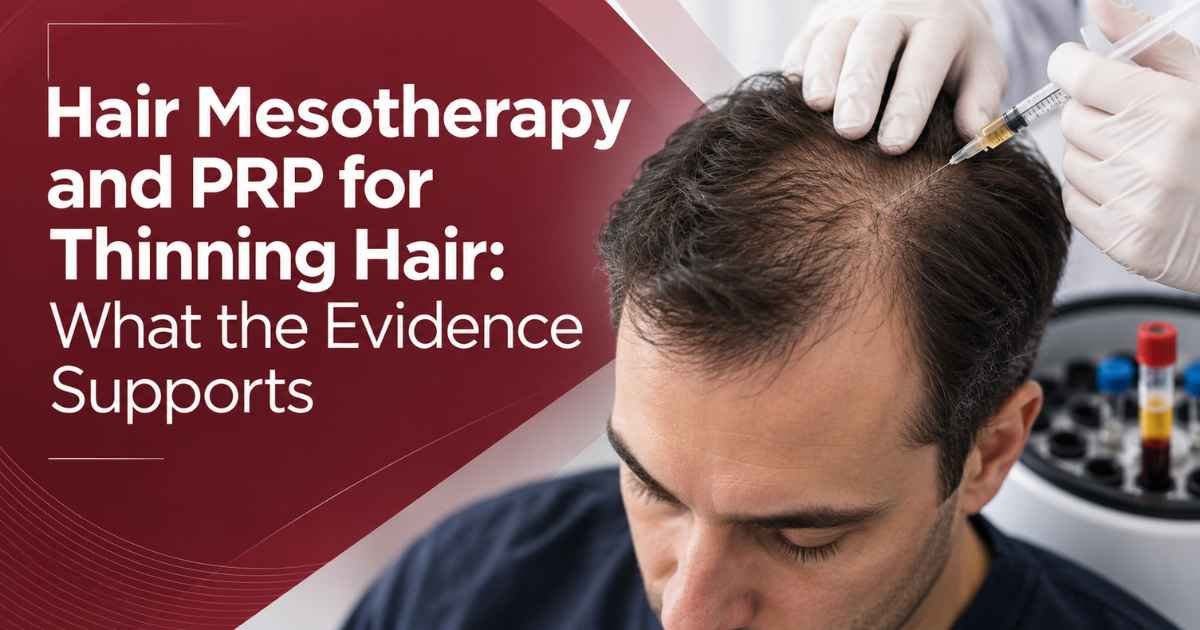
Scalp mesotherapy and platelet-rich plasma (PRP) are two injectable, in-office approaches used for early hair thinning, and they work in different ways. Mesotherapy places small amounts of active ingredients into the upper layers of the scalp, while PRP concentrates growth factors from a person’s own blood and returns them to the same area. Clinics deliver mesotherapy using fine needles or hair mesotherapy devices, which meter tiny doses into the dermis where the hair follicles sit. Understanding what each method can realistically do, and where the evidence stops, matters more than the marketing around either one.
Both are usually considered for pattern hair loss, the gradual miniaturization of follicles also called androgenetic alopecia. They are best understood as add-on treatments for follicles that are still alive but weakening, not as replacements for the therapies with the strongest track record.
What scalp mesotherapy actually delivers
Mesotherapy is a minimally invasive technique that injects active agents directly into the dermis rather than relying on them to soak through the skin surface. For hair, the mixtures vary widely from clinic to clinic. Commonly used agents include minoxidil, dutasteride, growth factors, biomimetic peptides, vitamins and micronutrients. Biomimetic peptides have drawn attention because they are designed to imitate naturally occurring growth factors such as vascular endothelial growth factor, insulin-like growth factor-1 and fibroblast growth factor, which are involved in the hair growth cycle and in the small blood vessels that feed follicles.
The logic is straightforward: deliver supportive compounds close to the follicle in a controlled dose. The evidence, however, is still early. A systematic review of mesotherapy for pattern hair loss found positive results across the studies examined, with few significant side effects, but also flagged real limits. Sample sizes were small, head-to-head comparisons against established treatments were scarce, and study quality varied. That combination means mesotherapy can be described as promising and generally well tolerated, not as a proven standalone cure.
How PRP works for hair, and what trials show
PRP starts with a routine blood draw. The sample is spun in a centrifuge to separate and concentrate the platelets, which are then injected into the thinning scalp. Platelets release growth factors such as platelet-derived growth factor, vascular endothelial growth factor and transforming growth factor beta, and the working theory is that these signals prolong the active growth phase of the follicle and improve its local blood supply. Because the material comes from the patient’s own body, allergic reaction to the injected substance is not a concern.
PRP has more clinical data behind it than mesotherapy. Systematic reviews and meta-analyses of randomized trials in androgenetic alopecia report that PRP can increase hair density compared with placebo, with measurable gains around the three and six month marks. Reviews focused on female pattern hair loss similarly found increases in terminal hair density against controls. The caveats are consistent across these analyses: the trials are highly heterogeneous, preparation and injection protocols differ, sample sizes are modest, and publication bias is a concern. The direction of the evidence is encouraging, but it is not the same as a guarantee for any single person.
Who tends to be a good candidate
Both treatments assume there are follicles left to support. They are most relevant for people in the earlier stages of pattern hair loss, and PRP has also been studied in some cases of diffuse shedding. They are far less useful once an area has been bald for years, because a follicle that is gone cannot be reactivated by growth factors or nutrients.
- Early to moderate pattern hair loss, where thinning is visible but follicles are still producing hair.
- People looking to complement, not replace, treatments like topical minoxidil or oral therapy prescribed by a clinician.
- Those who can commit to a series of sessions and ongoing maintenance rather than a single visit.
Some situations call for caution or a different plan. Scarring types of hair loss, active scalp infection or inflammation, bleeding disorders, and the use of blood-thinning medication are all reasons to be assessed by a physician first. PRP in particular depends on the patient’s own platelet health, so certain blood conditions can make it a poor fit. A proper diagnosis of the cause of shedding should come before any injection, since hormonal, nutritional and thyroid issues can drive hair loss and are treated differently.
Realistic expectations and where the limits are
Neither method is a one-time fix. Typical protocols involve an initial series of sessions spaced weeks apart, followed by periodic maintenance, because any benefit tends to fade if treatment stops and the underlying tendency to thin continues. Results also vary with the stage of hair loss, the specific protocol used, and how consistently a person keeps up with sessions.
The most honest framing is that mesotherapy and PRP are supportive options that may improve density for suitable candidates, most credibly as part of a broader plan alongside treatments with stronger evidence. Because scalp injections are medical procedures, they belong in the hands of a qualified clinician who can confirm the diagnosis, match the method to the type of hair loss, and set expectations that the current research can actually support.
Disclaimer: The information provided in this article is for general informational and educational purposes only and does not constitute professional medical advice, diagnosis, or treatment. Hair loss causes vary, and injectable treatments carry risks that require clinical assessment. Readers should consult a qualified dermatologist or healthcare provider before pursuing mesotherapy, PRP, or any hair restoration procedure. The author and publisher disclaim all liability for health outcomes, treatment decisions, or financial losses arising from reliance on this content. Always seek a proper diagnosis and personalized medical guidance before beginning any treatment.
Browse through wisdom that feels like common sense—our grounded content keeps things simple and real.