I. What are LoRa Point-to-Point and Networked Communication?
LoRa Point-to-Point Communication
LoRa point-to-point communication operates similarly to handheld two-way radios; it requires no intermediate devices such as gateways or servers, allowing two or more terminal devices to establish direct, independent communication links. By configuring LoRa modules (equipped with chips like the SX1262) with matching communication parameters—such as frequency, spreading factor, and bandwidth—devices can achieve unidirectional data transmission or perform bidirectional data exchange using a “ping-pong” protocol.
This mode features a simple architecture and low deployment costs. It offers millisecond-level latency and excellent real-time performance, with controllable power consumption that supports long-term sleep modes and on-demand wake-up. It is suitable for lightweight IoT scenarios involving a small number of devices (typically fewer than 10), fixed communication relationships, and a need for high real-time responsiveness—such as greenhouse soil sensors triggering irrigation valves or factory equipment triggering a shutdown command upon detecting an anomaly.
LoRa Networked Communication
LoRa networked communication typically refers to a star network topology based on the LoRaWAN protocol. It addresses requirements for large-scale, wide-coverage, and multi-device connectivity that point-to-point communication cannot meet, supporting centralized communication and data aggregation for hundreds or thousands of distributed sensors.
The complete networked system forms a centralized scheduling network comprising four components: terminal devices, gateways, network servers, and application servers. Terminals handle on-site data collection and transmission; gateways act as relays, receiving RF signals and forwarding data via links such as Ethernet or 4G; network servers manage packet deduplication, decryption, and network administration; and application servers handle data parsing and business logic processing.
This mode offers high device connection capacity and extensive signal coverage, featuring AES-128 encryption and Adaptive Data Rate (ADR) capabilities, resulting in superior system security and intelligence. However, it entails greater deployment complexity and higher hardware installation costs; communication latency is in the second range, making real-time performance lower than that of point-to-point communication.
II. Core Characteristics of the Two Communication Modes
- Network Architecture: Point-to-point communication involves no gateways or servers, with terminals communicating directly with each other; networked communication utilizes a centralized star network topology, relying on the collaborative operation of gateways, network servers, and application servers.
- Device Connection Scale: Point-to-point is suitable for small-scale setups (fewer than 10 devices); networked communication allows a single gateway to support thousands of terminal nodes, enabling large-scale system expansion at the campus or city level.
- Communication Latency: Point-to-point offers millisecond-level response times and excellent real-time performance; networked communication involves second-level latency and poorer real-time performance.
- Deployment Cost and Complexity: Point-to-point architecture is simple, requires minimal hardware investment, and is easy to deploy; networked communication entails higher hardware and installation costs, as well as a complex deployment process.
- Security and Intelligent Capabilities: Networked communication features AES-128 encryption and ADR (Adaptive Data Rate) for automatic optimization of network status and terminal power consumption; point-to-point communication lacks these standardized network management capabilities.
6. Coverage Scope: Point-to-point is suitable for localized, small-scale scenarios; networked communication relies on gateways to achieve signal coverage across large areas, complex environments, and remote regions.
III. Selection Principles for the Two Communication Modes
Scenarios Suitable for LoRa Point-to-Point Communication
Choose LoRa point-to-point communication for projects requiring rapid interaction between a small number of devices, simple IoT control, or short-term testing, where low cost, low latency, and quick deployment are priorities.
Typical applications: Greenhouse sensors linked to irrigation valves; control systems for emergency shutdowns of factory equipment.
Scenarios Suitable for LoRa Networked Communication
Choose LoRaWAN networked communication for projects requiring concurrent access for multiple devices, wide-area coverage, centralized device management, and data analysis—specifically when building large, complex IoT systems.
Typical applications: Smart municipal services, environmental monitoring, smart meter reading, and large-scale agricultural sensor monitoring.
> Note: These are not two distinct underlying technologies; rather, they are two operating modes derived from the same underlying LoRa technology, differentiated by device count, scenario scale, and functional requirements.
IV. Ebyte Product Recommendations
Based on the technical characteristics of LoRa private point-to-point and LoRaWAN standardized networking, operational requirements, and Ebyte product compatibility, we recommend two industrial-grade LoRa modules. These are tailored for low-latency point-to-point transparent transmission and large-scale wide-area networking scenarios, respectively, serving applications such as industrial sensing, smart agriculture, and municipal monitoring. Specific product recommendations are as follows:
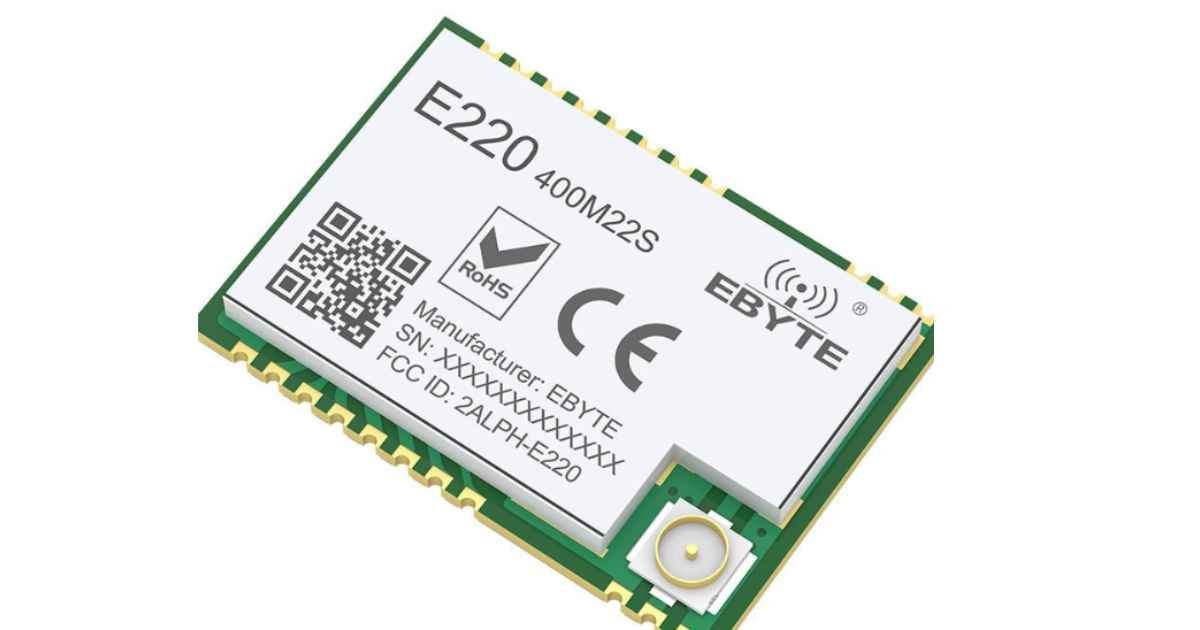
E220‑400M22S: Utilizes Semtech’s original LoRa spread-spectrum technology; operates in the 410–493 MHz frequency band with a transmit power of 22 dBm and a communication range of up to 3.5 km in open environments. It features ultra-low power consumption (microampere level), with a sleep current of only 2.5 μA, rapid wake-up response, and support for low-latency transmission (millisecond level). It supports transparent transmission and wireless parameter configuration; requiring no gateway server, two modules can communicate simply by pairing. With easy deployment and low costs, it is an ideal choice for lightweight LoRa point-to-point communication scenarios.
E77 Series: Designed specifically for standard LoRaWAN networking, this series integrates the STM32WLE5 RF-plus-MCU chip and offers native compatibility with the LoRaWAN protocol. Operating in the mainstream 400 MHz IoT frequency band with a transmit power of 22 dBm, it achieves a maximum communication range of 6.5 km. It supports concurrent multi-device access and wide-area coverage, making it suitable for large-scale IoT network applications requiring centralized cloud management—such as smart municipal systems, environmental monitoring, smart meter reading, and large-scale agricultural sensor monitoring.
Disclaimer: The information in this article is for general informational purposes only and does not constitute professional, technical, or engineering advice. Module specifications, frequency bands, communication ranges, power consumption, and product compatibility may vary by region, configuration, and operating conditions, and may change without notice. Readers should verify all technical details, regulatory requirements, and product specifications directly with the manufacturer before designing or deploying any IoT system. Any mention of specific products or brands does not imply endorsement. The author and publisher disclaim any liability for decisions made based on this content.
Discover posts that feel like a crackling fireplace—our warm-glow articles bring comfort on the coldest days.