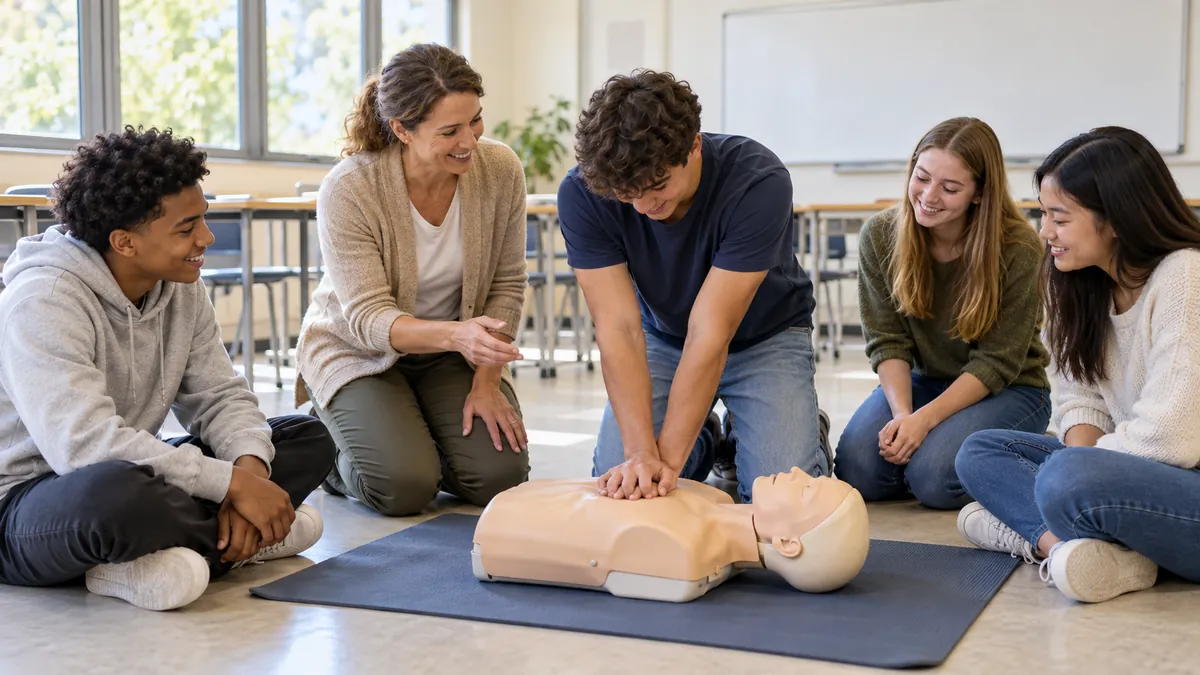
Ask a room full of students to memorize the steps of CPR, and you’ll get polite nods. Turn those same steps into a race, a quiz or a scavenger hunt, and suddenly everyone wants a turn. That’s the magic of game-based learning. It won’t replace hands-on certification, but it can build the awareness that makes students curious, confident and ready to learn more. Teachers who want to model the skill themselves often start with Coast2Coast CPR Certification Guelph and then bring that knowledge back to class.
So, can a game really teach a student to save a life? On its own, no. But it can plant the steps deep enough that a student remembers them when it counts, and it can spark the interest that leads to real training later. Here are five easy ways to make it happen.
Why Does CPR Belong in the Classroom at All?
Because emergencies don’t wait for an adult with a certificate to walk in.
According to the Heart and Stroke Foundation, an estimated 60,000 out-of-hospital cardiac arrests happen in Canada every year. Only about 1 in 10 people survive. The same source says that doing CPR and using an AED can double a person’s chance of survival, and every minute without CPR or defibrillation lowers the odds by about 10%.
Those numbers turn into a simple message for students: the first few minutes matter, and ordinary people can make a difference. When kids learn that early, they grow up seeing themselves as helpers, not bystanders.
Why Do Games Help Students Remember?
Think about the last review game you ran. The energy changed, right? Students leaned in. They argued about answers. They wanted another round.
Games work for a few simple reasons:
- Repetition feels like fun. Students happily go through the same steps five times when there’s a score on the line.
- Quick feedback sticks. Seeing right away whether an answer was right helps fix the idea in memory.
- Emotion boosts recall. A little friendly competition makes the moment memorable.
- Everyone takes part. Quieter students often join in more when it’s a game.
For CPR awareness, that’s exactly what you want. The steps are short and clear. They’re perfect for drilling through play.
1. How Can Quiz Review Rounds Teach the CPR Steps?
Start with the easiest win. Build a short quiz on the basic steps of CPR and run it on whatever classroom quiz games you already use, or simply with paper cards and a whiteboard.
Good questions might include:
- What’s the first thing you should check before helping someone?
- Who should you tell to call 911?
- How fast should chest compressions be? (100 to 120 per minute)
- How deep should adult compressions be? (At least 5 cm, or 2 inches)
- What does AED stand for, and why is it important?
- What’s the ratio of compressions to breaths for trained rescuers? (30 to 2)
Mix in a few “true or false” questions to catch myths. For example: “You should wait to see if the person wakes up before calling for help.” (False!) Run the quiz at the start of the unit, then again a week later, and watch the scores climb.
2. What Is an AED Scavenger Hunt?
This one gets students out of their seats and builds real-world knowledge about their own school.
Split the class into small teams. Give each team a map of the school, or ask them to sketch one. Their mission is to find and mark:
- Every AED in the building
- The first aid kits
- The main office, where help can be called
- The nearest exits to the gym, cafeteria and main hallways
Check with your principal first, so teams know which areas are open. When the teams come back, compare maps. Did anyone miss an AED? Did someone find one the rest of the class didn’t know about?
Wrap up with a quick talk. Why does it matter where the AED is? Because in a real emergency, someone has to grab it fast. Knowing the spot ahead of time saves precious seconds.
3. How Do You Run a Beat-the-Clock Compression Challenge?
Here’s where students learn the rhythm of CPR. Chest compressions should happen at 100 to 120 per minute. That’s quicker than most people guess.
Find a song with a tempo in that range. Many music apps and websites list a song’s beats per minute, so you can pick something your class already likes. Play it and have students clap or tap along to feel the speed.
Then add the challenge. If your school has practice manikins, use them. If not, a firm pillow or a rolled-up towel works for rhythm practice. Students take turns doing compressions in time with the music for 30 seconds while a teammate counts. The goal isn’t strength. It’s keeping a steady beat without speeding up or slowing down.
Be clear with students: this is for learning the rhythm only. Never practise compressions on a real person.
4. How Can “Choose Your Response” Cards Build Decision-Making?
Real emergencies are messy. This game helps students think through what to do when things aren’t textbook-perfect.
Write short scenarios on cards. Each card ends with two or three choices. For example:
*At recess, a classmate’s grandparent sits down on a bench, clutches their chest and says they feel dizzy and sweaty. What do you do first?*
- A) Wait to see if it goes away
- B) Tell a teacher and make sure someone calls 911
- C) Go get them a snack
Teams pick an answer, then explain why. Use the moment to teach the warning signs of a heart attack: chest discomfort or pressure, discomfort in the arms, neck, jaw or back, shortness of breath, sweating, nausea and light-headedness.
You can add stroke cards, too, using FAST: Face drooping, Arm weakness, Speech difficulty, Time to call 911. Kids love a good acronym.
5. How Does a Chain of Survival Relay Work?
The chain of survival is the idea that each step in an emergency links to the next. If one link breaks, the whole chain gets weaker.
For a simple classroom version, use these links:
- Recognize the emergency and call 911
- Start CPR right away
- Use an AED as soon as one arrives
- Hand over to paramedics
Write each link on a card. Set up a relay with teams lined up at one end of the room. The first runner grabs the first card and places it on the board, then tags the next runner, who adds the next link. The first team to build the chain in the correct order wins.
Then shuffle the cards and try again with a twist: one link goes missing. Ask the class what would happen in real life if that step got skipped. It’s a quick way to show why every person’s role matters.
What Can’t a Game Replace?
Here’s the honest part. Games build awareness and confidence, but they can’t teach the feel of proper compressions or how to use an AED the right way. That takes hands-on training with a certified instructor who can watch, give feedback and correct technique.
Think of classroom games as the warm-up. They make students familiar with the steps and eager to learn more. Certified courses are where the real skill gets built.
Why Should Teachers Get Certified, Too?
Teachers spend their days surrounded by students, parents and staff. That makes them some of the most likely people to be nearby when something goes wrong.
For school staff as workers, Ontario’s WSIB Regulation 1101 applies. It requires at least one worker with Basic First Aid on a shift of five or fewer workers, and at least one with Intermediate First Aid on a shift of six or more. Certificates are valid for three years. If you’re booking a course, note that Ontario renamed its courses in June 2026 to match the national CSA Z1210:24 standard: Emergency First Aid is now Basic First Aid, and Standard First Aid is now Intermediate First Aid.
Beyond the rules, certification helps teachers lead these lessons with confidence. Ontario’s Good Samaritan Act, 2001 also protects people who give emergency first aid in good faith. If you’d like to explore options for yourself or your staff team, Coast2Coast First Aid courses are worth a look before your next professional development day.
Ready to Press Play?
You don’t need a big budget to teach life-saving awareness. A few quiz questions, a school map, a catchy song and a stack of index cards can go a long way. Your students may not remember every vocabulary word from this year, but they just might remember how to help someone in trouble.
If you are looking for CPR and first aid training near Water Street and Gordon Street, the University of Guelph campus area, or surrounding areas, you may reach out to Coast2Coast First Aid & Aquatics in that area.
Frequently Asked Questions
Q: Can classroom games really teach CPR?
A: Games are great for building awareness of the CPR steps, the right compression rhythm and when to call 911. They can’t replace hands-on training with a certified instructor, which is needed to learn proper technique.
Q: What song tempo should students use for compression practice?
A: Chest compressions should be done at 100 to 120 per minute, so choose a song with a tempo in that range. Many music apps and websites list a song’s beats per minute.
Q: Is it safe for students to practise compressions in class?
A: Yes, as long as they use a practice manikin, a firm pillow or a rolled towel. Students should never practise compressions on a real person.
Q: Do teachers in Ontario need first aid certification?
A: For school staff as workers, WSIB Regulation 1101 requires at least one worker with Basic First Aid on a shift of five or fewer, and at least one with Intermediate First Aid on a shift of six or more. Many teachers choose to certify so they can respond with confidence.
Q: Why does it matter how quickly someone starts CPR?
A: According to the Heart and Stroke Foundation, every minute without CPR or defibrillation lowers survival chances by about 10%. Doing CPR and using an AED can double a person’s chance of survival.
Disclaimer: The information in this article is for general informational and educational purposes only and does not constitute medical, safety, or professional training advice. Classroom games build awareness only and do not replace hands-on CPR certification from a certified instructor. Readers should never practice chest compressions on a real person and should follow current emergency care guidelines from recognized authorities. First aid regulations, course names, and certification requirements vary by jurisdiction and may change without notice. Any mention of specific providers or services does not imply endorsement. The author and publisher disclaim any liability for decisions made based on this content.
Discover posts that make complex ideas feel simple—our clear-thinking guides turn confusion into confidence.