For a long time, OOH advertising leaned on instinct over evidence. Media buyers leaned on highway visibility, rough traffic counts, or a general sense of what a neighborhood looked like. Nobody minded much when the only goal was getting a logo in front of enough passing cars. It’s less fine now. Marketers who spend most of their budget on precisely targeted digital ads are starting to push back on that gap, and honestly, they’ve got a point.
What’s changed the equation is point-of-interest data. Layer it into media planning and most of the guesswork disappears. Billboards start going up where buyers with real purchase intent already are, not just wherever traffic happens to be heaviest.
Why Location Context Changes The OOH Game
Location-based targeting isn’t a nice-to-have anymore, it’s a measured lift. According to 2026 OOH industry data compiled by Marketing LTB, adding location-based targeting to a campaign increases ROI by 15% to 40%, and consumers exposed to OOH ads are roughly 48% more likely to actually walk into a store afterward. That advantage isn’t limited to flagship billboards in flagship markets either, smaller markets see the same lift once targeting replaces guesswork. Planners can skip the busiest intersection by default and instead use audience data to find the specific OOH units a niche audience actually passes, then build messaging that lands once they do.
None of that sounds dramatically written down, but it plays out as a real shift in how inventory gets bought. Planners can now place ads on the route to a competitor’s store, catching shoppers who are already in the mood to buy and might just switch brands instead. They can filter inventory by what kinds of businesses sit nearby. They can even watch for short-term dips in ad pricing and jump on inventory while it’s cheap.
The Analysis Problem: Proving The Ad Actually Worked
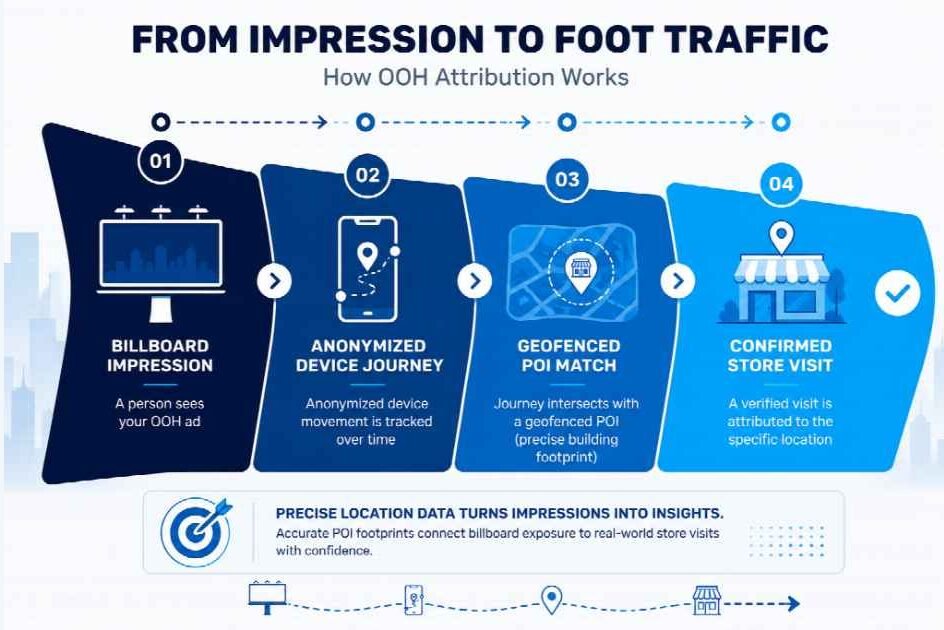
Smarter placement is only half the equation. The industry’s bigger, longstanding challenge has been attribution: did someone who drove past a billboard actually walk into the store afterward?
This is where most OOH measurements break down. Advertisers could track anonymized device journeys well enough, but connecting a GPS ping to “this device entered this specific store” rather than the parking lot next door, or the business next to it, is a genuinely hard geospatial problem.
A case study from Billups, an ad-tech company serving the OOH and digital OOH marketplace, is a useful illustration of how this gets solved in practice. Billups builds anonymized device journeys and cross-references them against outdoor inventory to determine ad exposure. That part worked fine for digital brands, where a billboard exposure could be tied to online conversion pixels. But for brick-and-mortar retailers, Billups needed to know whether a billboard exposure actually turned into a store visit, which meant needing precise, building-level location data rather than rough address points.
Where Safegraph Fits In
This is the exact problem SafeGraph’s Places data was built to solve. Rather than relying on store centroids or geocoded street addresses, which can misattribute a visit to the wrong business entirely, SafeGraph provides precise POI building footprints, the actual shape and boundary of a store or venue, that let companies like Billups confirm store visits with far more confidence than address-based approximations allow.
That precision comes with scale: SafeGraph’s Places dataset covers 80 million-plus verified locations globally across more than 15,000 brands, refreshed monthly. That’s what let Billups onboard new clients and markets quickly without maintaining its own POI database by hand, and recommend billboard placements based on the actual types of stores and shoppers near a given location.
The Takeaway
OOH advertising isn’t losing ground to digital so much as it’s catching up to it. POI data gives media planners the same kind of targeting logic and measurable proof of impact that digital channels have offered for years, applied to physical billboards and out-of-home inventory. As more platforms like Billups build attribution and placement strategy on top of precise, regularly updated location data, the gap between “we think this billboard works” and “we can prove this billboard drove store visits” keeps closing.
Disclaimer: This article is for general informational purposes only and does not constitute professional marketing, data, or business advice. Statistics, ROI figures, and case study details cited are based on third-party sources and may change or be updated without notice. Location data privacy regulations, platform capabilities, and vendor offerings vary by region and may change. Readers should verify all data sources, compliance requirements, and vendor claims directly before implementing any location-based advertising strategy. Any mention of specific companies or services does not imply endorsement. The author and publisher disclaim any liability for decisions made based on this content.
Stay motivated with content that meets you where you are—our encouraging articles keep you moving forward.