Two numbers land on the same desk for the same 120 m² flat. One is a subscription: $49.90 a month, 530 credits. The other is a quote: a site survey, six to twelve hours of drafting, and revisions until the client stops moving walls. Almost nobody compares them honestly, because they are not the same purchase — and treating them as the same purchase is where projects quietly lose money.
The pitch makes it worse. An AI floor plan generator is sold as the end of drafting fees; a drafter is defended as the only honest option. Neither claim survives a real budget. The question worth asking is not whether an AI floor plan generator matches a drafter. It is which part of the work each one is being paid for.
What a drafting fee actually buys
Read a drafting quote closely and most line items are not drawing. You are paying for a measured survey: wall thickness, ceiling heights, window positions, things a photograph cannot tell you. You are paying for structural information the plan must not contradict. You are paying for familiarity with whatever your local code says about egress, headroom, and ventilation. And you are paying for a signature that carries liability.
The drawing is the visible residue of all that, not the product itself. Drafting is priced by precision, in hours — the one thing an image model cannot supply, and the reason you do not want it in week one.
What an option round used to cost
Before anyone commits to measurement, a project usually needs three schemes to argue about. Historically that meant three half-finished drawings: roughly 1.5 hours each if the brief was clear, more if it was not, so four to five billable hours before any decision had been made. At $50 an hour that is $225 spent on options that will mostly be rejected.
The complete brief for a 120 m² three-bedroom scheme: five counts, one area, one toggle.
Three Advanced generations inside an AI floor plan generator cost 90 credits, about $8.50 on the $49.90 tier.
Subscription tiers, as listed: $19.90 for 180 credits, $49.90 for 530, $99.90 for 1,200.
The comparison is not $225 versus $8.50, because the outputs are not equivalent. It is $225 versus $8.50 to reach the same decision — and the decision is all an option round was ever for.
The same flat, two ways
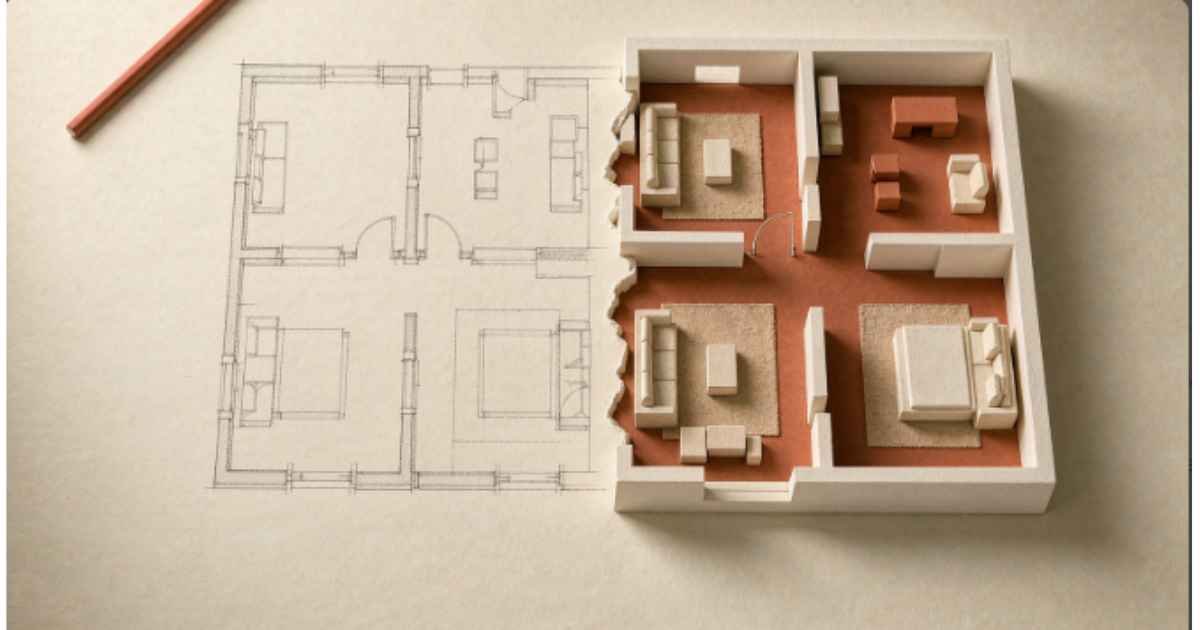
A drafter gets that same brief plus a site visit, and returns a dimensioned, code-aware set you can build from. An AI floor plan generator returns a proposal you can argue with. Those are different products with different failure costs: a wrong proposal costs an afternoon, a wrong measured drawing costs a wall — and only one of those two mistakes is recoverable by drawing again.
The credit arithmetic an AI floor plan generator hides
Credits are not plans, and that mismatch is where budgets go strange. In the AI floor plan generator workspace, a Basic generation costs 10 credits, Advanced 30, and Pro 60. On the $49.90 tier with 530 credits a month, that is 53 Basic runs, 17 Advanced, or 8 Pro — before a single regeneration.
Per generation, on the same tier: about $0.94 for Basic, $2.83 for Advanced, $5.65 for Pro. On the $19.90 tier the same runs cost $1.11, $3.32, and $6.63, because you are buying fewer credits at a higher unit price.
That asymmetry is the whole argument. An AI floor plan generator is cheap exactly where it is useful — comparison — and expensive exactly where it is tempting: polishing one image until it looks like a deliverable. Eight Pro runs is a month of subscription, and eight Pro runs is also one wasted afternoon if you were only testing adjacencies.
Pack economics: $0.198 a credit (Mini), $0.157 (Plus), $0.145 (Studio Pack). Every monthly plan still beats all three.
The revision cycle is the hidden line item
Clients do not change their minds once. They change them after seeing an option, which is precisely the point at which a drafting revision becomes billable. Three rounds of “move the kitchen, try it the other way” is six to nine hours on a conventional contract, and it is the line item that turns a fair quote into an awkward conversation.
This is the least discussed economic effect of an AI floor plan generator: it does not reduce the cost of the final drawing by much, but it collapses the cost of being wrong early. Ten Advanced variations cost less than one hour of drafting. If the client needs to see four kitchens before they can describe what they actually want, that is a ten-dollar conversation instead of a two-hundred-dollar one.
The failure mode is easy to spot. If you are already at Pro tier, polishing materials for a scheme that has not been measured, you have stopped buying options and started buying wallpaper.
Where the fee is genuinely unavoidable
Four items resist automation; pretending otherwise ends with a cheap drawing and an expensive problem.
Measured dimensions come from a building, not from a model. Structural spans are a calculation, not a composition. Code compliance depends on a jurisdiction that changes by postcode. And liability requires a person who can be insured. A plan that is 200 mm out on a load-bearing wall is not a rounding error; it is a demolition order with paperwork.
Where the hybrid actually holds
The workflow that survives contact with real projects is unglamorous: let an AI floor plan generator produce the options, choose one, then pay for measurement once.
Hand over three things when you do: the chosen image, the written brief that produced it, and a DXF export if the drafter wants geometry in CAD rather than a picture. Two habits keep that handoff cheap. Name the approved variant in the brief document, so nobody guesses which of five versions won. And send the Technical style, not the Realistic render — material and lighting read as detail, and detail is what makes a drafter rebuild the whole layout from scratch.
A decision rule for an AI floor plan generator
Three questions, in this order.
- Will anyone build from this? If yes, it needs measurement and a drafter.
- Does someone have to sign it? If yes, it needs a professional who carries the liability.
- Do you need to compare three options before paying for measurement? If yes, an AI floor plan generator is the cheapest instrument available.
Two out of three pointing at a drafter is not a verdict against the tool. It usually means the generator has already done the part nobody wanted to bill for: the first twenty minutes, when the layout is still an argument.
What I would actually spend
The mistake is rarely picking the wrong tool. It is paying drafting rates for the first twenty minutes, or quoting concept-phase fees to a client who needs a permit set. An AI floor plan generator priced at drafting rates is an expensive way to look busy; a drafter hired to brainstorm is a slow way to do it.
That is the whole split, and an AI floor plan generator only makes sense inside it: pay for thinking at concept speed, pay for precision once, at the end, when the layout has stopped moving. And keep the two invoices separate in your head, because the moment you compare them as if they were the same purchase, one starts looking like a bargain and the other starts looking like a waste — and both judgments will be wrong.
Disclaimer: This article is for general informational purposes only and does not constitute professional, financial, architectural, or construction advice. Pricing, subscription tiers, credit costs, and drafting rates cited are examples based on the information available at the time of writing and may change without notice; actual costs vary by provider, region, and project. AI-generated floor plans are conceptual proposals and are not measured, code-compliant, or structurally verified drawings—no one should build from them. Measured surveys, structural calculations, code compliance, and liability-bearing signatures require qualified professionals. Readers should verify all pricing, licensing requirements, and local building regulations with the relevant providers and authorities before making decisions. Any mention of specific products or tools does not imply endorsement. The author and publisher disclaim any liability for decisions made based on this content.
Unlock a fresher way to approach everyday learning—browse our original insights and discover ideas you won’t find elsewhere.