Most engineering job descriptions read like a shopping list: five years of React, three years of AWS, Kubernetes, PostgreSQL, “AI experience a plus.” Hiring managers then screen résumés against that list and interview for recall of specific tools.
The problem is that the list starts expiring the day you post it. The technology your team uses today will not be the technology it uses in three years. If you only hire for what people know right now, you are building a team that is optimized for a moment that has already passed.
The data backs this up. The World Economic Forum’s Future of Jobs Report 2025 finds that employers expect 39% of workers’ core skills to change by 2030, with AI and big data topping the list of fastest-growing skills. In software, the pace is even faster. Stack Overflow’s 2025 Developer Survey of more than 49,000 developers found that 84% use or plan to use AI tools in development, and 69% spent time in the past year learning new coding techniques or a new language.
This article explains what adaptable engineering teams look like, how to hire for adaptability without sacrificing technical depth, and how to structure teams that keep up as technology shifts.
What Is an Adaptable Engineering Team?
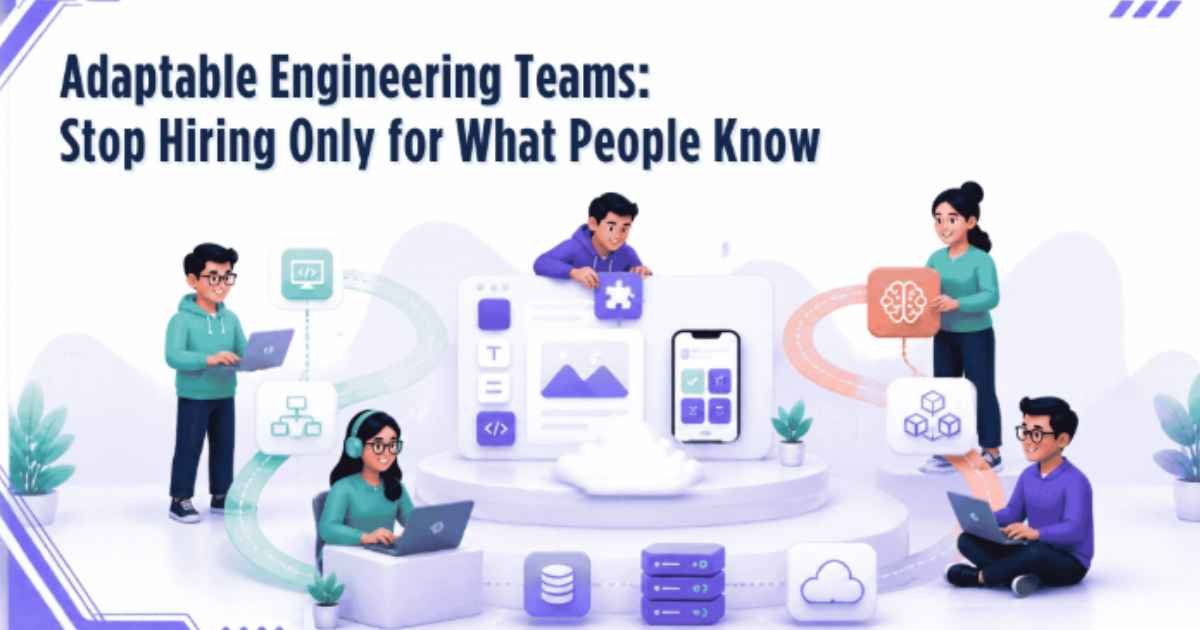
An adaptable engineering team is one that can absorb new technologies, changing requirements, and shifting business priorities without stalling or needing to be rebuilt. Its strength comes from how its people learn, reason, and collaborate, not just from what they already know.
Adaptable teams share four traits:
- Strong fundamentals. Engineers understand data structures, system design, networking, and testing well enough to pick up new frameworks quickly.
- Learning velocity. They can get productive in an unfamiliar codebase or tool in weeks, not quarters.
- Sound judgment. They know when to adopt a new technology and when to leave a working system alone.
- Shared ownership. They care about the product outcome, not only the ticket in front of them.
Why Hiring Only for Current Skills Backfires
Hiring for a precise list of current tools feels safe. In practice, it creates four problems.
1. Your Stack Will Change
Teams migrate from monoliths to microservices, from on-premise to cloud, and now from traditional features to AI-enabled workflows. An engineer hired only because they know Framework X may struggle when Framework X is no longer the right choice.
2. AI Is Changing What “Knowing” Means
With AI coding assistants widely used, recalling syntax matters less than it did. What matters more is the ability to frame problems, review AI-generated code critically, and catch subtle errors. The same Stack Overflow survey found that 46% of developers do not trust the accuracy of AI tool output. Engineers who can evaluate that output are worth more than engineers who can only produce code from memory.
3. You Shrink Your Talent Pool
Demanding an exact combination of tools and years of experience filters out strong engineers who could learn your stack quickly. That makes hiring slower and more expensive, especially for roles like AI engineers, where demand already outpaces supply.
4. You Get Specialists Who Cannot Flex
A team made entirely of narrow specialists becomes fragile. When priorities shift, work piles up in one area while other engineers wait. Adaptable teams can rebalance.
Skills-Based Hiring vs. Hiring for Adaptability
Skills-based hiring means evaluating candidates on demonstrated abilities rather than degrees or job titles. It is a strong step forward, but it can still fall into the trap of testing only today’s tools.
Hiring for adaptability goes one step further: it asks “Can this person learn and apply what we will need next?” alongside “Can this person do the job today?”
| Approach | What it tests | Risk |
| Credential-based hiring | Degrees, brand-name employers, years of experience | Misses capable engineers; weak link to performance |
| Tool-checklist hiring | Specific frameworks and versions | Hires for the present only |
| Skills-based hiring | Demonstrated ability on real tasks | Can still over-index on current stack |
| Hiring for adaptability | Fundamentals, learning velocity, judgment, plus core skills | Requires better-designed interviews |
The goal is not to ignore current skills. A senior backend role still needs strong backend experience. The goal is to weigh learning ability and fundamentals as heavily as tool familiarity.
How to Hire for Adaptability: 6 Practical Methods
1. Rewrite Job Descriptions Around Outcomes
Replace “5+ years of React” with what the person will accomplish: “Own the customer dashboard and improve load time and usability.” List a small number of must-have skills and label the rest as nice to have.
2. Test Fundamentals, Not Trivia
Use system design discussions and problem-solving exercises that require reasoning, not memorized APIs. Ask candidates to explain trade-offs: why a queue instead of a direct call, why caching here and not there.
3. Run an “Unfamiliar Territory” Exercise
Give candidates a short task in a library or language they have not used, with documentation available. Watch how they explore, ask questions, and validate their work. This reveals learning velocity better than any résumé.
4. Include an AI-Assisted Code Review
Show candidates a pull request that contains AI-generated code with a subtle bug or security flaw. Strong engineers will spot issues, question assumptions, and suggest tests. This mirrors how modern engineering actually works.
5. Ask About Past Transitions
Behavioral questions reveal adaptability:
- “Tell me about a time you had to learn a new technology under a deadline.”
- “Describe a migration you worked on. What went wrong, and what did you change?”
- “When did you decide not to adopt a new tool, and why?”
6. Look for Breadth Around a Deep Core
The most adaptable engineers are often “T-shaped”: deep in one area, comfortable across several. A full-stack developer with strong backend fundamentals, or a data engineer who understands product needs, can move where the work is.
How to Structure Teams That Stay Adaptable
Hiring is only half the picture. Team design determines whether adaptability survives contact with real deadlines.
- Mix generalists and specialists. Keep a core of versatile engineers and add specialists, such as generative AI developers or DevOps engineers, where deep expertise is needed.
- Protect learning time. Give engineers time for experiments, internal demos, and training. Adaptability that is never exercised fades.
- Rotate ownership. Moving engineers between components spreads knowledge and reduces single points of failure.
- Use flexible capacity. Instead of hiring permanently for every new skill, add engineers for a defined period through staff augmentation while your core team learns.
- Measure outcomes, not activity. Track delivery metrics like lead time and change fail rate. Adaptable teams show it in how quickly they recover and ship after a change.
If your team is distributed, the same principles apply across locations. Our guides on how to manage a remote engineering team in India and offshore team management cover ownership, onboarding, and metrics for remote teams.
When Deep, Specific Expertise Still Wins
Hiring for adaptability does not mean ignoring experience. Prioritize specific, proven expertise when:
- You face a time-critical problem with no room for ramp-up, such as a production performance crisis.
- The work involves regulated or high-risk domains, such as healthcare data or payments security.
- You need someone to set direction for a technology your team has never used.
In these cases, bring in specialist developers for the gap, and let your adaptable core team learn alongside them.
How JumpGrowth Builds Adaptable Engineering Teams
JumpGrowth is a Texas-headquartered software development and AI consultancy that helps US companies build engineering teams designed to evolve with their product. Under JumpGrowth’s team-building process, every candidate goes through a recruiter screen, a live coding exercise in your stack, and a specialist interview, with role scorecards shaped around what your product actually needs.
Companies work with JumpGrowth through flexible models:
- MVP launch teams for startups building a first product
- Dedicated production teams that own delivery long term
- Staff augmentation to add skills without permanent headcount
- Specialist developers for niche, senior expertise
Teams can be built onshore in the USA, nearshore in Mexico, or offshore in India, depending on how much real-time collaboration your roadmap needs. Not sure which model fits? Compare engagement models or explore JumpGrowth’s case studies.
Frequently Asked Questions
What is an adaptable engineering team?
An adaptable engineering team can absorb new technologies, changing requirements, and shifting priorities without stalling. It is built on strong fundamentals, fast learning, sound judgment, and shared ownership of outcomes.
What is skills-based hiring?
Skills-based hiring evaluates candidates on demonstrated abilities, such as work samples and practical exercises, rather than degrees, job titles, or years of experience. Hiring for adaptability adds a focus on how quickly candidates can learn what the team will need next.
How do you assess adaptability in a technical interview?
Use system design discussions, an exercise in an unfamiliar library with documentation available, a review of AI-generated code with hidden flaws, and behavioral questions about past technology transitions.
Should startups hire generalists or specialists?
Most early-stage startups benefit from versatile, product-minded generalists first, then add specialists as specific constraints emerge. Our guide on full-stack vs. backend vs. AI engineers covers this decision in detail.
Does hiring for adaptability mean ignoring experience?
No. Core skills still matter. The shift is to weigh fundamentals and learning ability as heavily as familiarity with specific tools, and to bring in specialists for time-critical or high-risk work.
Build for the Stack You Will Have, Not Just the One You Have
The best engineering teams are not the ones that know the most tools today. They are the ones that can learn tomorrow’s tools fastest and make good decisions along the way. Hire for fundamentals, learning velocity, and judgment, and design your team to flex.
Ready to build a team that keeps pace with your roadmap? Book a discovery call with JumpGrowth.
Related reading:
- Full-Stack vs Backend vs AI Engineer: Which Engineer Should Your Early-Stage Startup Hire First?
- Product Engineering Services in 2026: What They Actually Include
- Custom Software Development Company vs. In-House Team: A 2026 Cost and Risk Analysis
- Is Hiring Offshore Developers Worth It?
Disclaimer: This article is for general informational purposes only and does not constitute professional, HR, legal, or business advice. Statistics cited—including the World Economic Forum’s Future of Jobs Report 2025 (39% of core skills changing by 2030) and Stack Overflow’s 2025 Developer Survey (49,000+ respondents, 84% using or planning to use AI tools, 69% learning new techniques, 46% not trusting AI output accuracy)—are third-party figures and may be updated. Hiring practices, employment law, and assessment methods vary by jurisdiction and organisation. Details about JumpGrowth—including its Texas headquarters, team-building process, engagement models, and delivery locations—are based on the company’s own statements and have not been independently verified; their mention does not imply endorsement. Readers should design interviews and team structures in line with their own requirements and applicable regulations, and verify all service details directly with any provider. The author and publisher disclaim any liability for decisions made based on this content.
Turn reading into a superpower—our reading strategies help you absorb more, remember longer, and think deeper.