Getting the whole family into one room at the same time can feel like a small miracle. Everyone has their own schedule, their own screen and their own idea of a good evening. Then someone suggests a game, a bit of grumbling follows, and an hour later the same people who complained are laughing, arguing over the rules and asking for one more round.
That’s the magic of family game night. It doesn’t need to be fancy or perfectly planned. It just needs a game that works for different ages and a willingness to put phones aside for a while. Word games are especially good for this, because they’re easy to adapt, fun to play together and quietly educational without anyone feeling like they’re in school.
Why Word Games Work for All Ages
Many family games run into the same problem. They’re either too simple for adults or too complicated for younger kids. Word games avoid this trap better than most, for a few reasons.
Everyone already has the basic tools. If you can read and spell a little, you can play. Younger children use the short words they know, while adults and teenagers stretch for longer ones. Both feel involved.
Luck balances the field. In most word games, the letters or cards you draw play a part. That means a child can sometimes beat a parent with a lucky draw, which keeps younger players excited and stops anyone from dominating every game.
The rules are flexible. You can easily make house rules to suit your family. Allow younger players to use a dictionary, give them a bonus for any word they spell correctly or let them team up with an adult.
They spark conversation. Word games naturally lead to talk. Someone plays an unusual word and the others ask what it means. A silly word leads to a joke. A disputed word turns into a friendly debate. That conversation is half the fun.
Play matters for more than entertainment, too. The United Nations now marks an International Day of Play to recognise how important play is for children and adults alike, both for wellbeing and for building connections between people.
Classic Board Games for Families
When it comes to word games around the table, a few classics have stood the test of time.
Scrabble
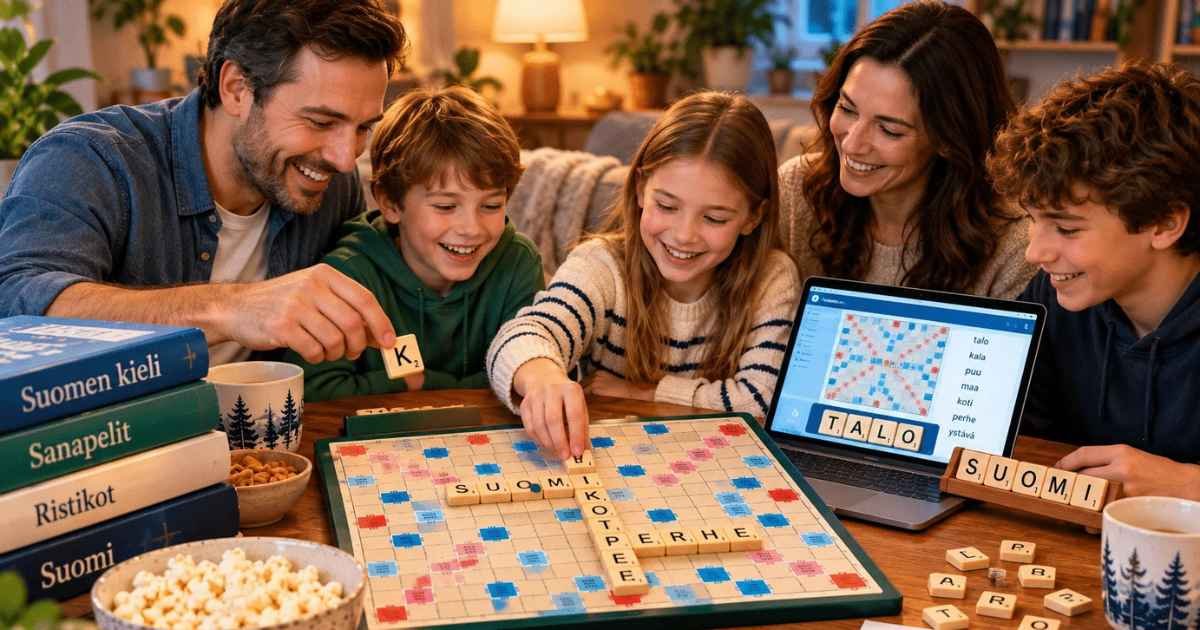
Scrabble is the obvious place to start. Players draw letter tiles and build words on a grid, scoring points based on letter values and bonus squares. It rewards vocabulary but also strategy, which makes it interesting for adults while still being accessible to older children. For younger kids, you can relax the rules by ignoring the timer, allowing help or not counting scores at all.
Word building with letter cubes or cards
Games where players roll letter cubes or draw cards and race to form words are fast and lively. They suit families with lots of energy and short attention spans, since each round only lasts a few minutes.
Guessing and description games
Games where one person describes a word without saying it, and the others try to guess, are fantastic for mixed ages. Kids love the excitement of guessing, and adults enjoy the challenge of describing tricky words. These are also great for larger groups.
Crosswords done together
A crossword doesn’t have to be a solo activity. Print one out or open one on a screen and solve it as a team. Each person contributes what they know, and younger family members often surprise everyone by knowing an answer the adults missed.
Simple homemade games
You don’t need to buy anything. Classic pen and paper games like hangman, or a game where everyone writes as many words as possible from one long word, cost nothing and can be played anywhere.
Online Options When the Board Isn’t Around
Real board games have a special atmosphere, but they’re not always practical. Maybe you’re travelling, staying at a holiday cottage or visiting relatives who don’t keep games at home. Maybe a tile went missing years ago and nobody ever replaced it. Or maybe it’s a quiet weeknight and setting up a full board feels like too much effort.
That’s where online word games are a helpful backup. A laptop or tablet in the middle of the table can work almost as well as a board, especially if you take turns or play in teams.
For Finnish families, a simple option is to play Scrabble online on Scrabblemania, a free Finnish site that runs in the browser without any registration. The game uses a Finnish word list, so letters like ä and ö work just as they should. The same site also has a crossword clue helper, a word finder and other brain games like sudoku and mahjong, which gives you options if some family members want a change.
Online games also suit families who live apart. Grandparents in one town and grandchildren in another can still enjoy a game together over a video call, with one person sharing their screen. It’s not quite the same as sitting at one table, but it keeps the tradition going across distance.
Making Games Educational for Kids
One of the best things about word games is that children learn without realising it. Spelling, vocabulary, reading and even simple maths all get a workout. Paediatric experts have long pointed out how much children gain from play. The American Academy of Pediatrics explains this well in its parent resource on how fun and games help children thrive.
Here are some easy ways to boost the learning side without spoiling the fun.
- Talk about word meanings. When someone plays a new or unusual word, take a moment to explain it. Use it in a sentence. Kids often remember these words far better than ones from a worksheet.
- Let kids keep score. Adding up points, doubling and tripling scores is great arithmetic practice. Let older children be the official scorekeeper.
- Celebrate effort, not just winning. Praise a well-spelled word or a clever idea, even if it didn’t score much. This keeps younger players motivated.
- Use teams. Pair a child with an adult or an older sibling. The child learns by watching and discussing choices, and nobody feels left behind.
- Keep a family word list. Write down the best or funniest words from each game night on a sheet stuck to the fridge. It becomes a fun record and a little vocabulary booster.
Tips for a Great Family Game Night
A few practical habits can make game night something everyone looks forward to rather than a chore.
- Pick a regular time. A set evening each week or every other week turns game night into a tradition people plan around.
- Put the phones away. A basket by the door for phones works wonders. Fewer distractions mean more fun.
- Let everyone choose sometimes. Rotate who picks the game. Kids especially love having a say.
- Add snacks. Popcorn, fruit or a special treat makes the evening feel like an occasion.
- Keep it short when needed. If younger children get tired, end on a high note rather than dragging a game on too long.
- Stay light-hearted. A bit of friendly competition is good, but the goal is time together, not a championship.
Conclusion
Family game night doesn’t need a big budget or careful planning. It just needs a good game and people willing to sit down together. Word games are one of the best choices because they work across ages, spark conversation and help kids learn while they play.
Whether you pull out a well-loved board, play a crossword as a team or open a game on a laptop when the tiles are nowhere to be found, the important part is the time you share. Years from now, your kids might not remember who won. But they’ll remember the laughs, the silly words and the evenings when the whole family gathered around one table.
Disclaimer: This article is for general informational purposes only and does not constitute professional educational, developmental, or parenting advice. Children’s learning and developmental outcomes vary, and play activities should be adapted to each child’s age and abilities. References to the United Nations International Day of Play and the American Academy of Pediatrics are general and may be updated. Online game platforms (including Scrabblemania) are mentioned as illustrative examples and do not imply endorsement; readers should verify current features, word lists, registration requirements, and privacy practices directly with the provider, and supervise younger children’s online play appropriately. Any mention of specific games, platforms, or services does not imply endorsement. The author and publisher disclaim any liability for decisions made based on this content.
Looking for content that makes learning feel effortless? Explore our smooth-reading articles—clear, useful, and genuinely enjoyable.