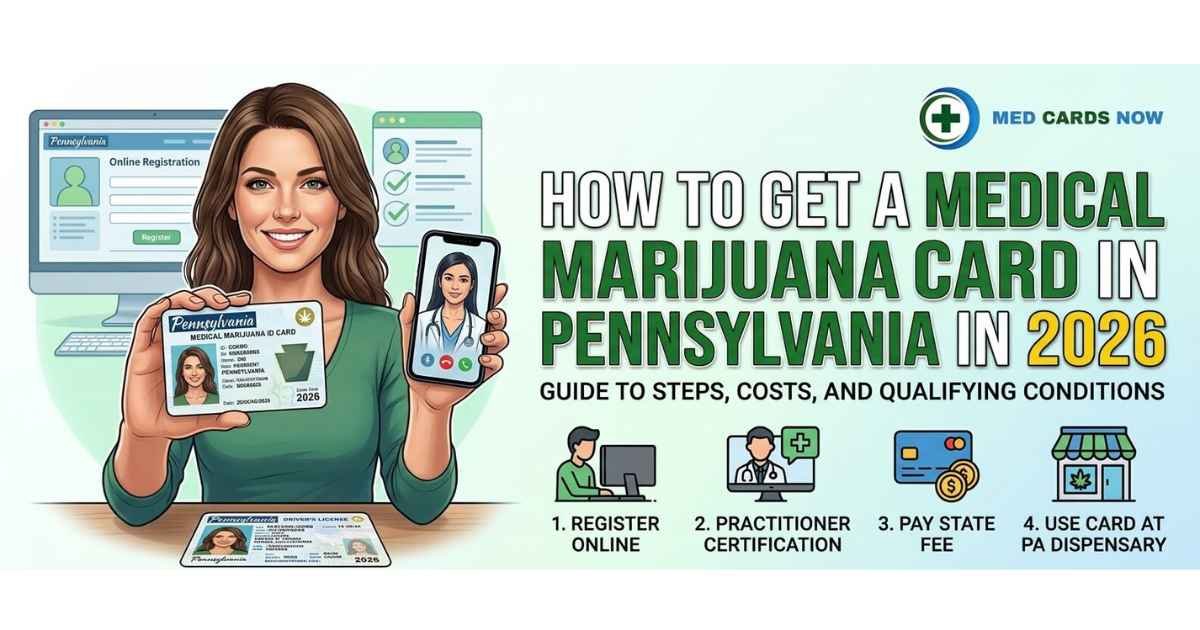
Getting a medical marijuana card in Pennsylvania in 2026 involves a few clear steps: registering with the state, receiving a certification from an approved practitioner, paying the state card fee if applicable, and using the issued card at a Pennsylvania-licensed dispensary. The process is manageable when you understand the requirements before you begin. This guide explains the steps, costs, qualifying conditions, renewal process, and common mistakes to avoid. It also explains how Med Cards Now can help you explore the next steps, while making clear that Pennsylvania’s Department of Health and an approved practitioner determine official eligibility and certification.
Pennsylvania’s Medical Marijuana Program is a regulated state program, not simply a purchase from a retail store. A person must be a Pennsylvania resident, have an approved serious medical condition, and be certified by a practitioner approved by the Pennsylvania Department of Health. Program details can change, so check the official state website before submitting information or paying a fee.
Understanding Pennsylvania’s Medical Marijuana Program
Pennsylvania established its Medical Marijuana Program under the Medical Marijuana Act, signed into law on April 17, 2016. The program provides a regulated route for eligible patients to access medical marijuana through approved dispensaries. Patients use the state registration system, receive a practitioner certification, and obtain a medical marijuana identification card. The card is important because it confirms participation in the state program and is used when purchasing approved products from a Pennsylvania dispensary.
A state medical marijuana card is not the same as a doctor’s note from an ordinary appointment. The practitioner must be registered with the state program and must assess whether the patient meets the program’s requirements. The practitioner also considers whether the patient is likely to receive therapeutic or palliative benefit, based on professional judgment and relevant health information. For that reason, no legitimate service should promise automatic approval before a proper evaluation.
The process generally has four core stages: register online, consult an approved practitioner, pay the state card fee when required, and visit a licensed Pennsylvania dispensary after the card is issued. Preparing your identification and relevant medical records can help make each stage easier. For official instructions, start with the [Pennsylvania Medical Marijuana Program registration page](https://www.pa.gov/services/health/register-for-the-medical-marijuana-program).
Who Qualifies for a Pennsylvania Medical Marijuana Card?
To qualify, you generally need to be a Pennsylvania resident, have at least one condition recognized by the state program, and receive certification from a practitioner who is approved to participate. A diagnosis alone does not automatically guarantee a card. The practitioner must review your situation and determine whether certification is appropriate under Pennsylvania’s rules.
You should have a valid Pennsylvania driver’s license or state-issued identification card showing your current address, along with a working email address. The state registration process asks for personal information, and details should match your official identification. If you have moved recently, make sure your address is up to date and follow the state’s instructions for any address discrepancy. Keep your login details safe because you will need to access your registry account later.
Patients under 18 may participate under specific rules, generally with a registered caregiver handling access to dispensaries. Caregiver arrangements also exist for certain homebound patients and people who qualify for assistance. Caregivers have separate registration requirements, including a background check and an identification card when approved. Families arranging care for a minor or another person should review the state’s caregiver guidance rather than assuming the adult patient process applies.
Pennsylvania’s Approved Qualifying Conditions
Pennsylvania’s program lists serious medical conditions that may qualify a patient for certification. The current state list includes conditions such as anxiety disorders, autism, cancer, chronic hepatitis C, Crohn’s disease, damage to the nervous tissue of the central nervous system associated with intractable spasticity, dyskinetic and spastic movement disorders, epilepsy, glaucoma, HIV/AIDS, Huntington’s disease, inflammatory bowel disease, intractable seizures, multiple sclerosis, neurodegenerative diseases, neuropathies, Parkinson’s disease, post-traumatic stress disorder (PTSD), severe chronic or intractable pain, sickle cell anemia, terminal illness, and Tourette syndrome. Opioid use disorder may qualify in specified circumstances involving conventional therapeutic interventions.
The state also identifies moderate to severe traumatic brain injury with chronic symptoms and Type II diabetes as conditions limited to Chapter 20 research purposes. Because this distinction matters, do not assume every condition listed on a general health website has identical eligibility status for routine certification. Confirm the latest list on the [official Pennsylvania Department of Health website](https://www.pa.gov/agencies/health/programs/medical-marijuana).
If you have a condition that appears on the approved list, collect relevant medical records, diagnosis details, current medication information, and any documentation your practitioner may need. These records can support a meaningful clinical discussion, but they do not replace the practitioner’s assessment. Be honest about your symptoms and treatment history, and ask the practitioner any questions you have about potential benefits, risks, interactions, and alternatives.
Step 1: Register With the Pennsylvania Medical Marijuana Program
The first practical step is to create an account through Pennsylvania’s official patient and caregiver registry. The state recommends that patients register before their practitioner consultation so they can provide their patient ID number during the appointment. Use the official state portal rather than an unofficial website that imitates a government service.
Have your Pennsylvania driver’s license or state-issued ID and working email address ready. Enter your name as it appears on your identification and use your current mailing address. Review every field before submitting the registration because mismatched names or addresses can create avoidable delays. Once your information is validated and you complete the account setup, save your login details and patient ID number securely.
If the portal does not accept your address or you cannot complete registration, consult the official program help resources. Pennsylvania lists a medical marijuana program helpdesk at 888-733-5595, with published hours of 7 a.m. to 9 p.m. Eastern Time every day except state holidays. Avoid creating duplicate accounts simply because the first attempt is confusing; resolve the original account issue first.
Step 2: Schedule an Appointment With an Approved Doctor
After registering, arrange a consultation with a practitioner approved by the Pennsylvania Department of Health. Not every physician is authorized to certify patients through the program. The practitioner must be enrolled in the state program and must determine whether you meet the requirements.
Before booking, ask whether the provider is currently registered in Pennsylvania, what the consultation costs, what records you should bring, and whether follow-up communication is included. The state certification visit may not be covered by health insurance, so ask about the full price before committing. Be cautious of advertisements that guarantee approval, claim no medical assessment is needed, or hide fees until checkout. Certification is a clinical decision, not a guaranteed retail transaction.
You can use the state’s practitioner information to verify program participation. If you choose a third-party appointment service, check what it actually provides: appointment scheduling, access to a licensed practitioner, administrative support, or something else. Make sure you understand which fees go to the provider and which payments must be made separately to the state.
Can You Get Certified Through Telehealth?
Pennsylvania permits qualifying practitioner consultations through synchronous interaction, including phone or video communication, under applicable program rules. This means telehealth may be an option when offered by an approved practitioner and when the practitioner determines that the consultation meets the state’s requirements. Availability and suitability depend on the provider, the patient’s circumstances, and the applicable rules.
A remote appointment can be convenient if travel is difficult or your schedule is busy. Before the appointment, test your internet connection, choose a private space, have your identification available, and prepare a concise summary of your medical history. Keep relevant records nearby so you can answer questions accurately. A video or phone appointment is still a medical evaluation; it should not be treated as an automatic approval process.
Step 3: Complete Your Medical Evaluation
During the consultation, the practitioner will discuss your medical condition, symptoms, treatment history, and relevant health information. The practitioner may review available medical records and consider whether the condition falls within the state’s program and whether medical marijuana is likely to provide therapeutic or palliative benefit. Answer questions truthfully and do not exaggerate or invent symptoms to try to qualify.
It may help to prepare a brief timeline of your diagnosis, symptoms, previous treatments, and current medications. Tell the practitioner about allergies, other health conditions, and concerns about side effects or drug interactions. If you are uncertain whether your condition qualifies, ask directly and allow the practitioner to explain the applicable requirements. A responsible consultation should give you a chance to ask questions rather than pressure you into a decision.
If the practitioner determines you qualify, they can submit the certification through Pennsylvania’s registry. You should receive instructions about the next step, including payment for the state-issued ID card if a fee is due. Follow the email and portal instructions carefully. A consultation receipt or certification notification is not necessarily the same as having an active medical marijuana ID card, so wait until the state process is complete before attempting to purchase through the program.
Step 4: Pay for Your Medical Marijuana ID Card
Pennsylvania’s published patient and caregiver ID card fee is $50. The state says participants in certain assistance programs may qualify for a no-cost card, including Medicaid, PACE/PACENET, CHIP, SNAP, and WIC. Eligibility and payment details should be confirmed in the official registry because program guidance can change.
The practitioner’s consultation fee is separate from the state ID card fee. The total cost therefore depends on the provider you select, whether you need additional services, and whether you qualify for a state fee reduction. Ask the provider for a clear breakdown before the appointment so you can budget accurately. Do not assume a low advertised consultation price includes the state payment.
After your practitioner submits the certification, sign in to the state registry and follow the instructions for payment. Pennsylvania’s patient FAQ says that if payment is not made within 60 days after the certification is submitted, the certification expires and a new certification may be required. Check the dates in your own account and complete the payment promptly to avoid repeating steps.
Step 5: Receive Your Card and Visit a Dispensary
Once the state requirements are complete and the applicable payment has been processed, your medical marijuana ID card can be printed and mailed. Pennsylvania’s published guidance says to allow approximately seven days for printing and 14 days for delivery by mail. These are estimates, not guarantees, so allow extra time if you have a deadline or an upcoming trip.
Make sure the mailing address in your registry profile is correct. If you move, update your information and follow the state’s instructions. Watch your email for status updates and keep a copy of any confirmation for your records. If your card does not arrive within the expected period, contact the official program helpdesk for guidance rather than submitting a second application unnecessarily.
After receiving your card, you can visit a Pennsylvania-licensed dispensary. Some dispensaries may require an appointment for a first visit, so check their procedures in advance. Bring your valid medical marijuana ID card and any additional identification the dispensary requests. Staff can explain available products, labeling, and purchasing procedures, but you should ask a qualified healthcare professional about treatment decisions, possible interactions, and whether a product is appropriate for your needs.
How Much Does a Pennsylvania Medical Marijuana Card Cost in 2026?
Your total cost usually has two main parts: the practitioner’s consultation fee and the state’s card fee. The state’s published fee for a patient ID card is $50, with possible fee relief for eligible participants in specified assistance programs. Consultation fees are set by providers and vary, so there is no single statewide total for every patient.
| Expense | Cost / Details |
| Practitioner Consultation | Fees vary by provider. Confirm the total cost before booking your appointment. |
| Pennsylvania Medical Marijuana ID Card | $50 state fee, according to published Pennsylvania guidance. |
| Fee Assistance Programs | Eligible participants enrolled in Medicaid, PACE/PACENET, CHIP, SNAP, or WIC may qualify for a no-cost ID card. Confirm eligibility with the state. |
| Card Renewal | Requires a new practitioner certification when due and an annual state payment when applicable. |
Be wary of services that imply the state fee is the only expense or that promise a card without a qualifying medical evaluation. Ask whether the quoted amount includes the consultation, follow-up support, and any administrative charges. Confirm the current state fee directly before paying, since the official portal is the authoritative source.
How Long Does the Application Process Take?
The timeline depends on how quickly you complete registration, how soon you can book a practitioner, whether additional records are needed, and how quickly you complete payment. A straightforward process may move quickly once the appointment is complete, but no provider should guarantee an exact delivery date for the physical card. Pennsylvania’s published guidance allows about seven days for printing and 14 days for mailing after payment, but real delivery times can vary.
You can reduce avoidable delays by registering before the appointment, using accurate information, preparing medical records, checking email and spam folders, and paying the state fee promptly. If your certification is submitted but you do not receive the expected instructions, check your registry account and contact the official program support channel. Keep a record of your appointment, payment, and relevant confirmation messages.
How to Renew Your Pennsylvania Medical Marijuana Card
A Pennsylvania medical marijuana card and its underlying certification need to be kept current. The Department of Health says patients are notified by email about 60 days before the certification and card expire, prompting them to obtain a new certification. You do not necessarily have to return to the same practitioner; the state says a patient may obtain recertification from any registered practitioner.
The state also describes a separate annual payment schedule. A reminder about the annual fee is generally sent 30 days before it is due, and the fee is paid once every 12 months regardless of how many cards or certifications a person receives. If you qualify for a fee reduction, confirm that status and the amount due through the registry. A new card is printed after recertification when the annual payment is up to date.
Do not wait until the last minute. Check the expiration date on your card, confirm your email and mailing address in the patient portal, and arrange the new appointment with enough time to complete the steps. Use your current card according to the state’s instructions until the replacement card’s effective date. For official details, read Pennsylvania’s [renewal guidance](https://www.pa.gov/agencies/health/programs/medical-marijuana/renew.html).
Common Mistakes to Avoid
One common mistake is booking with a provider without confirming that they are approved for Pennsylvania’s program. Another is entering a name or address that differs from the identification used for registration. Small errors can create unnecessary follow-up, so take a moment to review the information before submitting it.
Patients can also overlook the state fee because they assume it is included in a consultation package. Ask for a full cost breakdown and watch for the state’s payment instructions after certification. Missing the stated 60-day payment window can cause a certification to expire, according to the state’s patient FAQ. Set a reminder and use the official registry to complete payment.
Finally, do not rely on outdated blog posts, social media comments, or promises of guaranteed approval. Rules, fees, and administrative processes can change. Check Pennsylvania’s official program pages for current conditions, practitioner requirements, card payment, and renewal instructions. Keep expectations realistic: a service can help you navigate the process, but only the authorized practitioner and state process determine certification and card issuance.
Pennsylvania Medical Marijuana Laws You Should Know
A Pennsylvania medical marijuana ID card authorizes participation in the state’s regulated program under applicable state rules. It does not mean that every use or activity is lawful in every setting. Follow current state law, dispensary guidance, product labeling, and advice from qualified professionals.
Do not assume a Pennsylvania card is automatically valid in another state. Other states set their own rules for visiting patients, and some may not recognize an out-of-state card. Before travelling, check the destination state’s official rules and never carry a product across state lines without confirming the applicable law. Federal law and other restrictions may also apply.
Patients should also understand that certification is based on an individual medical assessment. Be open with your practitioner about medications and health conditions, and seek advice about impairment risks and safe storage. Keep products away from children and pets, and follow all instructions provided by the dispensary and product packaging. For legal questions or a situation involving employment, housing, driving, or travel, consult an appropriately qualified professional and current official guidance rather than assuming the card resolves every issue.
How Med Cards Now Can Help You Get Started
Navigating a state registry, choosing a practitioner, and understanding the difference between consultation fees and state fees can feel confusing when you are doing it for the first time. Med Cards Now provides online information intended to help people explore medical-card-related services and understand potential next steps. You can begin at the Med Cards Now homepage and review the site’s information before deciding whether its services fit your needs.
For readers specifically researching Pennsylvania, visit the dedicated Pennsylvania medical marijuana card. Use it as a starting point to learn more about the process, then verify current eligibility, provider participation, fees, and registration requirements with Pennsylvania’s Department of Health. If you are considering an appointment through any third-party service, confirm who provides the medical evaluation, whether the practitioner is approved in Pennsylvania, and what the quoted price includes.
Med Cards Now should be viewed as a source of guidance, not a substitute for the state registry or a medical professional’s judgment. No online article can guarantee that an individual will qualify. A reliable approach is to review the state requirements, gather your records, complete a proper evaluation, and follow the official instructions through card issuance. This keeps your decision informed and helps you avoid misleading offers or unnecessary costs.
Conclusion
Getting a medical marijuana card in Pennsylvania in 2026 begins with confirming that you are a Pennsylvania resident and may meet the state’s qualifying-condition requirements. Register through the official portal, save your patient ID, schedule an evaluation with an approved practitioner, and provide accurate information about your medical history. If the practitioner certifies you, follow the state’s instructions to pay the applicable fee and wait for your card to be printed and mailed.
Plan for the separate consultation and state costs, keep an eye on your email, and make sure your registry details remain current. When renewal time approaches, arrange recertification and settle any annual payment before your card or certification lapses. Med Cards Now can be a helpful starting point for understanding the process, but Pennsylvania’s Department of Health remains the definitive source for official requirements. Start with the state’s current instructions, ask questions when something is unclear, and make decisions with support from qualified healthcare professionals.
Frequently Asked Questions
1. How do I get a medical marijuana card in Pennsylvania in 2026?
Register in Pennsylvania’s official Medical Marijuana Program, obtain a certification from a state-approved practitioner, pay the state ID card fee if applicable, and follow the instructions for receiving your card. You must meet the state’s residency and medical eligibility requirements.
2. How much does a Pennsylvania medical marijuana card cost?
The state’s published patient ID card fee is $50. The practitioner’s consultation fee is separate and varies by provider. People enrolled in certain assistance programs may qualify for a no-cost card, so confirm your eligibility and the current fee with the state.
3. Can I get a Pennsylvania medical marijuana card online?
You can register through the state’s online system, and Pennsylvania allows qualifying consultations by synchronous phone or video interaction under applicable rules. You still need an evaluation by an approved practitioner and must complete the official state process.
4. Which conditions qualify for a medical marijuana card in Pennsylvania?
The state list includes conditions such as anxiety disorders, cancer, epilepsy, PTSD, multiple sclerosis, neuropathies, and certain forms of severe or chronic pain, among others. Eligibility depends on the current official list and an approved practitioner’s assessment. Check Pennsylvania’s Department of Health for the latest details.
5. How do I renew my Pennsylvania medical marijuana card?
Watch for the state’s renewal email, obtain a new certification from a registered practitioner, and make sure your annual payment is current if a fee applies. Check your registry profile and mailing address, and begin early enough to avoid a lapse.
Disclaimer: This article is for general informational purposes only and does not constitute legal or medical advice. Pennsylvania’s Medical Marijuana Program requirements, qualifying conditions, fees, practitioner rules, telehealth provisions, and renewal procedures are governed by state law and may change without notice. Eligibility and certification are determined solely by the Pennsylvania Department of Health and an approved practitioner—no service can guarantee approval. Consult a qualified healthcare professional about medical decisions and a licensed attorney for legal questions involving employment, housing, driving, or travel. A Pennsylvania card is not automatically valid in other states, and federal law may still apply. Details about Med Cards Now are based on its own statements and do not imply endorsement; verify all current requirements directly on official Pennsylvania government pages before registering or paying any fee.
Make every decision a step toward your best life—our life-design guides help you choose with purpose and live without regret.