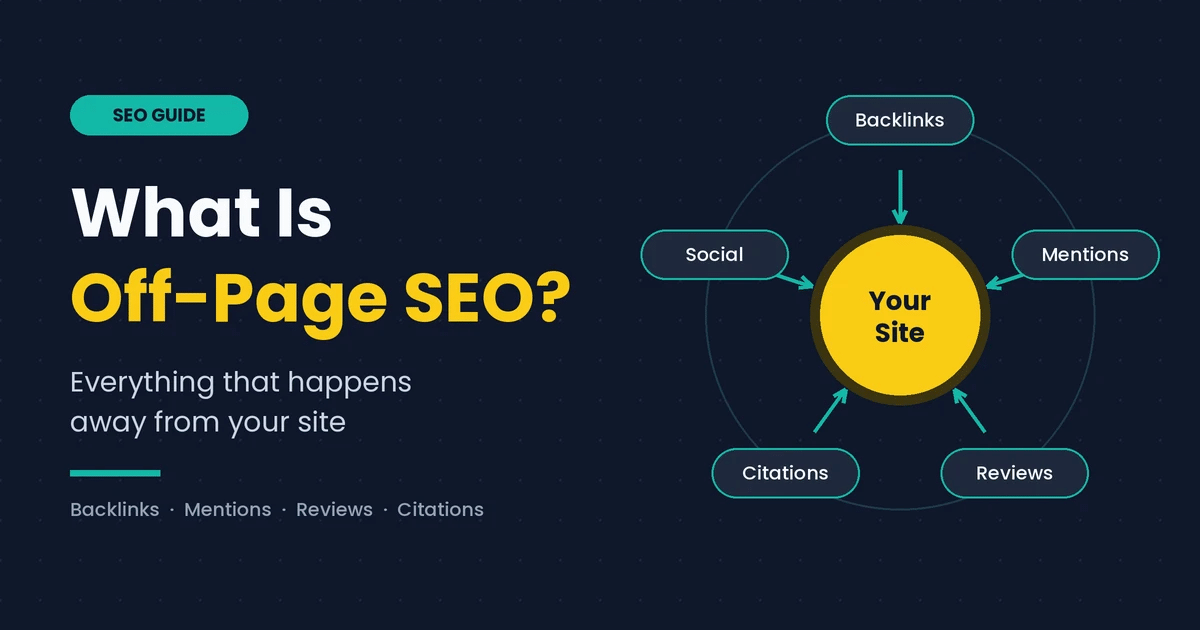
Off-page SEO covers every ranking signal that comes from outside a website: links from other sites, brand mentions, customer reviews, and business listings.
The idea behind it is simple. A site’s own pages describe what the business does. The rest of the web shows whether that business is trusted. Search engines give the second kind of evidence more weight, because it is far harder to fake.
This explains why two pages of similar quality can rank ten positions apart. One has other sites vouching for it, and the other does not.
This guide explains what off-page SEO includes, which signals carry the most weight, how those signals can be misused, and how a small site can build them on a limited budget.
Off-page vs. on-page vs. technical SEO
SEO is usually split into three areas, and off-page is the only one a site owner does not fully control.
| Type | Where it happens | What it covers | Who controls it |
| On-page | On the site’s pages | Content, titles, headings, internal links | The site owner |
| Technical | Behind the pages | Speed, crawling, indexing, mobile, security | The owner and developer |
| Off-page | On other sites | Backlinks, mentions, reviews, citations | Mostly other people |
On-page and technical work make a site worth ranking. Off-page signals are the outside proof. Links cannot rescue a weak page, and a strong page with no outside support rarely wins a competitive search.
The five off-page signals that matter
1. Backlinks
A backlink is a link from one website to another, and it remains the heaviest off-page signal. Each link acts like a vote, but the votes are not equal. One link from a respected site in the same field can outweigh hundreds from pages nobody reads.
The common ways to earn backlinks are:
- Guest posts: a useful article written for another blog, which links back to the author’s site.
- Digital PR: original data, a story, or a free tool that journalists and bloggers cite.
- Resource links: a guide that gets added to lists of recommended reading.
- Broken link replacement: a working page offered in place of a dead link on someone else’s page.
2. Brand mentions
A mention is a brand name appearing on another site, with or without a link. Search engines use mentions to understand what a brand is known for. AI answer tools rely on them as well, so brands discussed in many trusted places are more likely to be named in AI-generated answers.
3. Reviews
Reviews on Google, Trustpilot, and industry platforms influence rankings and clicks. For local businesses, the number of reviews, the average rating, and how recent they are all feed into map results. Replies to reviews, including negative ones, also help.
4. Local citations
A citation is a listing of a business name, address, and phone number on a directory or map service. The details should match everywhere. Conflicting phone numbers or addresses make search engines less confident about which version is correct.
5. Social and community activity
Social shares are not a direct ranking factor, but they have an indirect effect. Content that spreads on LinkedIn, Reddit, or X reaches writers and site owners, and some of them link to it later.
What separates a strong signal from a weak one
Four factors decide how much a link or mention is worth.
- Relevance: a link from a site in the same industry counts for more than one from an unrelated site. A dental clinic gains more from a health blog than from a car forum.
- Real audience: a site with readers who visit and click is worth more than one built only to sell links. Rankings and traffic are the quickest checks.
- Placement: a link inside the body of an article carries more weight than one in a footer, sidebar, or author box.
- Natural anchor text: the clickable words should vary between brand names, plain URLs, and descriptive phrases. One keyword repeated across fifty links looks manufactured.
Pace also matters. A new site that gains 500 links in a week attracts scrutiny, while steady growth over several months matches how real sites get discovered and referenced.
When off-page signals are used against a site
Because off-page SEO happens on sites the owner does not control, outsiders can try to manipulate it. The practice is known as Negative SEO attack, and it means a competitor or bad actor tries to push a site’s rankings down from the outside.
The usual methods mirror the signals above:
- Thousands of spam links pointed at a site, often with adult or gambling anchor text
- Fake one-star reviews on a business profile
- Content copied and republished across many low-quality sites
- Fake removal requests sent to sites that link to the target, asking them to take good links down
Search engines ignore most junk links automatically, so a few odd backlinks are rarely a problem. Small and new sites face more risk, because a flood of spam makes up a larger share of a thin link profile.
A monthly check of backlinks and reviews is usually enough. Action is only needed when a sudden spike in bad links or reviews arrives together with a ranking drop.
How to build off-page signals on a small budget
Off-page SEO has a reputation for being expensive, mostly because of paid link placements. It does not have to be. SyncCrawl explains how to run a cheap SEO campaign successfully without spending a lot, and the same thinking applies to off-page work: start with the steps that cost time, and pay only for what moves rankings.
A sensible order for a small site looks like this:
- Claim the main listings. Set up a Google Business Profile and the key directories for the industry, with the same name, address, and phone number on each.
- Ask for reviews. Send satisfied customers a direct link to the review page. A few new reviews each month is enough.
- Recover unlinked mentions. Search for the brand name, and where a site mentions it without a link, ask politely for one.
- Publish one piece worth citing. A price guide, a small study, or a clear how-to gives other writers a reason to link.
- Write for one or two good blogs a month. Choose blogs with real readers in the same field. Two solid guest posts do more than twenty weak ones.
- Review the profile monthly. Track new links, lost links, and new reviews so that problems show up early.
Frequently asked questions
Is off-page SEO just link building? No. Link building is the largest part, but mentions, reviews, and citations count as well.
How long does off-page SEO take to show results? Usually three to six months. Search engines need time to find new links and weigh them.
Can it be done without paying for links? Yes. Listings, reviews, unlinked mentions, and guest writing cost time, not money.
How many backlinks does a site need? There is no fixed number. The pages already ranking for a keyword set the benchmark, and matching the quality of their links matters more than matching the count.
Key points
Off-page SEO is a site’s reputation, measured by what other sites say about it. Links from relevant sites with real readers, consistent listings, steady reviews, and a monthly profile check cover most of the work. Sites that keep this up for six months usually see their rankings improve.