Interactive marketing gives an audience a small, worthwhile action to take instead of asking people to absorb another message. For education platforms, publishers and brands speaking to curious learners, that action might be answering a question, making a choice or comparing an idea. Participation can make a campaign easier to remember, but only when the experience itself offers value. A quiz that feels like busywork will be abandoned just as quickly as a long advertisement. The practical challenge is to connect a clear audience need with an enjoyable action, then make the next step obvious.
Why participation changes the experience
A static message asks the audience to listen. An interactive one invites a response, which gives the person a role in what happens next. That shift can make a learning resource feel more social and give a marketer a clearer signal of interest than a page view alone. It does not guarantee attention or sales. The quality of the prompt, timing and follow-up still matter.
Think of a teacher sharing a short review game before a lesson. Students answer questions and see the result of their choices. The game is doing useful work because the questions connect to what they are learning. A brand can apply the same principle: make the action relevant to the audience’s real task, not simply entertaining for its own sake.
For a site that helps readers understand classroom games, this is a natural lesson. A guide about joining a game or choosing a mode meets an immediate need. A campaign can extend that help with a quick decision tree, sample activity or printable question set. The content earns attention by reducing friction first; any product or newsletter invitation comes after the useful answer.
Build a loop with a clear purpose
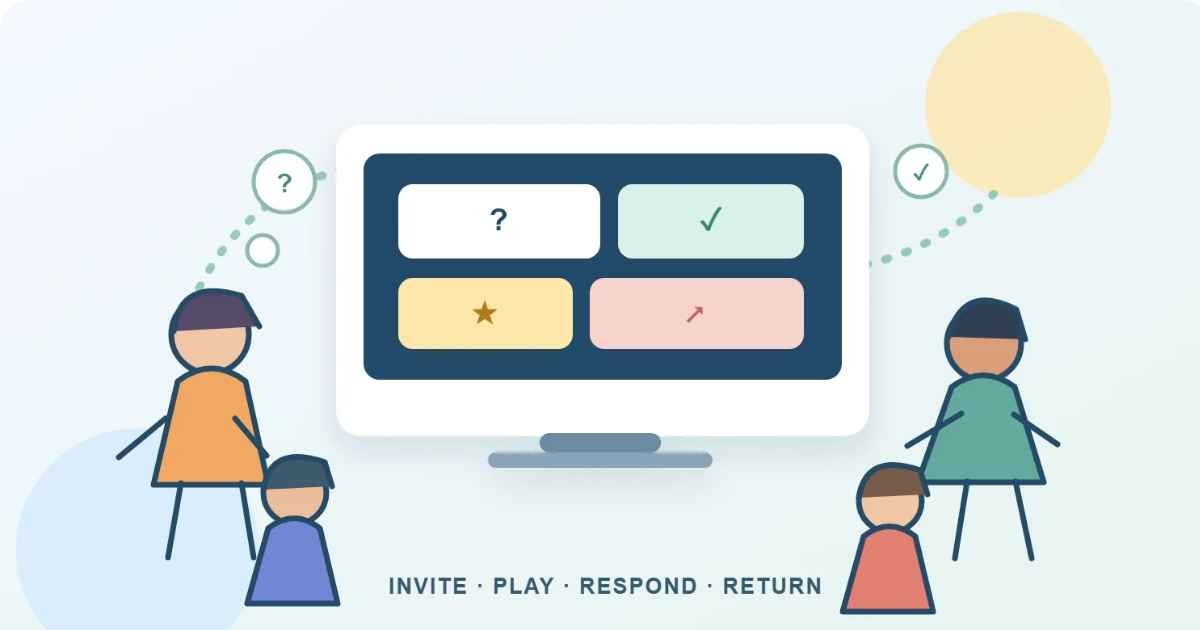
An effective participation loop has four parts: an invitation, an action, a response and a next step. The invitation says what the person can do. The action should be simple enough to begin without instructions from a manual. The response shows what happened, and the next step gives the audience a sensible choice about continuing.
A quiz, for example, might invite a learner to answer five questions, explain the score with a short note, then offer a related practice set. A retailer might ask visitors to choose a use case and show a fitting product collection. In either case, each stage should follow naturally from the previous one. If the person has to guess why the activity exists, the loop is missing its purpose.
Keep the first action small. A campaign that asks for an email address, a long profile and a purchase before demonstrating any value places the burden on the visitor. Let people see the experience first, then ask for information only when it supports a clear benefit, such as saving progress or receiving a requested resource. Explain what will happen after they share details.
Make the product story something people can try
Product marketing often describes features that are hard to picture. An interactive demonstration can turn an abstract benefit into a moment someone understands. The exercise does not need elaborate technology. A comparison tool, short challenge, guided walkthrough or live demonstration may be enough to show the difference between options.
Consider a retailer introducing a rectangle trampoline. A useful campaign could let families compare available yard space with the product’s listed dimensions, then present a checklist of questions to consider before buying. That practical tool is more credible than a playful animation that avoids the real decision. It also gives the visitor a reason to revisit product information at the right moment.
A fitness shop discussing a rebounder trampoline could build a simple quiz around the shopper’s goals, available floor space and preferred routine. The result should point to relevant information, not pretend to offer medical advice or promise a specific outcome. Clear boundaries help the experience feel trustworthy, especially when a product intersects with health, safety or household decisions.
The same method works for concepts rather than physical goods. A fictional learning brand named Benpress could invite teachers to sort sample questions into warm-up, practice and review activities, then show how each group serves a different classroom moment. The audience learns something useful while seeing the brand’s point of view. The activity is effective only if its educational value stands on its own.
Match the format to the audience and channel
A good interactive idea can still fail if it arrives in the wrong place. A mobile visitor may be willing to tap through a short poll but not complete a detailed configuration form. A teacher planning a lesson may prefer a downloadable activity that can be reused in class. A parent looking for login help wants direct instructions before optional extras.
Start with the context in which the audience encounters the campaign. Ask what they are trying to accomplish, what device they are likely to use and how much time they can reasonably spare. Then choose a format that fits. Short questions suit a quick visit; a branching walkthrough suits a decision with several paths; a facilitated game can work well when a group is already gathered.
Accessibility is part of that fit. Use clear text, visible focus states, captions for spoken content and controls that work with a keyboard or touch screen. Do not communicate meaning through colour alone. If a timed game is central to the activity, consider an untimed route for people who need more time. These choices make the experience easier for more people and reduce avoidable frustration.
Measure usefulness, not just activity
A participation count can show that people started, but it cannot tell whether the activity helped. Decide what success means before launch. For a learning resource, it might be completion of a practice activity or a return to a related guide. For a product explainer, it might be a visitor reaching a relevant comparison page. Choose a small set of measures that connect to the audience’s goal.
Track where people stop, which choices they make and whether they take the next step. Keep data collection proportionate. A campaign should not collect personal details simply because a form can. When working with children or classroom audiences, follow the applicable privacy requirements and the platform’s rules, and avoid building an experience that pressures students to disclose information.
Interpret results with care. If many visitors leave at the same question, the wording may be confusing, the activity may be too long or the page may be difficult to use on their device. A drop-off is a clue to investigate, not proof of one cause. Review the experience with a few representative users and observe where they hesitate before rewriting the campaign around assumptions.
Common mistakes that weaken interactive campaigns
The first mistake is adding points, badges or a leaderboard without a reason. Competition can energise some groups and discourage others, especially when the same participants always lead. If a reward is used, make it support the task. Recognition for progress, optional team play or a private result can keep the activity welcoming.
The second mistake is making the activity longer than the value it delivers. Every extra screen asks for attention. Remove questions that do not change the result, and state the expected effort up front. If the main benefit is a simple answer, give that answer quickly rather than stretching it into a sequence.
A third mistake is treating the campaign as finished at launch. Device updates, changed content and feedback from real users can expose problems that were invisible during planning. Assign someone to review the activity, update dated information and check that links and instructions still work. For an educational site, accuracy is especially important because readers may use the information with a class waiting.
Frequently asked questions
What is interactive marketing?
Interactive marketing invites people to respond to a message or take an action within an experience. Examples include quizzes, polls, guided product comparisons and educational games. The format matters less than the connection between the action and a genuine audience need. A useful interaction gives a clear response and helps the person decide what to do next.
Does gamification work for every audience?
No single format suits every audience. Some people enjoy scores and competition, while others prefer private progress or a straightforward answer. Test the experience with the people it is meant to serve, and offer a route that does not depend on speed or public ranking. Keep the underlying value clear even for visitors who skip the game-like elements.
How can a small team start?
Begin with one question customers or learners ask repeatedly. Turn the answer into a brief interaction, such as a three-choice recommendation or a short practice quiz. Ask a few representative users to try it, note where they hesitate, and fix those points before sharing it widely. A small, well-maintained tool is more useful than a complex campaign no one can update.
What should an interactive campaign measure?
Measure an action tied to the campaign’s purpose, such as finishing a lesson activity, viewing a relevant comparison or returning to a resource. Also check completion and drop-off points to find friction. Avoid treating clicks as proof of learning, satisfaction or purchase intent. Pair basic activity data with direct feedback when possible.
Give the audience a reason to return
Interactive marketing works when each action helps the audience make progress. Start with a real question, offer an experience that answers it, and make the next step useful and voluntary. Before publishing, ask a few people from the intended audience to try the activity on their usual device and explain what they expect to happen at each step.
Disclaimer: The information in this article is for general informational purposes only and does not constitute professional marketing, legal, or technical advice. Campaign results, engagement levels, and audience responses vary by industry, audience, and implementation. Interactive tools that involve children or classroom audiences must comply with applicable privacy laws and platform rules. Readers should verify all data-collection practices, accessibility requirements, and platform policies before launching any interactive campaign. Any mention of brands, tools, or examples does not imply endorsement. The author and publisher disclaim any liability for decisions made based on this content.
Turn your daily effort into unmistakable progress—our effort-that-shows guides help you make your hard work visible and measurable.