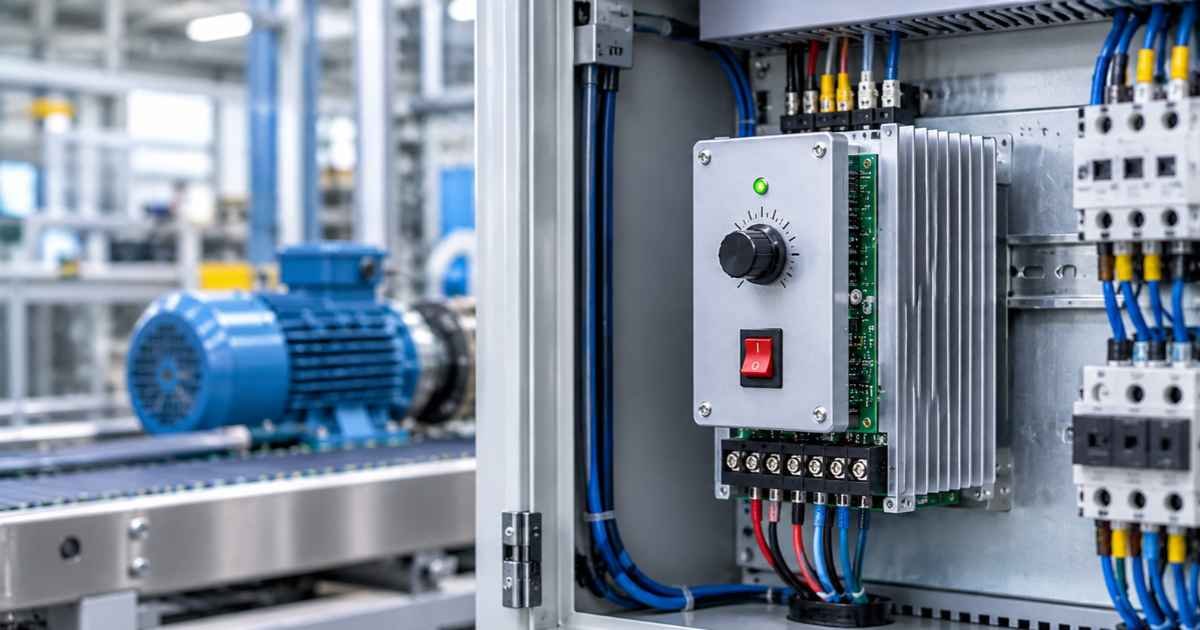
Single-phase DC drives are used in industrial applications where accurate motor speed regulation, controlled acceleration, adjustable torque, and reliable operation are required. From conveyors and winding equipment to machine tools, material handling systems, and production machinery, selecting the right drive is essential for maintaining process efficiency and protecting the motor from unnecessary electrical and mechanical stress.
Selecting a suitable single-phase DC drive includes more than matching the controller to the motor’s voltage and current ratings. Engineers must also consider the motor type, operating speed range, load characteristics, braking requirements, control signals, and whether the application needs regenerative braking.
Knowing these factors helps identify a suitable DC motor speed controller for both new installations and replacement projects involving existing DC motors.
Single-Phase DC Drive
A single-phase DC drive is an electronic motor control system that converts single-phase AC input power into a controlled DC output in order to regulate the speed and torque of a DC motor. Unlike a motor that is connected directly to a fixed DC supply, a DC drive adjusts the armature voltage or field current to control motor performance according to the operating requirements.
In industrial environments, single-phase DC drives are commonly used where a three-phase electrical supply is unavailable, where equipment operates at relatively modest power levels, or where existing DC machinery needs adjustable speed control.
Most conventional single-phase DC drives are controlled by rectification, typically with thyristors, to vary the DC voltage supplied to the motor armature. Other designs use switching-based control techniques, depending on the drive architecture, power rating, and application.
The drive may also include current limiting, ramp acceleration, controlled deceleration, feedback regulation, and protection against electrical faults.
Key Factors to Consider When Selecting a DC Motor Speed Controller
Choosing a suitable DC motor controller requires evaluating the motor, supply, load, and operating conditions together. A drive that works well for a lightly loaded polishing machine may not be appropriate for a conveyor with high starting torque or a machine that needs frequent braking.
1. Motor Voltage and Current
The first step is to identify the motor’s rated armature voltage, full-load current, field voltage, and field current, where applicable.
The selected controller must support the motor’s operating voltage and continuous current requirements. It should also provide sufficient short-term current capacity to manage acceleration and load transients without exceeding the motor’s permissible current or thermal limits.
Control size should account for the motor’s actual load, overload duration, ambient temperature, cooling, and the derating guidance from the manufacturer. Matching only the voltage rating can lead to drive trips, overheating, or unreliable operation.
2. Speed Range and Regulation Accuracy
Industrial machinery often needs different operating speeds for production, setup, material feeding, or process adjustment.
A suitable DC motor speed controller should provide the required speed range while maintaining stable operation under changing loads. Applications including accurate positioning, consistent material feed, or controlled winding tension may need closed-loop speed feedback.
Engineers should evaluate:
- Minimum stable operating speed
- Maximum rated motor speed
- Speed regulation under changing loads
- Available speed reference inputs
- Feedback compatibility
- Field weakening capability, if higher-than-base speeds are needed
3. Starting Torque and Acceleration Control
High starting current is a common consideration in DC motor applications. When the motor is stationary, back EMF is effectively zero, so direct application of rated voltage can result in excessive armature current unless it is limited by the circuit.
A drive with adjustable acceleration ramps and current limiting can control the motor’s starting behaviour. Instead of reaching operating speed immediately, the controller increases the output gradually over a configured period.
This is particularly useful in:
- Conveyor systems carrying variable loads
- Industrial winding and unwinding equipment
- Packaging machinery
- Machine tools
- Mechanical systems with high inertia
4. Control Signals and System Integration
The drive should also be configured with the machine’s existing control system. Depending on its design, a controller may support a potentiometer, analogue voltage input, digital inputs, enable signals, direction control, or external speed references.
For automated machinery, integration with PLCs and other control equipment is an important consideration. The drive’s available inputs and outputs should also support the required start/stop logic, speed commands, fault signals, and interlocking functions.
Single-Phase vs. Regenerative DC Drive
During braking, not all drives operate in the same way. Conventional non-regenerative drives mainly control power flowing from the supply to the motor, while regenerative systems can return electrical energy generated during braking to a designated power source.
A regenerative DC drive is useful in applications where the motor frequently decelerates, drives an overhauling load, or operates in situations where braking energy can be recovered rather than dissipated in the form of heat.
| Feature | Conventional DC Drive | Regenerative DC Drive |
| Power flow | Mainly supplies to the motor | Can support power flow from motor back to supply |
| Braking | Coasting, mechanical braking, or electrical braking depending on design | Electrical braking with energy regeneration where supported |
| Energy handling | Braking energy may be dissipated or managed externally | Braking energy can be returned to the supply |
| Application suitability | General variable-speed motor control | Frequent deceleration, reversing, or overhauling loads |
| System complexity | Generally simpler | More complex power electronics and supply requirements |
Regeneration is not available simply because a motor slows down. The controller must be designed for regenerative operation, and the supply system must be capable of accepting returned energy. Some single-phase drives use specialised regenerative arrangements, while others need a braking limiter or an alternative method in order to handle the whole energy.
Common Mistakes Businesses Made While Choosing a DC Drive
Choosing a drive based on voltage and price alone can create operational problems. Some of the most common mistakes you should that most buyers across the UK make are following:
- Undersizing the drive: A controller with insufficient current capacity may trip during acceleration or sustained operation.
- Ignoring motor field requirements: Field supply and field control requirements can differ between permanent-magnet, shunt-wound, and separately excited motors.
- Overlooking load inertia: High-inertia machinery needs longer acceleration and deceleration ramps or an additional braking mechanism.
- Selecting an unsuitable speed range: The required minimum and maximum operating speeds must be compatible with motor cooling, torque characteristics, and mechanical limits.
- Ignoring braking requirements: Applications that involve regular stops or driven loads may need dynamic braking, regenerative braking, or a different braking arrangement.
- Failing to check compatibility: Existing wiring, feedback devices, control signals, supply characteristics, and protection arrangements must be suitable for the replacement drive.
How to Choose the Right Single-Phase DC Drive for Industrial Applications
The correct drive depends on how the motor operates, the type of load it handles, and the level of control required. A practical selection process should include the following checks before buying or replacing a controller.
| Parameter for Selection | What to Check |
| AC input supply | Single-phase voltage, frequency, and supply compatibility |
| Motor rating | Armature voltage, current, power, and field requirements |
| Load characteristics | Constant torque, variable torque, inertia, and initial starting load |
| Speed requirements | Minimum, maximum, and operating speed range |
| Acceleration | Required ramp time and starting current limits |
| Braking | Coasting, dynamic braking, or regenerative braking |
| Feedback | Open-loop or closed-loop speed control |
| Installation | Panel space, cooling, ambient temperature, and wiring |
| Protection | Overcurrent, overload, field loss, and other available protections |
For replacements, it is specifically important to compare the original drive’s specifications with the replacement controller’s electrical ratings, control functionality, feedback requirements, and terminal configuration. Similar voltage and current ratings automatically guarantee compatibility.
Get the Right DC Motor Speed Controller
Selecting a suitable drive can improve motor control, simplify machine operation, and reduce mechanical stress associated with uncontrolled starting and stopping. However, the controller must be matched to the motor and application rather than selected mainly on its rated power.
If an installation needs a standard single-phase DC drive for adjustable speed operation or a regenerative DC drive for energy recovery during braking, understanding the motor’s electrical characteristics and operating requirements is the starting point.
For industrial replacement projects, Industrial Motor Warehouse offers a range of motor control solutions that are worth evaluating based on the required voltage, speed regulation, current, and braking functionality. Reviewing the drive’s technical specifications and capabilities with the existing motor can help engineers identify a controller suited to the application without unnecessarily redesigning the control system of the machine.
The most effective drive selection balances electrical compatibility, reliable speed regulation, load handling, control functionality, and the practical requirements of industrial operation.
Disclaimer: The information in this article is for general informational purposes only and does not constitute professional, technical, or engineering advice. Drive specifications, motor compatibility, performance, and safety requirements vary by equipment, application, and manufacturer, and may change without notice. Readers should verify all electrical ratings, compatibility details, and installation requirements directly with the manufacturer or a qualified electrical engineer before selecting or installing any drive. Incorrect selection or installation can damage equipment or create safety hazards. Any mention of specific products or suppliers does not imply endorsement. The author and publisher disclaim any liability for decisions made based on this content.
Turn your quiet hours into your most productive ones—our focus-ritual guides help you create the conditions for deep, meaningful work.