You just saw Blooket flash across a school Chromebook screen, and now you have to say the word out loud to a room of thirty students who are watching. The spelling is strange enough to freeze anyone. Is it Bloo-ket, Blook-ay, Blue-cket, or something else entirely? The short answer is BLOO-kit, said the same way you would say the color blue followed by a short kit. That is the technical pronunciation Blooket itself confirms on the official help site, and it beats every other version circulating on TikTok and teacher forums. This independent guide breaks the word down sound by sound, shows you why the common mistakes happen, and gives you a memory trick that sticks after one try.
What is the correct pronunciation of Blooket?
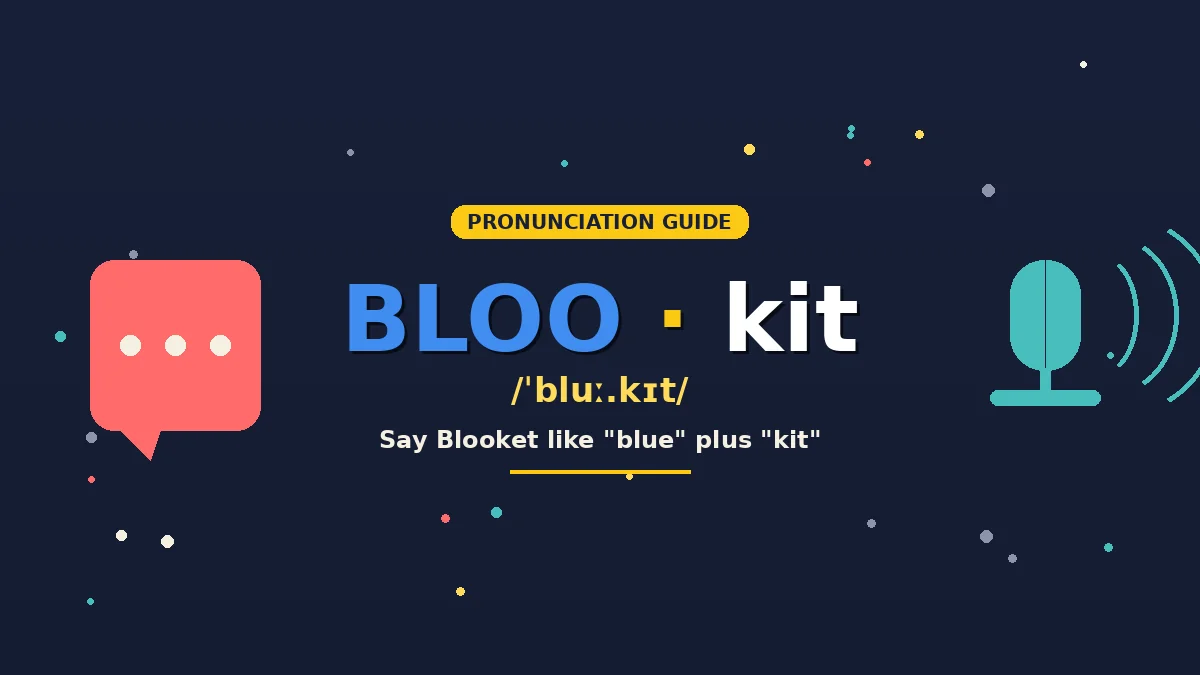
The correct pronunciation of Blooket is BLOO-kit, two syllables, with the stress on the first syllable and a short “i” sound in the second. In phonetic notation, that is /ˈbluː.kɪt/. The first syllable rhymes exactly with the color “blue”, and the second sounds like the “kit” in “first-aid kit” or the last syllable of “market”.
The official pronunciation confirmed by Blooket
The Blooket support site has a short article titled “How to Pronounce Blooket” that resolves the debate directly. It states that the technical pronunciation is “Blue-kit”, while noting that the team is relaxed about how players actually say it in practice.
Since this comes straight from the platform’s own help centre, it settles the question with the highest authority available. Any competing pronunciation heard on TikTok or in a classroom is a variation, not the technical version.
The phonetic breakdown, sound by sound
Here is what your mouth is actually doing across the two syllables:
| Syllable | Sounds like | What your mouth does |
|---|---|---|
| BLOO | The colour “blue” | Lips rounded and slightly pushed forward, tongue flat, voiced “b” flowing into “l” and a long “oo” |
| kit | The word “kit” | Lips relax, tongue lifts to the roof for a soft “k”, short “i” as in “sit”, clean “t” at the end |
The vowel in the second syllable is the short /ɪ/, the same sound you make in “sit”, “hit”, and “market”. It is never a long “e”, never a long “a”, and never a schwa dragged into “-uh”.
How the stress pattern works
Stress on the first syllable is what makes the word sound natural in English. Say BLOO louder and slightly longer than kit, and the whole word snaps into place. If you flatten both syllables to the same volume, the word starts to sound robotic. If you push the stress onto the second syllable, it starts to sound French.
A good comparison word is “market”. You say MAR-kit, not mar-KIT. Blooket follows the same rhythm.
How to say Blooket step by step
To pronounce Blooket cleanly, start with the colour “blue”, add a short “kit”, blend the two without a pause, and let the first syllable carry the stress. The whole process takes about ten seconds to practise and about three attempts to lock in for good. Below is the exact drill that works with both adults and students in classrooms.
Step 1: start with “blue”
Round your lips as if you are about to whistle a note, keep your tongue flat behind your lower teeth, and say the colour “blue” out loud. Hold the “oo” for a beat.
This gives you the entire first syllable, BLOO, with the right lip shape and vowel length already in place.
Step 2: add “kit”
From the “blue” position, relax your lips, lift the back of your tongue to the roof of your mouth to make a soft “k”, drop into a short “i” as in “sit”, and finish with a clean “t”. You should feel your tongue tap once behind your upper front teeth.
The whole syllable should feel snappy and short, closer to the “kit” in a first-aid kit than any drawn-out sound.
Step 3: blend with stress on the first syllable
Connect the two syllables with no gap between them: BLOO-kit. Make the first syllable louder and a touch longer. The second syllable is quick and almost quiet, the way the second syllable in “basket” or “pocket” works in normal speech.
If you catch yourself saying “bloo-KIT” with the stress at the end, back off and try again with more energy on the first syllable.
Step 4: say it out loud three times
Record yourself saying “basket”, “blue”, and “Blooket” in order, then play it back. If Blooket lands with basket’s rhythm and blue’s vowel, you have it.
Do this in front of a mirror once, then in a normal speaking voice, then quickly at conversational pace. Three passes are enough for the word to feel natural before a class or a video call.
Why do people mispronounce Blooket?
People mispronounce Blooket because the spelling looks like more familiar English words that follow different pronunciation rules, and because brand names built from invented word parts do not have obvious phonetic anchors. The three most common wrong versions are “Blue-ket”, “Blook-ay”, and “Buh-loo-ket”, and each one comes from a specific pattern the brain applies by default.
The “bucket” trap
The single most common mistake is saying “Blue-ket” with a stressed second syllable that sounds like “bucket”. English speakers see “-ket” and reach for the closest familiar rhyme, which is bucket, socket, or docket.
The fix is to override the visual pattern with a sound-based one. Say “blue” out loud, then “kit” out loud, then run them together. Once you hear the correct version, the “bucket” pattern loses its grip fast.
The French-style “-ay” ending
Some people try “Blook-ay” because the “-et” ending looks French, in the same way “buffet” or “ballet” ends in a silent “-t” and a long “-ay”. Blooket is not French. The company behind it operates in the United States, and the word is a made-up brand name rather than a loan word.
The final “t” is fully pronounced. The vowel before it is short. Neither behaves like a French word.
The three-syllable overpronunciation
A small number of speakers land on “Buh-loo-ket”, stretching the “bl” cluster into a full extra syllable. This tends to happen when someone is reading the word slowly for the first time and overarticulating each letter.
The fix is to treat “bl” as a single blended sound at the start of one syllable, exactly the way you say “blue”, “black”, or “blast” without inserting a vowel between the “b” and the “l”.
How to teach Blooket pronunciation in the classroom
The fastest way to teach Blooket pronunciation is to model the word once with the “blue plus kit” trick, run a quick call-and-response with the class, and play a short clip of the official audio so students hear the target from more than one voice. Kids lock in on a pronunciation within a lesson or two when the anchor image is concrete and the correction happens the moment a mistake slips out.
The “blue plus kit” memory trick
Ask students to picture something blue and something small in a kit. Then have them say the two words separately: “blue”, “kit”. Then say them together: “BLOO-kit”.
The visual pairing is what makes it stick. In my own classroom rounds, students who cannot remember an abstract phonetic explanation still remember “blue plus kit” a week later, because the image is doing the memory work.
Call-and-response opener before every session
Before you host a Blooket game, run a five-second ritual:
- Teacher: “How do we say it?”
- Class: “BLOO-kit”
Repeated across the first week of using the platform, this shuts down mispronunciation before it has a chance to spread. It also sets the same expectation for substitute teachers and student teachers who join later in the year.
Use the official audio from Blooket
The Blooket team includes an audio pronunciation on the platform’s home page and support site. Playing that audio once in class means students hear the target from the brand itself, not just from you.
For younger grades, this is worth doing every time you introduce the game for the first time in a lesson block. It removes any suspicion that the teacher’s version is a personal preference rather than the official one.
Correct gently and specifically the moment it slips
When a student says “Blue-ket” during a session, do not respond with a vague “close” or “not quite”. Say the specific fix: “The second part is kit, like a first-aid kit. Try BLOO-kit.”
Specific correction with a real reference word beats general encouragement every time. The correction takes three seconds, does not embarrass the student, and prevents the same error from being echoed by the next child who was listening.
Blooket vs similar edtech names
Edtech brand names cluster around a few sound patterns, and Blooket sits in a family of “kit” and “let” endings that trip up new users across the whole category. Once you can hear the pattern, saying the neighbours correctly becomes easier too.
| Platform | Correct pronunciation | Common mistake |
|---|---|---|
| Blooket | BLOO-kit | Blue-ket |
| Quizlet | KWIZ-lit | KWIZ-let with a long e |
| Gimkit | GIM-kit (hard g) | JIM-kit |
| Kahoot | Kuh-HOOT | KAY-hoot |
| Quizizz | KWIZ-iz | KWIZ-eye-zz |
The shared thread across Blooket, Gimkit, and Quizlet is the short “i” or “-kit” ending. Once your ear tunes to that pattern, you stop pushing the second syllable into a long vowel and the whole set of brand names starts sounding natural at classroom speed.
Common myths about Blooket pronunciation
Four myths circulate on teacher forums and social feeds, and each one nudges people toward the wrong version. It is worth naming them so you can spot them fast when a colleague or student repeats one.
Myth: pronunciation does not really matter
It matters less than the marketing version of this argument suggests, and more than the “just say it any way” version suggests. Students who search for the platform online after class type what they hear, and typing “blue-ket game” leads to noisier search results than typing what the brand itself uses.
The middle-ground answer is that using the technical pronunciation makes you easier to follow, and being relaxed about a student’s variation on the spot is fine.
Myth: both pronunciations are equally acceptable
They are not equally correct, but Blooket itself is famously chill about the topic. The support page explicitly says people can say it however they like while confirming the technical version is “Blue-kit”.
Read as a whole, that is not “anything goes”. It is “here is the right one, and we are not going to police you if you use another”. In a classroom the right one is worth teaching.
Myth: the final “t” is silent
The final “t” is fully pronounced. This myth comes from readers assuming French-style silent endings apply, in the way they do to “buffet” or “ballet”. Blooket does not follow that pattern.
Say it the way you say the “t” in “market” or “pocket”, short and clean at the end of the syllable.
Myth: it is spelled differently on purpose to sound different
The unusual spelling comes from the platform’s naming convention around “Blooks”, the collectible characters that anchor the whole Blook rarity system. The extra “o” is a stylised nod to that character system, not a pronunciation cue.
The spelling is unusual on the page and standard in the ear. Once you know that, the surprise disappears.
Where Blooket the word actually comes from
The name Blooket is a portmanteau built around “Blook”, the term the platform uses for its cartoon-avatar characters that players collect. Adding the “-et” suffix creates a small, familiar sounding brand name in the tradition of Quizlet, Gimkit, and other education-tech products with clipped, catchy endings.
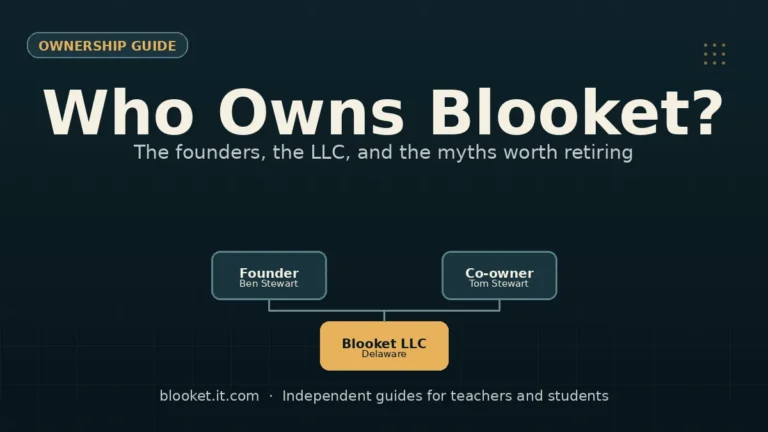
The Stewart brothers, who launched Blooket, chose the name to sit alongside the Blook mascots that would drive the collection loop across every game mode. You can read more on this in our Blooket origin and launch history and our guide on who owns Blooket, both of which cover the founders and early product decisions.
Knowing the etymology helps the pronunciation stick, because the word is not borrowed from another language. It was built in English, so it follows English stress and vowel rules by default.
FAQs
Is Blooket pronounced Blue-ket or BLOO-kit?
Blooket is pronounced BLOO-kit, with the stress on the first syllable and a short “i” in the second, not “Blue-ket” with a bucket-style ending. The official Blooket support page confirms this by describing the technical pronunciation as “Blue-kit”.
Where can I hear the official Blooket pronunciation?
The Blooket support site includes a short article on how to pronounce the name, and the platform’s home page has an audio play icon that plays the pronunciation aloud. Both sources give the same version, so you can use either one to check your own attempt.
Is the “t” at the end of Blooket silent?
The final “t” in Blooket is fully pronounced, not silent. This confusion usually comes from readers assuming a French-style silent ending like “buffet” or “ballet”. Blooket is an English-language brand name, and the “t” is clean and audible at the end of the second syllable.
How do you pronounce Blooket in British English?
British English speakers say Blooket the same way as American English speakers, using BLOO-kit with a short “i” in the second syllable. The vowel qualities, the stress pattern, and the ending “t” are identical across both accents, with only a very slight difference in how crisp the final consonant sounds.
How do you teach students to pronounce Blooket without embarrassing them?
Model the “blue plus kit” trick once, run a short call-and-response so the whole class practises together, and correct individual students privately with a real reference word like “market” or “kit”. Group practice removes the spotlight, and specific fixes prevent repeated errors from spreading through a class.
Why is Blooket spelled with two “o” letters?
The double “o” reflects the platform’s core mascots, the “Blooks”, which are the collectible characters students earn while playing. The spelling is a stylised extension of that word into a brand name and does not change how it sounds. In speech, the “oo” is simply the long vowel in “blue”.
Does mispronouncing Blooket cause any actual problems?
It causes small problems, not big ones. Students who hear a different version and then search for the platform can end up on incorrect sites, and a mismatched pronunciation across colleagues can make instructions harder to follow. Neither issue is severe, but both are avoidable with a quick group correction.
Final thoughts on saying Blooket correctly
The word Blooket is BLOO-kit, two syllables, stress on the first, short “i” in the second, and the final “t” fully pronounced. That version comes directly from the platform’s own support material, so you can teach it with full confidence in front of any class or colleague. The “blue plus kit” trick is the fastest anchor for both adults and students to memorise it in one try.
Say it out loud three times right now, teach one student or teammate the same trick, and move on. If you are new to the platform itself, our full guide on how to play Blooket and our walkthrough on joining a game with a code will get you from the correct pronunciation to a working classroom session in about five minutes.
Break free from the ordinary — uncover unique strategies that actually work.