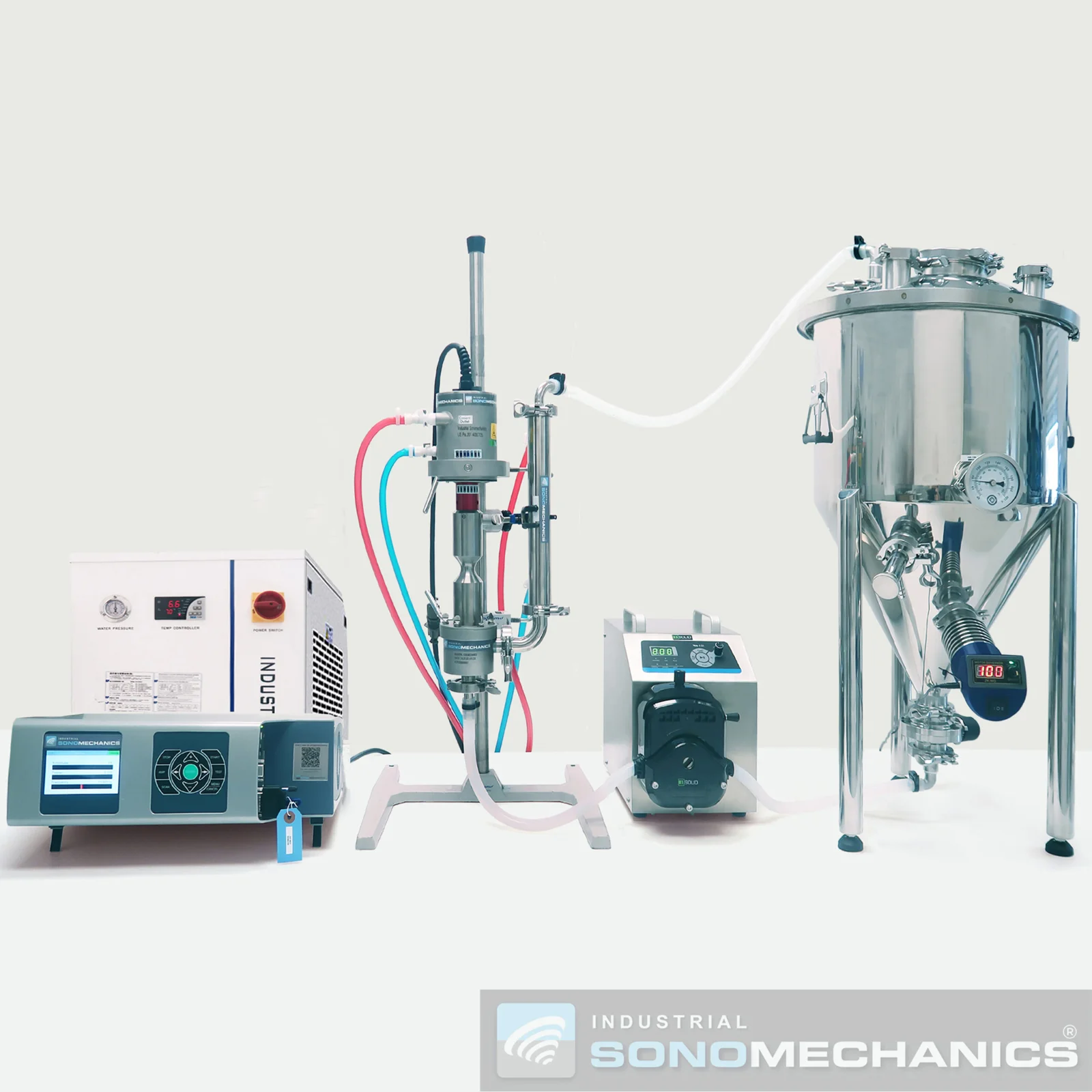
Scaling ultrasonic processing from lab experiments to industrial production is a critical step in moving from concept validation to commercial manufacturing. While ultrasonic systems perform reliably at bench scale, many projects fail during scale-up, not because the technology is unsuitable, but because key engineering parameters are not consistently maintained when moving from batch laboratory conditions to pilot and continuous industrial systems.
For R&D teams and process engineers, this transition is one of the highest-risk phases in process development. A formulation or process that performs well in a controlled laboratory environment can lose efficiency, reproducibility, or product quality when scaled, leading to repeated pilot trials, increased development costs, and delayed commercialization timelines.
In industries such as emulsification, extraction, cell disruption, and advanced material processing, scale-up inefficiencies often translate directly into lost R&D investment and extended time-to-market. This is why ultrasonic processor scale-up must be treated as a controlled engineering translation, not an equipment upgrade.
When properly engineered, ultrasonic systems demonstrate strong scalability across multiple industries, maintaining consistent cavitation behavior and process performance from lab scale through pilot and full production.
Here’s how ultrasonic scale-up works in industrial processing:
Below is a practical engineering breakdown of how ultrasonic systems transition from lab-scale validation to industrial production while maintaining performance consistency and reducing scale-up risk, cost overruns, and process failure probability.
1. Lab-Scale Processing and Scale-Up Gap Risk
At the lab scale, ultrasonic processors operate in small batch volumes using probe-based sonicators. These systems are widely used for feasibility testing, formulation optimization, and early-stage process validation.
Lab-scale systems provide:
- strong localized cavitation
- precise control over exposure time
- fast iteration of process parameters
However, this environment does not replicate industrial realities such as:
- continuous flow behavior
- heat accumulation in larger volumes
- non-uniform energy distribution in scaled geometries
- variable raw material behavior across batches
This creates a critical scale-up gap where successful lab results are incorrectly assumed to translate directly into pilot or production systems. In practice, this gap is one of the leading causes of delayed commercialization and repeated process redevelopment.
2. Energy Density as a Commercially Critical Parameter
The most important factor in ultrasonic scale-up is maintaining consistent energy density rather than simply increasing total power.
Energy density determines how much ultrasonic energy is delivered per unit volume, directly controlling cavitation intensity and process effectiveness.
At an industrial scale:
- Insufficient energy density leads to incomplete processing, reduced yield, and inconsistent product quality.
- Excessive energy density increases thermal load, accelerates equipment wear, and reduces system efficiency.
In real production environments, maintaining stable energy density is essential because flow rates, viscosities, and formulation properties often fluctuate between batches and operating conditions.
Failure to control this parameter properly often results in:
- failed pilot trials
- inconsistent product performance
- increased reprocessing or batch rejection costs
3. Amplitude Control and Process Reproducibility
Amplitude defines the vibration intensity of the sonotrode tip and directly influences cavitation strength.
At the lab scale, the amplitude is often fixed. At an industrial scale, it must be actively controlled based on:
- changing flow rates
- viscosity variations
- continuous production loads
Incorrect amplitude control during scale-up can result in:
- Unstable cavitation zones.
- Reduced process reproducibility across batches.
- Unnecessary energy consumption without performance gain.
- Accelerated equipment fatigue over long production cycles.
Proper amplitude tuning ensures that ultrasonic energy remains effective and consistent across variable industrial conditions, which is essential for reproducible manufacturing outcomes.
4. Flow Rate, Residence Time, and Throughput Efficiency
At an industrial scale, ultrasonic processing transitions from batch systems to continuous flow operation, making flow rate a critical engineering variable.
Flow rate determines residence time, the duration the material is exposed to ultrasonic energy.
If the flow rate is too high:
- Insufficient exposure reduces conversion efficiency and process performance
If the flow rate is too low:
- throughput decreases, increasing the cost per unit of production
In real industrial systems, engineers must balance:
- flow rate
- ultrasonic power
- reactor or chamber volume
This balance directly impacts production efficiency, yield consistency, and overall cost-effectiveness of the process.
Incorrect residence time design is a common cause of underperformance in pilot-scale systems, even when lab results are strong.
5. Horn (Sonotrode) Design and Scale-Up Failure Prevention
Horn design is one of the most critical and frequently underestimated factors in ultrasonic scale-up success.
While lab systems use simple probe horns, industrial systems require engineered geometries designed to ensure:
- uniform energy distribution across larger processing volumes
- stable cavitation zones under continuous operation
- thermal stability during long production cycles
Poor horn design is a leading cause of scale-up failure, even when power, frequency, and amplitude are correctly specified.
Industrial configurations typically include:
- flow-through sonotrodes
- multi-horn systems for distributed energy delivery
- modular scaling architectures for throughput expansion
Correct horn design ensures process stability and reduces the risk of costly redesign during pilot or production phases.
6. From Process Validation to Commercial Production Confidence
When properly scaled, ultrasonic systems provide a more predictable and linear transition from lab to production compared to many chemical or thermal processing technologies.
This is because ultrasonic processing is governed primarily by controllable physical parameters such as:
- energy density
- amplitude
- flow rate
- cavitation intensity
In industrial applications such as emulsification, extraction, and cell disruption, successful scale-up directly impacts:
- production yield consistency
- operational efficiency
- batch-to-batch reproducibility
- time-to-market for new products and formulations
For example, in processes aligned with ultrasonic cell lysis, poor scale-up control can result in incomplete cell disruption, requiring additional processing cycles and increasing overall cost per batch. Conversely, correctly engineered scale-up reduces reprocessing needs and improves process reliability across continuous production systems.
Ultimately, successful scale-up is not just a technical milestone—it is a commercial risk-reduction step that determines whether a process becomes economically viable at industrial scale.
Bottom Line
Scaling ultrasonic processing from lab to industrial production is a controlled engineering challenge that directly determines commercial success or failure.
Most scale-up issues do not originate from limitations in ultrasonic technology itself, but from inconsistent control of critical parameters such as energy density, amplitude, flow rate, and horn design during transition from lab to pilot and production systems.
When these parameters are properly engineered and maintained, ultrasonic systems demonstrate strong scalability across a wide range of industrial applications, including emulsification, extraction, and cell disruption, while maintaining consistent performance and predictable outcomes at scale.
For R&D teams and process engineers, ultrasonic processing provides a reliable pathway from laboratory validation to commercial production—reducing scale-up risk, minimizing development cycles, and improving overall process efficiency when engineering principles are correctly applied.
Disclaimer: The information provided in this article is for general informational and engineering guidance purposes only and does not constitute professional process engineering, manufacturing, or safety advice. Scaling up ultrasonic processing involves complex physical and chemical factors that vary by application and material. Readers should consult qualified engineers and conduct pilot trials before implementing full-scale production. The mention of specific equipment, configurations, and applications is illustrative and does not guarantee performance. The author and publisher disclaim all liability for process failures, equipment damage, or financial losses arising from reliance on this content. Always follow industry safety standards and validate processes under actual operating conditions.
Want better results? Copy the methods inside our result-driven playbooks today.