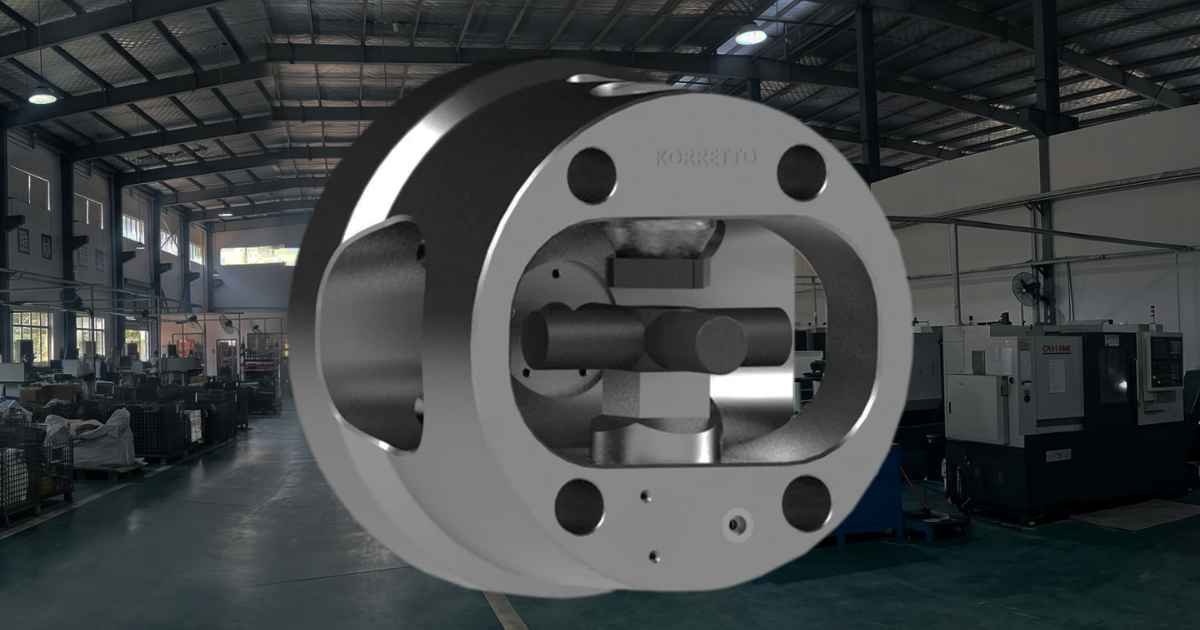
Indexing chucks allow manufacturers to machine multiple faces or angular positions of a component without repeatedly removing, repositioning and realigning the workpiece. They are commonly used for valves, pipe fittings, cross joints, shafts and other components that require accurate machining at several rotational positions.
Korretto has produced hydraulic indexing chucks for many years. The existing system is technically mature and delivers stable indexing accuracy in demanding CNC machining applications. However, experience from actual customer projects has also revealed several limitations associated with conventional hydraulic indexing designs. After three years of development, Korretto has completed a new electric indexing chuck designed to provide programmable indexing, self-centering clamping, real-time process monitoring and simpler machine installation. The product is scheduled to enter mass production and become commercially available in August 2026.
Limitations of Conventional Hydraulic Indexing Chucks
A hydraulic indexing chuck remains an effective solution when a component has a fixed and repeated angular machining requirement. Common configurations include eight positions at 45-degree intervals or six positions at 60-degree intervals.
A chuck can also be specially manufactured for a non-standard angle. However, once its mechanical indexing configuration has been produced, it remains dedicated to that angle. If the workpiece or machining process changes, a different chuck or a major mechanical modification may be required.
This limitation can become increasingly important in high-mix and low-volume production. Manufacturers may need to process different components on the same machine, with each component requiring a different number of positions or different indexing angles.
Traditional hydraulic indexing chucks may also have limitations in their clamping arrangement. In the existing design, the lower jaws perform the rotational indexing function while the upper jaws move downward to clamp the workpiece. This configuration is reliable for suitably designed components, but it does not provide self-centering clamping.
Installation is another important consideration. A hydraulic indexing chuck requires multiple hydraulic circuits to control clamping, release, indexing and locking functions. A hydraulic distributor or rotary union must normally be installed at the rear of the spindle, and modifications may be required to the machine tool’s hydraulic system.
The additional hydraulic components increase installation work and may make retrofitting more difficult, particularly when the available space behind the spindle is limited.
Electrically Driven Clamping and Indexing
The new Korretto electric indexing chuck replaces the hydraulic clamping and indexing functions with an electrically driven system.
Instead of being restricted to mechanically fixed increments, the chuck supports programmable indexing to arbitrary specified angles within its operating range. Operators can set the required angle according to the component and machining process without ordering a new fixed-angle chuck for every application.
This provides greater flexibility for manufacturers processing different component families or frequently changing production requirements.
The electric system controls both workpiece clamping and rotational positioning. Indexing parameters can be adjusted through an application installed on a compatible mobile phone or tablet.
Self-Centering Workpiece Clamping
The new chuck uses a self-centering jaw movement during clamping. The jaws move together to locate and clamp the workpiece around the chuck centre.
Self-centering operation reduces the limitations of the previous upper-and-lower jaw arrangement and makes the chuck suitable for a wider range of rotationally symmetrical and regularly shaped components.
It can also simplify loading during manual production and automated machine-tending applications because the workpiece does not need to be positioned against a single fixed lower jaw in the same way as the previous design.
Adjustable Clamping Force
Different workpieces require different clamping forces. A heavy steel component may require high holding force, while a thin-wall or easily deformed part may need a lower and more carefully controlled force.
Through the application interface, the operator can set the clamping force according to the workpiece material, geometry and machining load.
This allows one chuck to support a broader range of components while reducing the risk of using unnecessarily high force on parts that may deform during clamping.
Real-Time Monitoring
The electric indexing chuck is designed to monitor both clamping and indexing throughout the operating process.
The system can provide real-time feedback on clamping force and rotational position. This allows the control system or operator to confirm that the workpiece has been clamped correctly and that the chuck has reached the specified indexing angle before machining begins.
Monitoring these functions is particularly useful in automated production, where there may be no operator continuously observing the loading, clamping and indexing sequence.
Process feedback can also help identify abnormal conditions earlier, reducing the risk of machining at an incorrect angular position or with insufficient clamping force.
Mobile and Tablet Application Control
The accompanying application provides a direct interface for setting the main operating parameters of the chuck.
Depending on the machining process, operators can configure:
- Clamping force
- Indexing angle
- Indexing sequence
- Time interval between indexing operations
- Other operating parameters required for the production cycle
The settings can be changed using a compatible mobile phone or tablet. This removes the need to mechanically rebuild the indexing mechanism whenever a different angle is required.
It also makes process adjustment easier during initial setup, testing and small-batch production.
Simplified Machine Installation
The new electric indexing chuck connects directly to the machine tool spindle.
It does not require an external hydraulic cylinder, a rear-mounted hydraulic rotary distributor or support from the machine’s hydraulic system. This reduces the number of additional mechanical and hydraulic components required during installation.
Simplified installation can make the system easier to integrate with new CNC machines and more practical for retrofitting existing equipment.
The design also avoids extensive modifications to the machine tool’s hydraulic circuits, reducing installation complexity and the amount of space required behind the spindle.
Supporting Flexible CNC Production
The development of the electric indexing chuck reflects the changing requirements of CNC production.
Manufacturers increasingly need to process smaller batches, more product variants and components with different angular features. A fixed-angle hydraulic indexing chuck remains effective for stable, long-running production, but it is less adaptable when indexing requirements change frequently.
By combining programmable angles, adjustable clamping force, self-centering jaws, real-time monitoring and application-based control, the new Korretto chuck is intended to support more flexible production environments.
The system is particularly relevant to components requiring multiple angular machining positions while maintaining consistent clamping and positioning within a single setup.
Korretto plans to begin mass production of the electric indexing chuck in August 2026. Additional product specifications, available chuck sizes and machine integration information will be released as the product approaches commercial availability.
Disclaimer: The information provided in this article is for general informational and technical awareness purposes only. It does not constitute professional engineering, manufacturing, or purchasing advice. Product specifications, features, availability, and performance characteristics are based on the manufacturer’s published information and may change before commercial release. Readers should verify all technical details directly with Korretto or authorized distributors before making any equipment decisions. The author and publisher disclaim all liability for any production issues, installation problems, or financial losses arising from reliance on this content. This article does not endorse the product or guarantee its suitability for any specific application. Always consult qualified CNC specialists and follow machine tool safety guidelines.
Stay informed with expert opinions—our authoritative voices offer perspectives you can rely on.