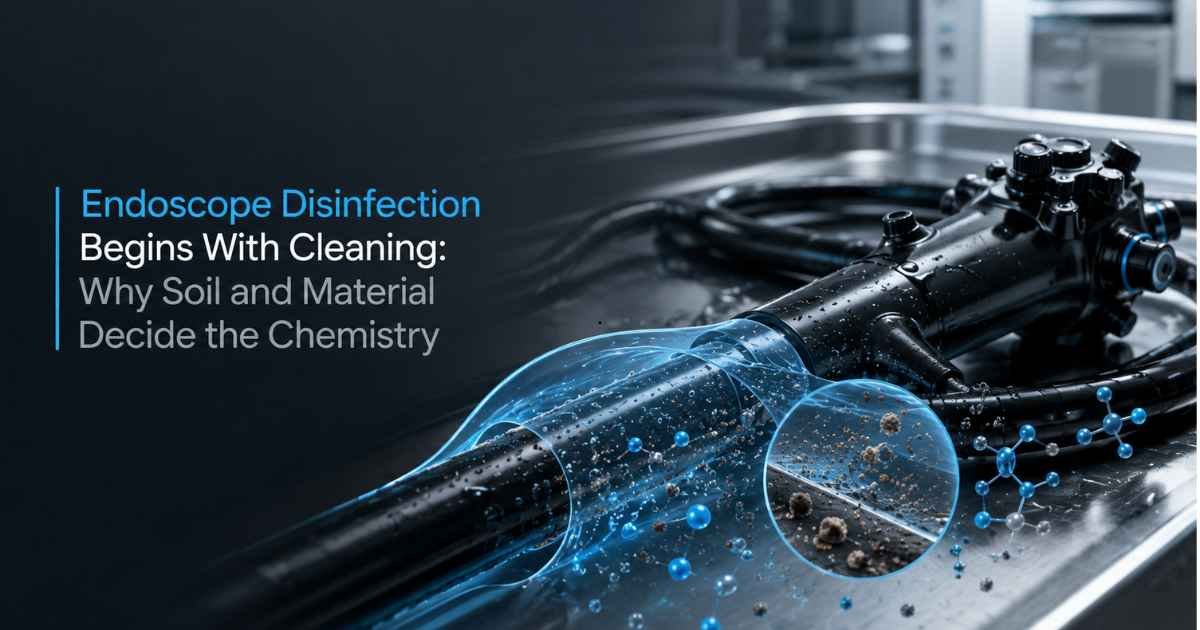
A high level disinfectant can only act on the surface it actually touches. Whatever survives a procedure on a flexible endoscope, dried blood inside a channel, fat around the distal parts, protein and starch across the outer surface, stands between the chemical and the material that needs treating. Cleaning is therefore not a courtesy rinse on the way to disinfection. It is the step that decides whether disinfection is working on an endoscope or on a layer of soil.
Detro Healthcare, the Türkiye-based manufacturer behind the Detrox product brand, splits its endoscopy range along exactly that line: enzymatic cleaners on one side, high level disinfectants on the other, both published in the same Detromed catalogue. The claims the company attaches to each group are different claims about different jobs, and reading them next to each other is the quickest way to see where the dependency really sits.
A Disinfectant Only Acts on Surface That Cleaning Has Exposed
Soil behaves as a physical shield. Residue left in a channel or around a joint keeps the chemical in contact with the residue instead of the device, and extending the exposure does not repair a surface the chemical never meets. That is why the two stages are not interchangeable grades of the same operation.
Detro Healthcare credits part of the microbiological work to the cleaning stage itself. Its enzymatic cleaner is described as lowering the microbial load carried by materials that have been freed of organic soil, which places a share of the reduction before the high level step even starts. Where organic soil stays put, that share is never collected, and one chemistry is left covering two problems.
Automation does not delete the step. Enzymatic pre-cleaning keeps its own identity in units that run a washer disinfector, and the presence of a machine cycle is not an argument for skipping it.
What Enzymatic Cleaners Are Built to Dissolve
The company’s published decontamination guidance is direct about the mechanism: solutions that contain enzymes work on protein residue and make the cleaning job easier. Enzymes are selective by nature, each acting on a particular class of soil, and that selectivity is the reason multi enzyme formulations exist at all.
Detro Enzym Plus DW is the concentrated form of that idea. It is a reinforced enzymatic cleaner developed for medical instruments, with flexible endoscopes named as the case it was built around, and it carries five different enzymes that dissolve the residues sitting on instrument surfaces. The soil it targets is named specifically rather than generically: blood, fat, protein and starch on the endoscope surface.
Two separate gains are claimed for the product, and they are worth keeping apart because they land in different departments. Stripping organic soil reduces the microbial load the instrument carries, which is an infection control outcome. Stripping inorganic soil helps lower the corrosion risk the material runs, which is an asset outcome visible in service life and repair budgets rather than in a laboratory result.
The product also has a stated home: it is designed for use in the manufacturer’s own Detrowash machines. That fact reads in both directions. A unit already running those machines has a chemistry specified against its equipment, and a unit running something else is holding a compatibility question for the manufacturers rather than a decision to settle locally.
Material Compatibility Narrows the Shortlist Before Efficacy Does
The catalogue page for the company’s instrument and endoscope range carries a caution that reorders the usual selection logic. Different products may be preferred for different materials, some chemicals are not suitable for particular metal types, and knowing what your equipment is made of is presented as the thing that keeps corrosion from turning up later. Read plainly, that is an instruction to start from material data.
The caution appears on the same page that lists the cleaners and disinfectants used for endoscope disinfection, which is the part worth noticing: a manufacturer is telling buyers to narrow the shortlist by material before anyone begins comparing efficacy.
Product level material lists are the practical form of that instruction. Detro Enzym Plus DW names glass, rubber, wood, ceramic, silicone, plastic and stainless steel among the materials it is intended for. A list like that works as a boundary rather than as a selling line. It shows where the product was designed to perform, and by omission it marks where a question still needs asking.
| What has to be settled first | Why it changes the chemical | Where the answer comes from |
|---|---|---|
| The material of every part that meets the chemical | Certain chemicals do not suit certain metal types | Endoscope and instrument manufacturer documentation |
| Whether the soil is organic, inorganic or both | Organic soil drives microbial load, inorganic soil drives corrosion risk | The procedure mix the unit actually runs |
| Whether the product is written for manual use, machine use or both | A chemical cleared for a washer disinfector is not automatically a manual product | The product instructions for use |
| Whether the endoscope manufacturer accepts the chemical | Compatibility is declared by the device maker, not inferred from a label | The endoscope manufacturer compatibility statement |
Delicate Parts Change the Method, Not Only the Chemical
Detro Healthcare’s decontamination guidance singles out the fragile end of the tray by name: telescopes, fibreoptic light cables, trocar covers and seals. For those items the answer is not a stronger chemical but a gentler method, and the guidance sets three limits.
- Clean them with water and a detergent at close to neutral pH, using gentle movements that keep the item from being dropped or knocked
- Use single use brushes, or clean the brush properly after every use
- Keep hard fabric and metal rods out of the cleaning process altogether
Each limit protects something the chemistry cannot repair. An abrasive tool damages the very surface the disinfectant then has to treat, and a brush reused without proper cleaning converts a cleaning instrument into a route between devices. A detergent near neutral pH is chosen for the same reason a metal rod is refused: the material has to survive the process it is being put through.
Where High Level Disinfection Sits, and What It Does Not Replace
With the surface exposed, the high level step finally has something to act on. For high level disinfection of medical instruments, Detro Healthcare names two active substance routes: orthophthalaldehyde, usually shortened to OPA, and peracetic acid, shortened to PAA. Its own products sit on both routes, Detro OPA and Detro PAA 2200, each declared as 93/42 EEC Class II B.
Read from the material side rather than the efficacy side, each product carries its own compatibility information instead of a general promise. Detro OPA is presented as suitable both for manual application and for endoscope washer disinfector devices, and the company states that its corrosion inhibitors are there to protect instruments and extend their working life, alongside compatibility with endoscope brands and a KARL STORZ endoscope approval. Detro PAA 2200 defines its scope by instrument type: heat resistant surgical instruments, anaesthesia instruments, dental surgical instruments, and rigid as well as flexible endoscopes.
High level disinfection is not a quieter word for sterilisation, and the manufacturer does not present it as one. Its published rule on uncertainty is blunt: where there is the slightest doubt about the sterilisation of an endoscope, the instrument stays out of service until it has been through the process again. A rule of that kind only means something when someone is willing to apply it to a device that looks perfectly clean.
No article settles which cleaner and which disinfectant belong in a particular unit. Three documents do that work: the instructions for use issued by the chemical manufacturer, the compatibility statement the endoscope manufacturer publishes for the specific model in service, and the infection control policy the institution itself operates under. Where a catalogue and those documents disagree, the documents decide.
Questions Endoscopy Units Ask Before Changing a Chemical
What does a concentrate actually change in daily use?
It moves accuracy from the shelf to the bench. A concentrated cleaner such as Detro Enzym Plus DW performs as described only when it is prepared the way its instructions for use specify, which turns dosing into an operational control rather than a housekeeping detail. The gain is storage volume and transport weight. The cost is that a preparation error has become a cleaning error.
Who confirms that a chemical is compatible with a specific endoscope?
Two parties, in a fixed order. The chemical manufacturer defines the materials and instrument types the product was developed for, which is why Detro OPA cites an approval from an endoscope manufacturer instead of asserting universal fit. The endoscope manufacturer then declares whether that chemical is accepted for the model in question. The unit reconciles the two, and where the answers fail to overlap the product does not reach the tray.
Does sourcing the device and the chemistry from one manufacturer simplify anything?
It shortens the list of documents that have to agree. Detro Healthcare produces endoscope washing and disinfection devices as well as the cleaners and disinfectants used in high level disinfection of endoscopes, so the cleaner and the machine are specified against each other rather than matched after purchase. It does not remove the endoscope manufacturer’s compatibility statement from the chain, and it is no reason to skip the material check on any instrument that is not an endoscope.
Disclaimer: The information provided in this article is for general informational and educational purposes only. It does not constitute professional infection control, medical, or regulatory advice. Endoscope cleaning, disinfection, and sterilization protocols must follow the chemical manufacturer’s instructions for use, the endoscope manufacturer’s compatibility statement, and the institution’s infection control policy. The mention of specific products, manufacturers, or chemical agents is illustrative and does not imply endorsement. The author and publisher disclaim all liability for any equipment damage, incomplete disinfection, patient harm, or other consequences arising from reliance on this content. Always consult qualified infection control professionals and manufacturer documentation before implementing or changing any reprocessing procedure. This article does not guarantee specific clinical outcomes or regulatory compliance.
Stay ahead with knowledge that empowers—our empowering insights give you the edge you need.