The right gate automation system depends on your property layout before anything else. A flat suburban block, a long rural driveway, and a sloped or irregular site each demand a different motor type, power source, and mounting configuration. Getting that match right the first time means a gate that opens reliably for a decade. Getting it wrong means noise, reversals, and a motor replacement within three years. The five-minute layout assessment below tells you exactly which system your property needs.
The Mistake Most Buyers Make Before They Even Look at a System
Most people start with a budget. They find a motor they can afford, check that the box says “swing gate” or “sliding gate,” and buy it.
Then they discover their driveway is slightly sloped, or their gate posts are too close together for the motor arm, or their property has no mains power within 40 metres of the gate.
Property layout should be the first filter, not the last. An automatic swing gate that works on a flat suburban block will struggle on a sloped rural driveway unless the motor is rated for that extra gravitational load.
The system follows the site. The site does not adapt to the system.
Flat Suburban Block: Match the Gate Type to the Space You Have
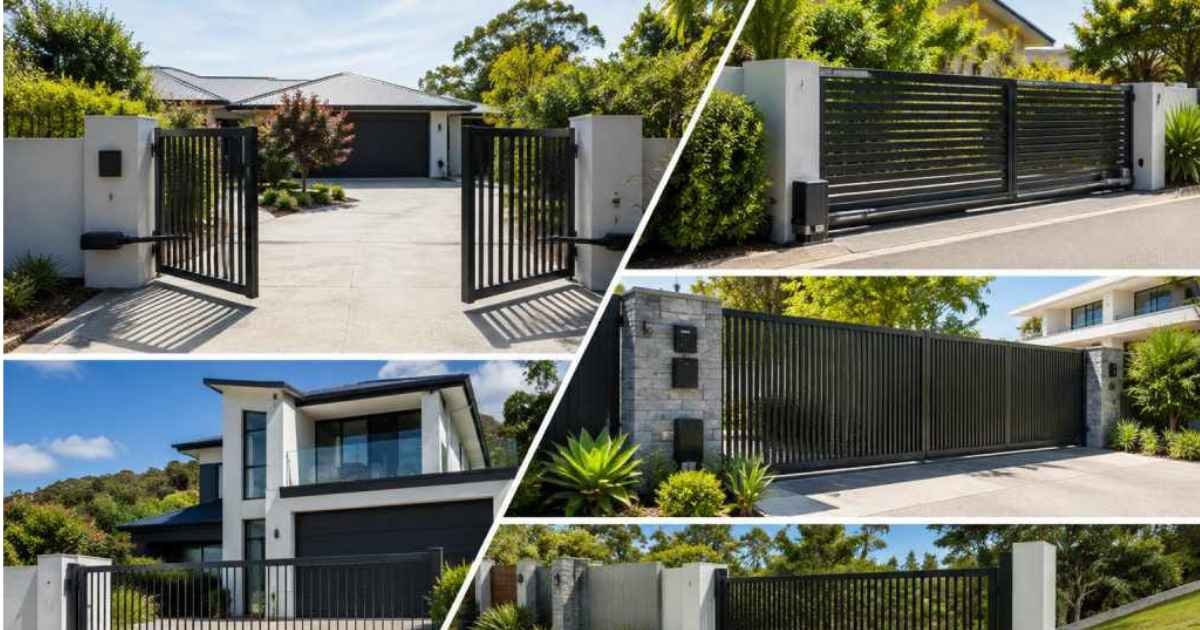
On a flat suburban property, you are choosing between a swing gate and a sliding gate. The decision comes down to one thing: how much space sits behind the gate on the inside.
A swing gate needs clearance equal to the leaf length on the inside. A 3m leaf needs 3m of clear space to swing into.
If that space has a garden bed, a slope, or a vehicle parked there, a swing gate will not work. A sliding gate solves the clearance problem by running the leaf parallel to the fence line, but it needs a straight, level track and a gate leaf that is not too heavy for a standard residential motor.
- Swing gate: suits flat, clear driveways with adequate inward clearance and gate posts at least 600mm wide
- Sliding gate: suits narrower driveways, corner blocks, and properties where inward swing is obstructed
Long Rural Driveway: The Gate Is Not the Hard Part
On a rural property with a driveway over 30 metres, the gate itself is clear. Power supply is the hard part.
Trenching a 240V cable from a farmhouse to a gate 80 metres away can cost $2,400 to $4,800, depending on ground conditions.
A solar gate kit with a battery backup eliminates that cost entirely. It also means the gate continues to work during a grid outage, which matters for rural properties in storm-prone areas.
Size the solar battery for your usage pattern, not the average day. A property with farm staff, deliveries, and multiple daily entries needs at least 18Ah of battery capacity to handle overcast periods without a flat battery.
Sloped or Irregular Layout: This Is Where Underpowered Motors Fail
A gate on a sloped driveway carries an uneven load through its travel arc. Opening uphill is easy. Closing downhill, the gate gains momentum, or the motor fights gravity on every cycle. A motor sized exactly to the gate’s weight rating will trip its overload protection regularly on a sloped site.
Buy a motor rated at 30 per cent above your actual gate weight. That buffer gives the motor enough headroom to handle slope, wind load, and seasonal timber swelling without straining.
For steep driveways, also check that the motor arm bracket geometry is suitable for the installation angle. Not every linear actuator mounts correctly on a non-standard pillar face.
Narrow Entry or Shared Driveway: Remote Access Changes the Equation
Narrow entries and shared driveways create a practical problem that motor specs alone cannot solve. When multiple households or users share a gate, a single remote system becomes unmanageable.
Someone loses a remote. A tenant leaves and keeps theirs. A contractor needs access for one week, but you have no way to grant a temporary code.
A Wi-Fi-enabled gate kit with app control solves all of this. You grant access via the app, revoke it instantly when needed, and review a log of every opening.
For any property with more than two regular gate users, smart access control is not a luxury. It is the only system that stays manageable over time.
The One Question That Decides Everything
Before looking at any motor specification, answer “What is the heaviest thing my gate will ever weigh, and what is the furthest point on the leaf from the hinge?”
Weight and lever length together determine the torque your motor must produce. Every other decision, power source, motor type, and control board follows from getting those two numbers right.
A gate automation company that does not ask you both of these questions before recommending a system is guessing.
And a guess that saves you $200 upfront tends to cost $800 in two years when the motor burns out.
The right system is not the most expensive one. It is the one that matches what your property actually demands. Know your layout, know your weight, and buy to that.
Disclaimer: The information provided in this article is for general informational and educational purposes only. It does not constitute professional installation, electrical, or safety advice. Gate automation systems involve mechanical, electrical, and access-control components that must be properly specified for the specific property layout and gate specifications. Readers should consult a qualified gate automation professional before purchasing or installing any system. The mention of specific costs, power requirements, or access features is illustrative and may vary by location. The author and publisher disclaim all liability for any property damage, personal injury, or system failure arising from reliance on this content. Always comply with local regulations and manufacturer guidelines. This article does not guarantee specific performance or reliability outcomes.
Looking for strategies that drive real change? Discover our change-driving strategies—built for lasting impact.