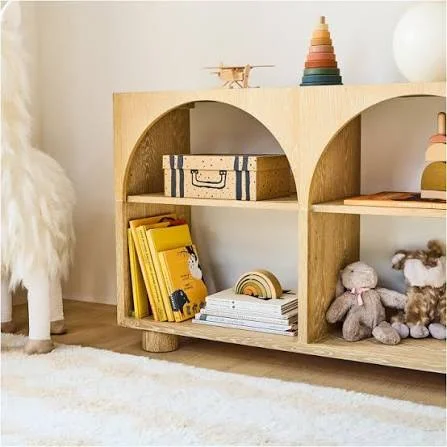
Kids with a hundred books at home are three times more likely to finish ninth grade than kids with none, according to a long-running study spanning twenty-seven countries. That gap isn’t only about money, it’s about whether books sit somewhere a child can actually see and grab them. A shelf stuffed in a closet doesn’t count for much. An arch book shelf puts books face-out and eye-level, so a toddler can grab one without asking for help. Shape matters here too, not just placement. A curved silhouette softens a room that’s otherwise full of hard corners and flat walls.
Why Visible Books Beat Stored Books
Books tucked spine-out on a tall shelf might as well be invisible to a three-year-old. Research on reading habits found a sharp gap by income: kids in middle-income homes log somewhere between 1,000 and 1,700 hours of picture book time before kindergarten, while kids in lower-income homes often get closer to 25. Visibility and access explain a big piece of that gap. A shelf a child can reach and browse on their own turns reading into a habit instead of a scheduled event.
An arch shape earns its keep beyond looks alone:
- The rounded top removes a sharp corner parents usually pad or avoid anyway
- Face-out storage lets a toddler browse covers, not squint at tiny spine text
- It works as a soft room divider without blocking light like a boxy cabinet
- The curve fits neatly under a sloped ceiling or dormer, where square units waste space
How Many Books, How High
Stock the shelf for the child using it, not for how it looks in a photo. Lower shelves need board books facing out, since a one-year-old can’t yet flip through pages efficiently. Higher shelves can hold more text-heavy books as your child grows into them.
| Age Range | Reachable Shelf Height | What to Stock There |
|---|---|---|
| 1 to 2 years | 12 to 18 inches | Board books, face-out only |
| 3 to 4 years | 18 to 28 inches | Picture books, mixed display |
| 5 to 7 years | 28 to 40 inches | Early readers, spine-out is fine |
Reading Time That Actually Adds Up
Eleven minutes a day of shared reading is linked to stronger literacy scores that show up years later, not just in preschool. Reading aloud to a baby as young as nine months predicts stronger vocabulary by age three, well before a single word gets sounded out independently. None of that requires a formal lesson. It just requires books being close enough to grab during ten spare minutes before bed.
Anchor It to the Wall
A bookshelf looks harmless, but federal safety data tells a different story. Nearly 8 in 10 furniture tip-over deaths involve children five and younger, and a government survey found roughly a third of parents never bother anchoring shelves or dressers to the wall at all. Toddlers climb. A low arch shelf sits closer to the ground than a tall bookcase, which already cuts the risk, but a simple wall strap or anti-tip bracket takes minutes to install and removes the danger for good. Skipping it is the one shortcut not worth taking.
Where It Fits Best
Skip the far corner nobody walks past. Put the shelf near the reading chair, the bed, or wherever the bedtime routine already happens, so grabbing a book takes zero extra steps. A shelf that’s three feet from the pillow gets used every night. One across the room gets used once a month, then turns into a dust catcher nobody remembers buying.
Disclaimer: The information provided in this article is for general informational and educational purposes only. It does not constitute professional child safety, furniture installation, or home improvement advice. Furniture anchoring requirements and child development milestones vary; always follow manufacturer instructions and consult a qualified professional for wall mounting. The mention of specific studies or statistics is illustrative and does not guarantee individual outcomes. The author and publisher disclaim all liability for any injuries, property damage, or other consequences arising from reliance on this content. Always prioritize child safety and supervise young children around furniture. This article does not guarantee specific literacy or developmental results.
Looking for guidance that sparks real progress? Discover our progress-sparking guidance—built to move you forward.