A commercial and industrial energy storage system stores electricity so a business can use it later, on its own terms, instead of pulling everything from the grid at the worst possible moment. For a factory, warehouse, hospital, or data center, that difference shows up directly on the utility bill and on the balance sheet.
Electricity rates for businesses in the US have climbed steadily, and utility demand charges can account for 30 to 70 percent of a commercial bill depending on the state and rate structure. At the same time, grid outages caused by extreme weather have become more frequent, and interconnection queues for new solar and storage projects keep growing. Companies that once treated backup power as an afterthought are now treating it as a core part of their operating strategy.
This guide walks through what these systems actually are, how they work, what they cost, which standards govern them, and how to plan a project that pays for itself. It also covers the manufacturer landscape so you know what to look for before signing a contract.
What Is a Commercial and Industrial Energy Storage System
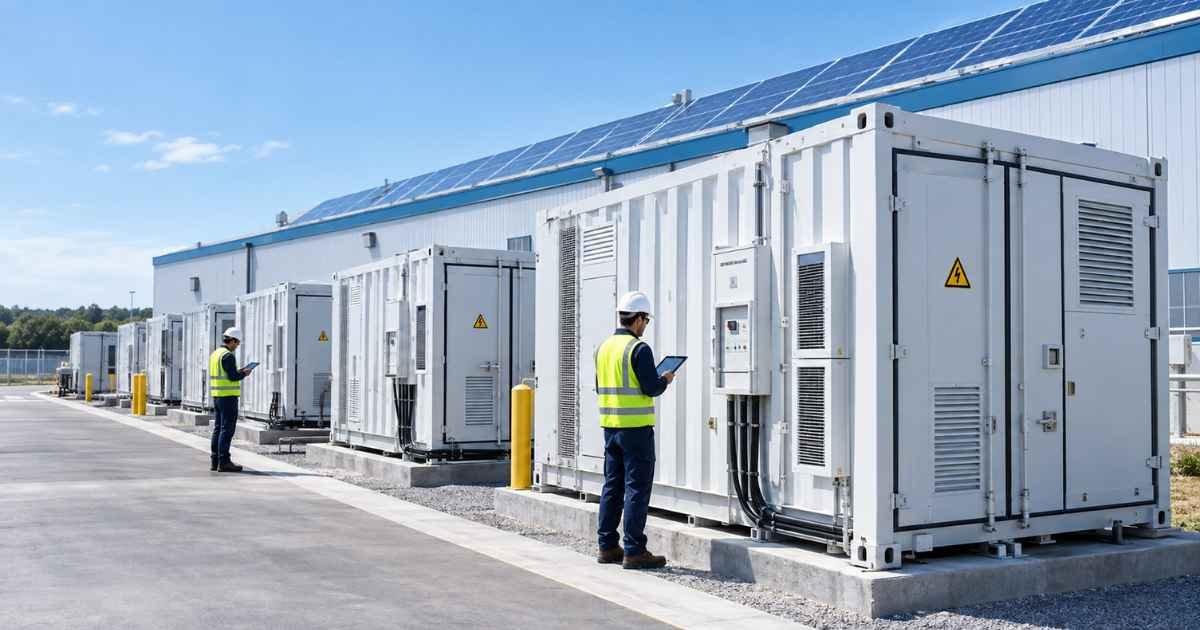
A commercial and industrial energy storage system, often shortened to C&I BESS, is a battery-based setup sized for businesses rather than homes or utility-scale power plants. These systems typically range from about 30 kW to several megawatts and are installed at a single facility or campus.
The system charges when electricity is cheap or plentiful, usually overnight, during solar production hours, or during off-peak utility rate periods. It discharges when electricity is expensive or when the grid goes down. In between, software decides exactly when to charge and discharge based on the facility’s usage patterns and the local utility rate structure.
Companies like commercial and industrial energy storage systems build these units as containerized or cabinet-based products that can be installed outdoors on a concrete pad, cutting down on site work compared to older custom-built systems.
Unlike a home battery paired with rooftop solar, a C&I system is engineered around a business’s load profile, its utility tariff, and often its production schedule. That means two facilities with identical square footage can need very different storage configurations.
What Is Energy Storage Technology, in Plain English
Energy storage technology is any method of capturing energy and holding it for later use. It sounds simple, but the physics behind it varies a lot depending on the method.
Think of it like a water tower. A water tower fills up when demand is low and supplies water when demand spikes, so the pumping system does not have to run at full output all day. A battery energy storage system does the same job for electrons instead of water.
The US Department of Energy tracks storage deployment nationally, and its data shows battery storage now represents the overwhelming majority of new storage capacity added each year, well ahead of pumped hydro and other older methods. That shift happened because lithium-ion battery costs dropped by roughly 80 percent over the past decade, according to BloombergNEF price surveys, making batteries the default choice for most new commercial projects.
Types of Energy Storage Systems Businesses Actually Use
Not every storage technology fits every application. Here is how the main types compare for commercial and industrial use.
Lithium-Ion Batteries
Lithium-ion is the dominant technology in C&I storage today. Within lithium-ion, most modern commercial systems use lithium iron phosphate (LFP) chemistry rather than the nickel manganese cobalt (NMC) chemistry common in earlier deployments and in electric vehicles.
LFP costs slightly more per kilowatt-hour of usable capacity in some cases, but it offers a longer cycle life, better thermal stability, and a lower fire risk. That combination is why most manufacturers building for stationary commercial use have shifted toward LFP over the last several years.
Flow Batteries
Flow batteries store energy in liquid electrolyte tanks rather than solid cells. They are heavier and bulkier per kilowatt-hour, but they can be discharged for much longer durations and they degrade more slowly over thousands of cycles. Facilities that need four or more hours of continuous backup, such as certain manufacturing plants, sometimes choose flow batteries for that reason.
Thermal Storage
Thermal storage systems store energy as heat or cold rather than electricity. Ice storage systems, for example, freeze water overnight when power is cheap and use that ice to cool a building during the day, shifting air conditioning load away from peak hours. This works well for facilities with large, predictable cooling loads like cold storage warehouses and grocery distribution centers.
Mechanical Storage
Flywheels and compressed air systems store energy as motion or pressure. These are less common in typical commercial buildings but show up in specialized industrial applications that need very fast response times, such as data center power quality support.
Hydrogen and Emerging Technologies
Some industrial sites are piloting hydrogen storage paired with fuel cells for longer-duration backup. This remains a niche and capital-intensive option today, but it is worth watching as costs come down.
How a C&I Battery Storage System Actually Works
A complete system has five core components, and understanding them helps when comparing quotes from different suppliers.
- Battery modules. These hold the actual stored energy, arranged in racks inside a cabinet or shipping-container-style enclosure.
- Power conversion system (PCS), also called the inverter. This converts the direct current stored in the battery into the alternating current your facility’s electrical system uses, and vice versa when charging.
- Battery management system (BMS). This monitors the health, temperature, and charge level of every cell, preventing overcharging and catching problems before they become safety issues.
- Energy management system (EMS). This is the software brain. It reads your utility tariff, your facility’s usage pattern, and sometimes real-time grid signals, then decides exactly when to charge and discharge to save the most money.
- Safety and fire suppression systems. Modern C&I systems include thermal monitoring, ventilation, and in many cases built-in fire suppression, all tested against UL 9540A fire propagation standards.
Why Businesses Are Installing Commercial and Industrial Energy Storage Systems
Cutting Demand Charges
Most commercial utility bills include a demand charge based on the highest 15-minute spike in power usage during the billing period, separate from the total energy consumed. A single equipment startup or a hot afternoon can set that peak for the entire month.
A battery system detects when usage is climbing toward a new peak and discharges to shave off that spike, a practice called peak shaving. Facilities in high demand-charge territories like California, New York, and parts of the Northeast often see the fastest payback because demand charges there can run $15 to $25 per kW or higher.
Backup Power During Outages
Unlike a diesel generator, a battery system switches to backup power in milliseconds with no interruption, which matters enormously for facilities running sensitive equipment, refrigeration, or continuous production lines. Many systems today pair battery storage with rooftop or ground-mount solar so the facility can keep running indefinitely during a multi-day outage, not just until fuel runs out.
Making Solar Actually Useful Around the Clock
Solar only generates during daylight hours, but most commercial facilities have significant evening and early morning loads. Storage lets a business use its own solar generation at night instead of selling it back to the utility at a low rate and buying power back later at a high one.
Earning Revenue Through Demand Response and Virtual Power Plants
In markets like California, Texas (ERCOT), and the PJM region covering much of the mid-Atlantic, utilities and grid operators pay commercial customers to reduce load or discharge stored energy during grid stress events. Enrolling a battery system in these programs, sometimes bundled into a virtual power plant, can generate a secondary revenue stream on top of bill savings.
Federal Tax Incentives
Under the Inflation Reduction Act and its current implementation through Section 48E of the tax code, standalone commercial battery storage remains eligible for a 30 percent Investment Tax Credit when a project meets prevailing wage and apprenticeship requirements, and this credit structure for storage is scheduled to hold through 2033 before phasedown begins. That is a meaningfully different timeline than commercial solar, whose base credit was reduced under the 2025 One Big Beautiful Bill Act. Businesses should confirm current eligibility with a tax professional, since rules around domestic content and foreign entity restrictions have added complexity.
Applications Across Industries
- Manufacturing plants use storage to avoid demand charge spikes from large motors and compressors starting up, and to keep production lines running through short grid blips that would otherwise trip equipment offline.
- Data centers pair battery storage with backup generation to bridge the gap between a power interruption and generator startup, while also using storage for frequency regulation services. Data center electricity demand in the US has grown sharply with the buildout of AI computing infrastructure, and the Electric Power Research Institute and multiple grid operators have flagged this growth as a major driver of new storage demand.
- Cold storage and food distribution facilities use thermal and battery storage together to protect refrigerated inventory during outages, where even a few hours without power can mean spoiled product.
- EV charging depots for delivery fleets and transit agencies use storage to avoid the massive demand charges that come from simultaneously fast-charging dozens of vehicles.
- Hospitals and healthcare facilities use storage as a bridge to backup generators and, increasingly, as a way to reduce operating costs on top of life-safety backup requirements.
- Retail chains and grocery stores use storage across multiple locations, often centrally managed, to flatten demand charges chain-wide.
Cost, Sizing, and Payback
Commercial battery storage typically costs between $300 and $600 per kWh of installed capacity as of 2026, though larger projects with favorable site conditions can come in lower, and projects requiring extensive electrical upgrades can run higher. Total project cost depends heavily on battery capacity (measured in kWh), power rating (measured in kW), enclosure type, and whether solar is included.
Sizing a system correctly starts with an energy audit. A qualified installer will pull 12 months of interval usage data from your utility, identify your peak demand patterns, and model how much storage capacity is needed to shave those peaks without oversizing the system and wasting capital.
Payback periods for demand-charge-driven projects in high-cost utility territories often fall between 4 and 8 years, and that timeline shortens further with the ITC and any available state or utility incentive programs like California’s Self-Generation Incentive Program.
Safety Standards and Certifications to Look For
Fire safety is not optional when it comes to lithium-ion storage, and the industry has matured significantly around this. Look for equipment tested to UL 9540, the product safety standard for energy storage systems, and UL 9540A, which specifically tests how a battery fire would propagate and whether the enclosure design contains it.
Installation and permitting in most US jurisdictions also references NFPA 855, the fire code developed by the National Fire Protection Association specifically for stationary energy storage systems, which governs spacing, ventilation, and fire department access requirements.
Ask any supplier for their UL 9540A test report and confirm their local fire marshal or authority having jurisdiction has approved similar installations before signing a contract.
Choosing an Energy Storage System Manufacturer or Supplier
The manufacturer landscape has become crowded, and quality varies more than pricing alone suggests. The market includes established players such as Tesla, BYD, CATL, Sungrow, Fluence, and Sigenergy, alongside manufacturers that specialize specifically in the C&I segment such as AlphaESS, Fortress Power, SolaX, HyperStrong, and Socomec.
A large share of battery cell and pack production, including for many US-branded systems, comes out of energy storage system manufacturers in China, where scale has driven down cell costs significantly over the past several years. This is not automatically a red flag. Many of these factories hold UL and IEC certifications and supply components to Western integrators. What matters more than country of origin is whether the specific factory has a verifiable quality track record, a real warranty backed by a company likely to still exist in ten years, and responsive after-sales support in your time zone.
When evaluating an energy storage system manufacturer, look for a few concrete things rather than marketing claims.
Ask how long the company has been manufacturing at scale, not just distributing. Ask for third-party cycle life test data rather than just a marketed cycle count. Confirm the warranty covers capacity degradation, not only defects, and check what percentage of original capacity is guaranteed at year 10. Request references from installers who have serviced the equipment after the first year, since that reveals more than a sales call ever will.
Also compare software. The energy management system is often the biggest differentiator between two batteries with nearly identical hardware specs, since it determines how much money the system actually saves month to month.
How to Plan and Install a Project
- Start with an energy audit. Pull interval data from your utility bills and identify your actual peak demand pattern, not just your average usage.
- Size the system to your real load profile. Oversizing wastes capital, and undersizing leaves savings on the table.
- Confirm interconnection requirements with your utility. Timelines vary widely by region and can take anywhere from a few weeks to over a year in congested grid areas.
- Apply for permits and confirm fire code compliance. Your local fire marshal will review the installation against NFPA 855 requirements.
- Install and commission the system. This includes electrical integration, EMS configuration, and safety testing before the system goes live.
- Monitor performance for the first 90 days. Compare actual savings against the pre-installation model and adjust the EMS dispatch strategy if needed.
- Set up an ongoing maintenance schedule. Most reputable suppliers include remote monitoring and scheduled inspections as part of a service agreement.
Common Mistakes Businesses Make
Skipping the energy audit and relying on a rough estimate from a sales rep is the single most common mistake, and it usually leads to a system that is either too small to meaningfully cut demand charges or too expensive to pay back in a reasonable time.
Another frequent issue is underestimating permitting and interconnection timelines, which can delay a project by months in areas with strict fire codes or backed-up utility queues.
Businesses also sometimes choose a supplier based purely on price per kWh without checking cycle life warranties, which means the system may need partial replacement years before it was expected to.
Frequently Asked Questions
What is the difference between commercial and industrial storage and utility-scale storage?
Utility-scale systems are built by power generators or grid operators and sit on the grid side of the meter, typically in the tens or hundreds of megawatts. Commercial and industrial systems sit behind the meter at a specific business site and are sized to that facility’s own load, usually between 30 kW and a few megawatts.
How long do commercial batteries last?
Most LFP-based commercial systems are rated for 6,000 to 10,000 charge cycles and come with warranties of 10 to 15 years, guaranteeing a minimum retained capacity, often around 70 to 80 percent, at the end of that period.
Do commercial energy storage systems still qualify for tax credits in 2026?
Yes. Standalone battery storage projects remain eligible for the Section 48E Investment Tax Credit at up to 30 percent when prevailing wage and apprenticeship requirements are met, and this incentive structure is currently scheduled to continue through 2033 before phasing down, separate from the reduced timeline that now applies to standalone commercial solar.
Can a business add storage without adding solar?
Yes. Standalone storage is common and is often justified by demand charge savings alone, particularly in states with steep demand charges. Adding solar later is usually straightforward if the system was designed with that expansion in mind.
How much does a commercial energy storage system cost?
Installed costs typically range from $300 to $600 per kWh as of 2026, though final pricing depends on capacity, site conditions, and whether solar or backup generation is bundled in.
What happens to the batteries at end of life?
Reputable manufacturers and installers now have recycling partnerships in place, since LFP chemistry contains no cobalt and is generally considered easier and less hazardous to recycle than older NMC-based batteries.
Conclusion
Commercial and industrial energy storage has moved from a niche sustainability project to a mainstream financial decision. Rising demand charges, more frequent grid disruptions, and a tax credit structure that still favors storage make the math work for a growing list of industries, from manufacturing floors to data centers to grocery cold storage.
Getting it right comes down to sizing the system against real usage data, verifying the manufacturer’s safety certifications and warranty terms, and picking software that actually optimizes for your specific utility rate structure. Get those three things right, and the system pays for itself while quietly protecting the business from the next outage.
Disclaimer: The information provided in this article is for general informational and educational purposes only and does not constitute professional engineering, financial, or legal advice. Energy storage system costs, tax incentives, utility programs, and regulations vary by region and may change. Readers should consult qualified energy professionals and tax advisors before making investment decisions. The mention of specific manufacturers or products is illustrative and does not imply endorsement. The author and publisher disclaim all liability for financial losses, equipment failures, or regulatory issues arising from reliance on this content. Always verify certifications, warranties, and compliance requirements independently.
Unlock a calmer, clearer mind—browse our mindfulness articles and find balance in the chaos.