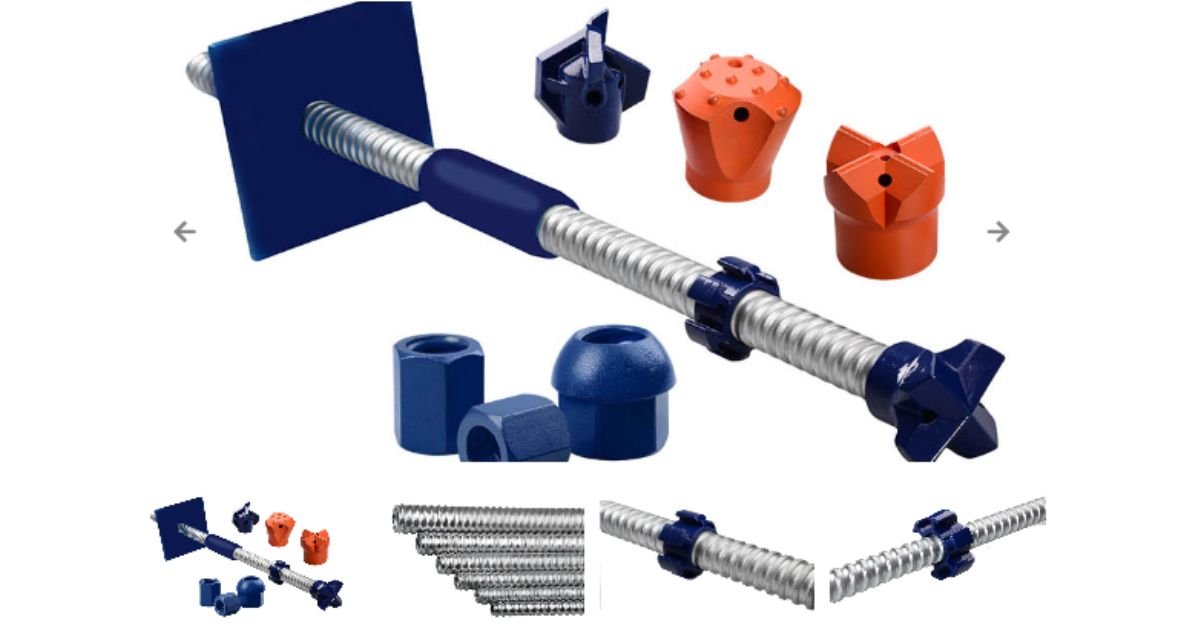
Modern construction projects frequently encounter unstable soil, fractured rock, restricted working spaces, and challenging foundation conditions. These problems require reinforcement systems that can be adapted to the site without compromising engineering requirements. Hollow injection bar are one option used by geotechnical professionals to address these challenges.
Designed to deliver grout through an internal passage, these steel components can combine drilling and reinforcement functions in compatible self-drilling systems. Their use across different construction applications makes them an important consideration for contractors and foundation specialists.
Why Are Hollow Injection Bars Important?
Ground conditions can change significantly across a single construction site. Loose soil may collapse during drilling, while fractured rock can make conventional anchoring procedures more complicated. In these situations, a suitable hollow injection bar system can help simplify installation by allowing grout to flow through the bar during drilling.
The bar provides the steel reinforcement, while the grout helps establish contact with the surrounding ground. Together, these elements form part of an engineered system intended to transfer loads and improve stability.
Performance depends on proper design, installation quality, and verification of the completed work.
Applications in Geotechnical Engineering
1. Soil Nailing Projects
Soil nailing is commonly used to reinforce excavated slopes and soil faces. Reinforcement elements are installed into the ground and connected to a facing system designed to support the exposed surface.
Hollow injection bars can be used as soil nails when the selected system meets the project’s design requirements. In self-drilling arrangements, the bar advances into the soil while grout is delivered through the drilling assembly.
This approach can be useful where maintaining an open borehole is difficult. Engineers must still assess soil strength, nail spacing, groundwater, and the required reinforcement capacity.
2. Rock Stabilization
Fractured or weathered rock can create instability around road cuts, excavations, and underground structures. Rock reinforcement systems help control movement by connecting potentially unstable sections to more competent material.
Hollow injection bars designed for rock reinforcement can provide a route for grout injection while serving as structural anchoring components. Selection depends on rock quality, discontinuities, installation depth, and anticipated loads.
3. Micropile Foundations
Micropiles are small-diameter foundation elements used in new construction, underpinning, and restricted-access locations. Depending on the design, hollow steel bars may form part of a drilled and grouted micropile system.
Their suitability depends on the required axial capacity, ground profile, connection details, and applicable design standards. Contractors should verify the complete foundation system rather than assuming that every hollow injection bar is suitable for micropiling.
4. Tunneling and Underground Works
Tunnel construction often involves variable ground conditions and limited access. Ground reinforcement may be required before, during, or after excavation to manage movement and improve stability.
Compatible hollow injection bar systems can be used for selected anchoring and reinforcement tasks. Their installation procedure must account for tunnel geometry, equipment access, groundwater, and the surrounding ground’s response.
5. Slope Stabilization
Unstable slopes can threaten roads, retaining structures, and nearby buildings. Engineers may use a combination of drainage, retaining structures, soil reinforcement, and anchoring to manage these risks.
Hollow injection bars can form part of an engineered stabilization solution when their load capacity and installation characteristics are appropriate. They should not be treated as a standalone solution for every slope problem.
Installation Factors That Affect Performance
The quality of an installed system depends on several interconnected factors.
Ground assessment: Soil type, rock fractures, groundwater, and existing structures influence the selection of drilling equipment and reinforcement design.
Grout quality: The grout mixture, flow characteristics, injection procedure, and curing conditions must meet project requirements.
Equipment compatibility: The bar, drill bit, couplers, and drilling rig should be compatible with one another.
Installation control: Operators should follow specified drilling and injection procedures and record relevant installation information.
Quality verification: Inspection and testing should be conducted where required by the design and applicable standards.
Ignoring any of these factors can affect the reliability of the reinforcement system.
How Contractors Can Choose a Suitable System
Before purchasing hollow injection bars, contractors should review the project’s technical specifications and consult the responsible engineer. Important considerations include bar diameter, steel grade, thread configuration, connection strength, corrosion protection, and required design loads.
Suppliers should be able to provide relevant technical documentation and explain which accessories are compatible with the selected bar. Delivery availability and support for installation planning may also affect purchasing decisions.
The lowest purchase price is not necessarily the most economical option. A compatible system with clear documentation can help reduce installation complications and avoid costly changes on site.
Conclusion
Hollow injection bar have applications in soil nailing, rock stabilization, micropiling, tunneling, and selected slope reinforcement projects. Their ability to carry grout through a hollow center can simplify installation in appropriate conditions.
Successful results depend on matching the system to the ground, using compatible components, and following a properly engineered installation procedure. Contractors who evaluate these factors can make more informed decisions when selecting reinforcement solutions.
Disclaimer: This article is for general informational purposes only and does not constitute professional, engineering, or construction advice. Hollow injection bar systems, their load capacities, grout requirements, corrosion protection, and installation procedures vary by manufacturer, project, and ground conditions, and may change without notice. All reinforcement designs must be verified by a qualified geotechnical or structural engineer in accordance with applicable design standards and site-specific requirements. Readers should not rely on this article as a substitute for professional engineering evaluation, testing, or approval. Any mention of specific applications or products does not imply endorsement. The author and publisher disclaim any liability for decisions made based on this content.
Build stronger connections and deeper relationships—our communication tools show you how to connect with confidence.