Key Takeaways
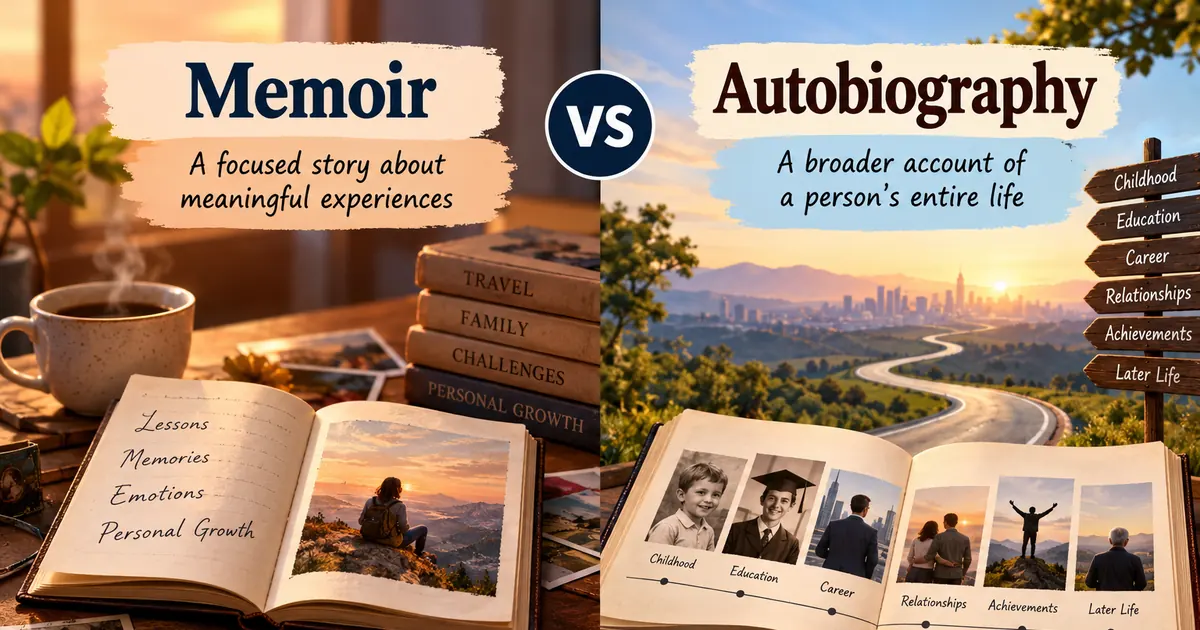
- Memoirs focus on selected memories, important experiences and personal lessons. Autobiographies cover a person’s life broadly.
- The main difference between memoir and autobiography involves story structure, time periods and the writer’s purpose.
- Memoir writing uses emotions, reflection, and storytelling to explore meaningful moments.
- Autobiography writing usually follows a timeline, beginning with childhood and moving through major life events.
- Understanding different types of life writing helps authors choose a format that matches their experiences and intended readers.
- Both genres require honesty, clear organization, careful fact-checking, and respect for other people’s privacy.
Introduction
Every person has a story worth telling. Some stories describe an entire lifetime, while others explore one experience that changed everything.
However, deciding how to tell these stories can be confusing, especially when two popular forms of personal writing seem almost identical.
The discussion of Memoir vs Autobiography helps explain how these two forms of life writing differ in purpose, structure, and storytelling style.
Both genres share real experiences, but they organize memories differently. A memoir explores meaningful moments and their emotional impact, while an autobiography presents a broader account of someone’s life.
Understanding these differences helps writers select the right approach, organize their experiences, and create stories that readers can easily follow.
Understanding Memoir vs Autobiography
Memoirs and autobiographies belong to nonfiction literature because they describe real people, places, and events. Both are usually written from the perspective of the person who experienced those events.
However, their storytelling goals are different.
An autobiography gives readers a broad picture of a person’s life. It usually includes childhood, education, family relationships, career achievements, personal challenges, and major turning points.
A memoir focuses on a particular part of someone’s life. Instead of describing every major event, it explores experiences connected by an important theme.
For example, a retired teacher might write an autobiography covering childhood, education, teaching, marriage, and retirement.
The same teacher could write a memoir about helping struggling students develop confidence. That story would focus on experiences connected to teaching and personal growth.
What Is a Memoir
A memoir is a nonfiction story based on personal memories and experiences. Its main purpose is to show how certain events shaped the writer’s thoughts, feelings, or understanding of life.
Memoirs often explore themes such as:
- Family relationships and childhood memories
- Travel, adventure, and cultural experiences
- Overcoming personal struggles
- Friendship, love, and belonging
- Career challenges and major life changes
Memoir writing combines factual experiences with scenes, dialogue, reflection, and emotion.
For example, Educated by Tara Westover explores the author’s unusual upbringing, education, and changing relationship with her family.
The book does not attempt to describe every moment of her life. Instead, it concentrates on experiences connected to learning, independence, and identity.
This focused approach helps readers understand why particular memories matter.
What Is an Autobiography
An autobiography is a nonfiction account of someone’s life written by that person. It generally provides a wider view of personal history.
Autobiographies often begin with early childhood and continue through important stages of adulthood.
They may describe family background, education, achievements, relationships, setbacks, and important decisions.
A well-known example is The Autobiography of Benjamin Franklin by Benjamin Franklin.
The book discusses Franklin’s early experiences, work, personal development, and values, although it does not cover his entire lifetime.
Autobiography writing places greater emphasis on life history and the sequence of events.
Nevertheless, autobiographies can also contain emotions, personal opinions, and meaningful reflections.
Both genres allow writers to share real experiences in ways that educate, inspire, or entertain readers.
Key Differences Between Memoir and Autobiography
The difference between memoir and autobiography becomes clearer when their main features are compared.
Although both describe personal experiences, they differ in scope, structure, purpose, and narrative focus.
| Feature | Memoir | Autobiography |
| Main focus | Selected life experiences | Broad personal history |
| Time period | One or several meaningful periods | Often childhood through later life |
| Structure | Thematic or chronological | Usually chronological |
| Writing style | Reflective and story-driven | Historical and personal |
| Main purpose | Explore experiences and lessons | Document a person’s life |
| Level of detail | Detailed scenes and memories | Major events and milestones |
| Central question | What did the experience mean? | What happened throughout life? |
These differences are useful guidelines rather than strict rules. Some books combine features from both genres.
Storytelling Style and Structure
A memoir often begins with an important moment rather than the writer’s birth.
For example, a story about surviving a dangerous ocean journey might begin during a storm. Earlier memories could appear later to explain how the journey started.
This structure creates interest while keeping attention on the central experience.
An autobiography generally follows a more traditional timeline.
It might begin with the writer’s birthplace, parents, childhood experiences, and education before moving into adulthood.
However, some autobiographies use flashbacks or begin with a dramatic event.
The difference lies mainly in the overall purpose rather than a fixed set of writing rules.
Emotional Reflection and Historical Detail
Memoirs usually place strong emphasis on the personal meaning of events.
A writer describing a difficult childhood might explore how those experiences affected trust, confidence, and relationships.
Autobiographies may give more attention to historical context, dates, achievements, and major decisions.
For example, a political leader’s autobiography might describe elections, public responsibilities, and important national events.
A memoir by the same leader could focus entirely on one election campaign and its personal challenges.
Both approaches benefit from accurate details and thoughtful reflection.
Memoir vs Biography
Another common comparison involves memoir vs biography.
A biography describes someone’s life but is written by another person. It often draws on interviews, documents, historical records, and other evidence.
An autobiography is written by the subject, while a memoir is also told from the subject’s personal perspective.
These distinctions help readers understand who is telling the story and what kind of information to expect.
How to Choose the Right Form of Life Writing
Choosing between a memoir and an autobiography depends on the story’s purpose.
Some writers want to preserve their family history for future generations. Others want to explore one experience that changed their perspective.
Neither format is automatically better.
The strongest choice is the one that allows the writer to communicate the story clearly and meaningfully.
When a Memoir Is the Better Choice
A memoir works particularly well when one experience or theme stands out.
For example, someone who spent five years traveling across different countries might write about discovering new cultures and learning independence.
The story would not need to include every childhood memory or career achievement.
Instead, the writing could focus on meaningful encounters, difficult decisions, and personal discoveries.
A memoir may be suitable when:
- One major experience connects the story.
- The writer wants to explore personal growth.
- Emotional meaning matters more than a complete timeline.
- A particular lesson could interest other readers.
A clear theme also helps writers decide which memories belong in the manuscript.
When an Autobiography Is the Better Choice
An autobiography works well when the writer wants to document a wider personal history.
For example, a business founder might describe childhood influences, early employment, business failures, major achievements, and later experiences.
The story would show how different stages contributed to that person’s development.
This format can also preserve important family details and historical experiences.
Writers often benefit from creating a timeline before drafting.
Birth records, photographs, letters, journals, and interviews with relatives can help confirm important details.
Understanding Other Types of Life Writing
Memoirs and autobiographies are not the only types of life writing.
Personal essays explore individual experiences or ideas, often in shorter pieces.
Diaries record thoughts and events close to the time they happen. Journals may include both daily records and deeper reflections.
Oral histories preserve memories through recorded or written interviews.
Biographies tell a person’s story from an outside perspective.
Understanding these formats helps writers recognize that personal stories can take many forms.
Practical Tips for Writing a Strong Life Story
Successful life writing requires more than remembering events.
Writers must select meaningful details, organize information, and create a clear connection between experiences.
An engaging story should help readers understand what happened, why it mattered, and how the people involved were affected.
Build a Clear Story Outline
Before beginning a manuscript, writers can identify the main purpose of their book.
For an autobiography, a timeline provides a useful starting point.
For a memoir, a list of important memories connected to one theme can be more effective.
A simple planning process includes:
- Identifying the central message.
- Listing important events and memories.
- Selecting the most relevant experiences.
- Arranging events into chapters.
- Reviewing the structure for missing information.
An outline helps prevent unnecessary details from distracting from the main story.
Use Realistic Details and Honest Reflection
Personal stories become more powerful when readers can picture the events being described. Instead of simply stating that a journey was difficult, writers can bring the experience to life by describing the weather, surroundings, decisions, and challenges involved. A professional book publishing service can help authors refine these details while preserving the authenticity of their personal experiences.
However, emotional detail should never replace factual accuracy. Memories can change over time, and conversations may not be remembered word for word. Writers should distinguish reconstructed dialogue from verified quotations when accuracy matters. They should also consider the privacy of family members, friends, and others mentioned in their stories. With careful editing and thoughtful publishing support, authors can improve clarity and readability without changing the truth of their experiences.
FAQs
Can a memoir cover an entire lifetime?
Yes. A memoir can include experiences from childhood through adulthood when those events support a shared theme.
For example, a writer exploring a lifelong relationship with music might describe early lessons, teenage performances, professional experiences, and later reflections.
The book could cover many decades without becoming a traditional autobiography.
Its central purpose would remain focused on the meaning of music throughout the writer’s life.
The distinction depends on the story’s focus, not simply the number of years covered.
Does an autobiography have to follow chronological order?
No. Chronological order is common, but it is not required.
Some autobiographies begin with a major achievement or important turning point before returning to childhood.
Writers may also include flashbacks to explain earlier experiences.
However, a clear timeline usually helps readers follow important changes across a person’s life.
Even when events appear out of order, the overall structure should remain easy to understand.
Does someone need to be famous to write a memoir?
No. Memoir writing is not limited to celebrities, politicians, or well-known authors.
Ordinary experiences can become meaningful stories when they explore themes that other people recognize.
For example, a parent raising a child, a student adjusting to a new country, or a worker changing careers may have valuable experiences to share.
The writer’s honesty, observations, and storytelling ability often matter more than public recognition.
What is the main difference between memoir and autobiography?
The main difference is the scope of the story.
A memoir usually examines selected experiences and explains their personal meaning.
An autobiography generally presents a broader history of the writer’s life, including important stages, events, and accomplishments.
Both belong to nonfiction writing and rely on real experiences.
However, memoirs often use a central theme to connect events, while autobiographies commonly use a timeline.
Neither format requires a writer to include every remembered detail.
Conclusion
Understanding Memoir vs Autobiography helps writers recognize two different approaches to sharing personal experiences.
A memoir concentrates on meaningful memories, emotional changes, and important lessons. An autobiography provides a broader account of someone’s life, often showing how different experiences connect over time.
Both genres can preserve personal history, strengthen family connections, and help readers understand unfamiliar experiences.
The right choice depends on what the writer wants the story to accomplish.
A person interested in exploring one important journey may find a memoir more suitable. Someone hoping to document childhood, education, relationships, achievements, and later life may prefer an autobiography.
However, these categories are flexible. Some life stories naturally combine personal reflection with a wider historical account.
Good writing also requires attention to accuracy, structure, and purpose.
Memories should be checked when possible, important experiences should be organized carefully, and unnecessary details should be removed.
Most importantly, the story should remain clear and meaningful to its intended audience.
Personal experiences do not need extraordinary achievements to become interesting. Everyday challenges, relationships, discoveries, and turning points can offer valuable lessons.
A thoughtful memoir can help readers understand one powerful experience, while a carefully written autobiography can preserve the larger journey of a lifetime.
Ultimately, the value of either form comes from its ability to share genuine human experiences with clarity, honesty, and lasting meaning.
Disclaimer: This article is for general informational and educational purposes only and does not constitute professional writing, publishing, legal, or privacy advice. Publishing requirements, defamation and privacy laws, and contractual terms vary by jurisdiction and publisher, and may change without notice. Writers should verify facts, distinguish reconstructed dialogue from verified quotations, and consider the privacy of individuals mentioned in their stories. Any mention of specific books, authors, or publishing services does not imply endorsement. Readers should consult qualified publishing professionals and, where appropriate, legal advisors before publishing personal or family narratives. The author and publisher disclaim any liability for decisions made based on this content.
Get inspired by practical wisdom you can apply today—our actionable resources help you improve right away.