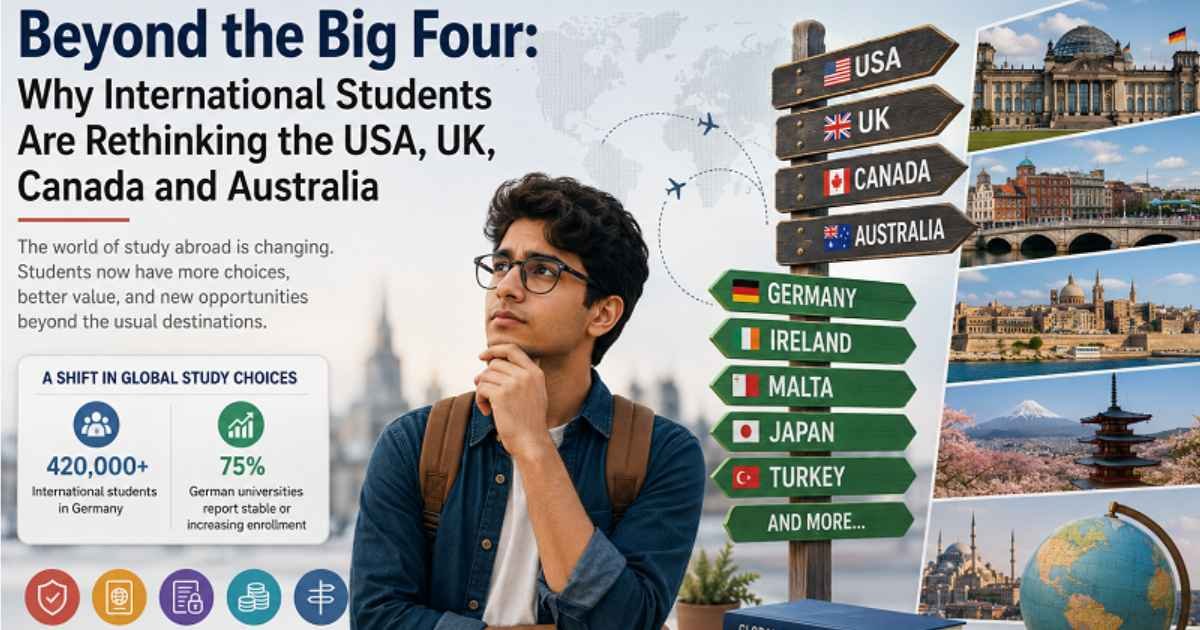
For nearly two decades, the calculus was simple. If you were a bright student in Chandigarh, Lahore, or Lagos plotting an overseas degree, you picked one of four countries and worked backward from there. That default is cracking. Germany now hosts more than 420,000 international students, and roughly three in four of its universities report enrollment that’s holding steady or climbing. Ireland, Malta, Japan, and Turkey are quietly absorbing applicants — many of them Indian and Pakistani students who, five years ago, wouldn’t have looked past a US or UK acceptance letter. This isn’t a fringe trend. It’s a redistribution of where the world’s students think their money and years are best spent, and it’s reshaping how counselors, universities, and platforms serving this audience need to talk about “where to study.”
The Cracks in the Big Four’s Default Status
The Big Four earned their dominance through a mix of language advantage, established alumni networks, and post-study work pathways that made the degree feel like a down payment on a career, not just a credential. That value proposition hasn’t disappeared, but it’s gotten noisier. Visa processing delays, shifting policy signals, and public political friction around immigration have made “safe choice” feel less safe than it used to.
The numbers back this up at a structural level. Across a recent global benchmark survey, 62% of surveyed institutions flagged visa or policy uncertainty as a significant barrier to enrollment. That’s a striking figure — nearly two-thirds of institutions worldwide are telling prospective students, implicitly or explicitly, that the paperwork and policy environment now factor into the decision as heavily as tuition or ranking once did.
What makes this genuinely interesting, though, is the regional split. Only 6% of institutions in Asian countries reported the same level of concern. That gap is the real story. While Western administrators grapple with policy churn, a cluster of Asian and Southern European destinations are positioning themselves as the calm alternative — stable, comparatively affordable, and increasingly willing to market directly to the students the Big Four used to take for granted.
Where Students Are Actually Going — and Why
Germany’s pull is the clearest data point. Tuition-free or low-cost public universities, a growing number of English-taught master’s programs, and a labor market hungry for skilled graduates have turned it into more than a “backup” option — it’s now a first choice for a meaningful share of engineering and STEM applicants. Add in the EU Blue Card pathway, and Germany offers something the Big Four increasingly struggle to promise cleanly: a legible, relatively predictable route from student visa to work visa to settlement.
Ireland has leaned into its English-language advantage and EU access without the scale (or scrutiny) of the UK. Malta, smaller still, has carved out a niche in business and hospitality-adjacent programs with a lighter regulatory footprint. Japan’s play is different — it’s courting students through targeted scholarships and an aging workforce that needs skilled immigration, particularly in technical fields. Turkey has become a genuine contender for students who want a Europe-adjacent experience without EU-level costs, and its universities have been aggressive about English-medium program expansion.
None of this happened by accident. Each of these countries has run deliberate, well-funded international recruitment campaigns over the past three to four years, timed almost precisely to when Big Four policy headlines started generating anxiety rather than confidence.
The Student Segment Driving This Shift
It’s worth being specific about who is moving. This diversification isn’t evenly distributed across all applicant pools — it’s concentrated among Indian and Pakistani students, historically two of the largest source markets for the US, UK, Canada, and Australia combined. When a segment that large starts hedging its bets across five or six countries instead of defaulting to one, universities and platforms that serve them need to update their content and advising strategy accordingly, not just their headlines.
What This Means for Students Weighing Their Options
Here’s where the narrative needs a correction, because it’s easy to read the headlines above and conclude the Big Four are in decline. That’s not quite right. Some vendor surveys — ApplyBoard and IDP among them — still show the US gaining share on pure affordability and OPT value, even amid the policy noise. The picture is genuinely mixed, and country rankings built from these surveys should be read as directional signals, not precise leaderboards.
The US, in particular, still has a strong case to make. Optional Practical Training remains one of the most valuable post-study work benefits available anywhere, and for STEM graduates specifically, the extended OPT window is hard to match. The UK’s upcoming 2027 Graduate Route cuts and Canada’s tightened permit caps are real headwinds for those two countries specifically — but they don’t automatically hand Germany or Turkey the advantage by default. They just mean students now have to actually compare, rather than assume.
That comparison work is exactly where students get stuck, and where good research support matters most. Weighing a German public university’s tuition savings against a US university’s higher sticker price but stronger OPT-to-H-1B pipeline isn’t a five-minute decision — it involves modeling total cost of attendance, realistic post-study earning potential, and visa risk tolerance all at once. Platforms like Tutorsglobe have become a go-to resource for students trying to work through exactly this kind of cross-country academic and career planning, offering subject-specific guidance across disciplines so students aren’t making six-figure decisions off a single blog post or forum thread.
The Bigger Picture: A Multi-Polar Study Abroad Market
Step back far enough and what’s happening isn’t really “decline of the Big Four” — it’s the end of a four-country monopoly on international education. For most of the 2000s and 2010s, “study abroad” was functionally shorthand for these four countries. That’s no longer true, and it’s not going back to true.
For universities and institutions, this means recruitment can no longer assume brand recognition does the work. A German or Turkish university actively selling itself to a student in Karachi has to explain, in detail, why its degree and its visa pathway are worth betting on — and that explanatory burden is pushing up the overall quality of information available to applicants, which is a genuinely good thing for students even if it complicates the marketing landscape for everyone else.
For students and their families, the practical takeaway is that the “safe default” era is over. Every country on the list — Big Four included — now has to be evaluated on its current policy environment, not its historical reputation. That’s more work upfront, but it also means students have more real leverage and more real options than they did a decade ago.
The next few admissions cycles will be the real test. If Germany’s numbers keep climbing and the 6% Asian-institution concern figure holds steady while Western institutions’ concern climbs further, this stops being a diversification story and becomes a genuine market realignment — one that content, advising, and platform strategy aimed at this audience will need to keep pace with.
FAQs
Is it still worth applying to the US, UK, Canada, or Australia in 2026? Yes, for many students it still makes sense — particularly for those prioritizing OPT value or Canada’s established immigration pathways. But it’s no longer the automatic first choice it once was, and it’s worth comparing against emerging destinations before committing.
Why is Germany gaining so much traction with international students? Low or no tuition at public universities, strong STEM demand, and a clear visa-to-work-to-settlement pathway via the EU Blue Card make it financially and practically competitive with the Big Four.
Are Ireland, Malta, Japan, and Turkey good alternatives to the Big Four? They’re strong options depending on the field and budget — Ireland and Malta for EU-adjacent access, Japan for scholarships and technical fields, Turkey for affordability with a Europe-adjacent experience. None fully replicate the Big Four’s scale, but each fills a specific niche well.
Why are Indian and Pakistani students leading this shift away from the Big Four? These two markets have historically sent the largest volumes of students to the Big Four, so any policy friction there is felt most acutely by these applicant pools — making them the fastest to diversify toward alternative destinations.
Does the UK’s 2027 Graduate Route change mean students should avoid the UK entirely? Not necessarily, but it does reduce the post-study work window, which changes the cost-benefit calculation, especially for students relying on work experience to offset tuition costs.
How should students actually compare study destinations beyond just rankings? Focus on total cost of attendance, realistic post-study work rights, visa policy stability, and field-specific outcomes rather than general reputation — the Big Four’s brand advantage matters less than it used to.
Disclaimer: The information provided in this article is for general informational and educational purposes only. It does not constitute professional immigration, educational, or career advice. Study‑abroad policies and visa regulations change frequently; students should always consult official government sources and university advisors before making decisions. The mention of specific countries, programs, or support platforms is illustrative and does not imply endorsement. The author and publisher disclaim all liability for any decisions or outcomes based on this content. This article does not guarantee admission, visa approval, or employment outcomes.
Looking for a competitive edge? Our strategic playbooks reveal the moves that matter most right now.