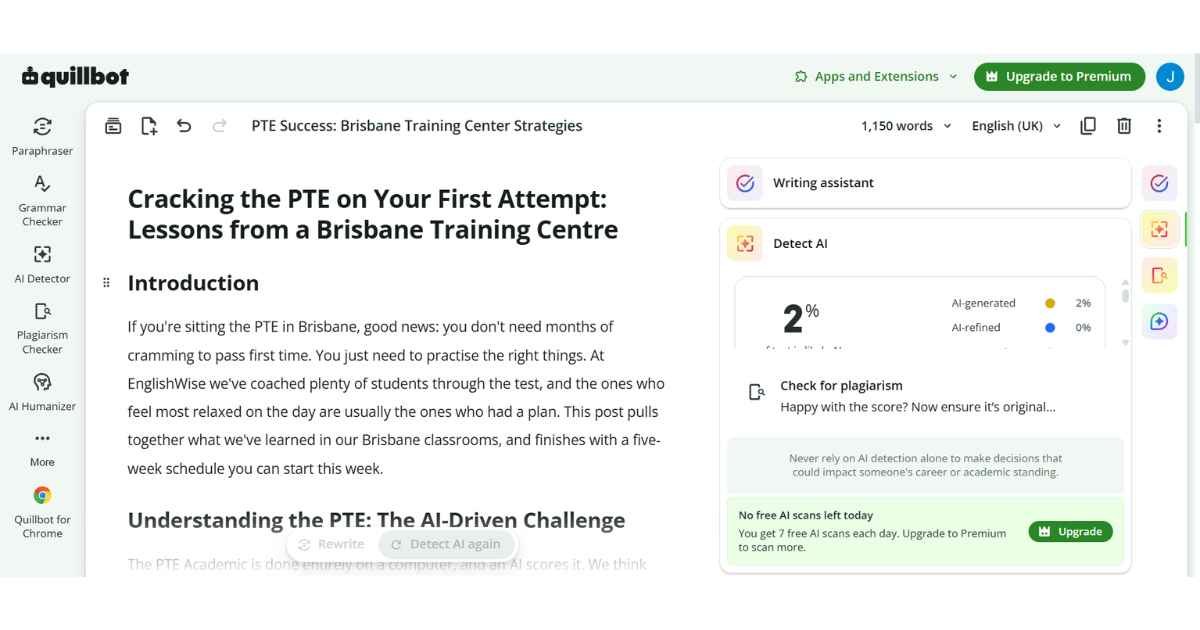
If you’re sitting the PTE in Brisbane, good news: you don’t need months of cramming to pass the first time. You just need to practise the right things. At EnglishWise, we’ve coached plenty of students through the test, and the ones who feel most relaxed on the day are usually the ones who had a plan. This post pulls together what we’ve learned in our Brisbane classrooms, and finishes with a five-week schedule you can start this week.
Understanding the PTE: The AI-Driven Challenge
The PTE Academic is done entirely on a computer, and an AI scores it. We think that’s a real plus. There’s no examiner having an off day, so the same answer earns the same mark every time. The whole test runs about two hours and covers speaking, writing, reading and listening, with plenty of overlap between them. A good response in one task can quietly lift two different scores. So once you know what the software listens for, you can practise exactly that, and your study time goes a lot further.
Core Lessons from the Brisbane Training Centre
Spend a few weeks in our Brisbane classrooms and you’ll hear the same four ideas over and over. Students who take them on board usually feel more in control, and their scores tend to follow. Here’s what we teach and why it sticks.
Strategy 1: Prioritising the High-Weight Tasks
Some tasks give you more bang for your effort. Read Aloud, Repeat Sentence and Summarize Written Text each count towards more than one skill, and Describe Image and the essay carry a lot of weight in Speaking and Writing. So that’s where we start. Get those tasks feeling comfortable first, and the smaller ones are easy to tidy up later. Put your hours where the points are and your total moves faster than you’d expect.
Strategy 2: Mastering Oral Fluency Over Perfect Accents
You don’t need to sound like a newsreader. The PTE cares about whether people can understand you, and your own accent is perfectly welcome. What helps is an even pace, natural pauses and clear words. In class we get students talking at a steady, comfortable speed and carrying on if a word comes out a bit wobbly. Record yourself on your phone, listen back that evening, and you’ll hear the improvement within days.
Strategy 3: Navigating the Dreaded “3-Second Silence” Rule
The mic closes if it hears about three seconds of silence, so the trick is to keep a gentle flow going. It sounds trickier than it is, and most students have it sorted after a few sessions. Start talking as soon as the recording opens. If you need a second to think, a short linking phrase like “as we can see here” buys you time and keeps the rhythm. Calm and steady beats fast and frantic every time.
Strategy 4: Moving Beyond Rigid Templates
A template is a handy scaffold, but the students who score best make it their own. The software looks for content that fits the prompt, clear structure and natural English. So we treat a template as a frame, then ask students to fill it with their own ideas and words. Your essay on city transport will naturally sound different from your essay on remote work: same bones, fresh content.
The Role of Targeted Practice and Feedback
Good practice is about quality, not just quantity. The right materials, quick feedback and a little expert guidance help you improve faster, and you’ll walk into the exam knowing what to expect. This is how we set it up.
Why Generic Practice Tests Fail You
Regular English exercises are lovely for building your skills, but the PTE has its own rhythm: its own task types, on-screen timers and quick pacing. Practising with PTE-style material means test day feels familiar. You’ve already seen the screen, heard the beeps and felt how fast it moves. That familiarity frees up your brain to focus on the answer itself.
Leveraging AI Mock Exams for Pinpoint Accuracy
The real test is scored by AI, so AI mock exams make a lot of sense. You get instant feedback on pronunciation, fluency, content and grammar, which shows you exactly where to spend tomorrow’s study time. One student might find Repeat Sentence is their quickest win, while another spots that their essay structure needs a little polish. Either way, you stop guessing and start practising with purpose.
The Value of Expert Human Intervention
The numbers tell you what happened, and a good trainer tells you why. Our Brisbane trainers listen to you speak, read your writing and give friendly, practical tips that suit how you actually work. Often a tiny tweak, like adding a linking word or slowing the start of a sentence, lifts a score noticeably. And honestly, having someone in your corner does wonders for your confidence.
Blueprint for a First-Time Pass: A Step-by-Step Action Plan
Five weeks is a good amount of time, and a clear plan keeps every session worthwhile. Each stage builds on the one before, so you’ll feel more confident as test day gets closer. Here’s a plan you can start straight away.
Week 1-2: Diagnostic Testing & System Familiarisation
Start with a full diagnostic test, so you know where you stand in all four skills. Then get friendly with the test platform: the screen layout, the headset, the microphone check and the timers. Work through each task type and jot down what you already do well. By the end of week two, you’ll have clear goals and a short list of things to work on.
Week 3-4: Intensive Section-Specific Drilling
Now you can dig in. Give each study session to one section: Speaking on Monday, Writing on Tuesday, Listening and Reading later in the week, for example. Run short, regular drills on the high-weight tasks, record your speaking and look over your results every few days. Ask your trainer for feedback and set small targets, such as smoother fluency or a tighter essay structure. Small wins add up fast.
Week 5: Full Mock Exams & Time Management Tweaks
Sit two or three full mock exams under real conditions, with the same timings and no pauses. Check your results to fine-tune your pacing so you know roughly how long each task deserves. Keep the last few days light: revisit your favourite strategies, double-check your booking and get plenty of sleep. Turning up rested and prepared is the best possible start.
Conclusion
You can pass the PTE on your first attempt. Focus on the high-weight tasks, speak with a steady flow, keep your rhythm going and treat templates as flexible frames. Add targeted practice and good feedback, follow the five-week plan, and you’ll be ready. If you’d like a hand along the way, the friendly team at EnglishWise would love to help you take the next step.
Disclaimer: This article is for general informational purposes only and does not constitute professional test-preparation, educational, or immigration advice. PTE Academic test structure, scoring, task weightings, timing, and platform features are set by Pearson and may change without notice. Test-day rules—including the microphone and silence thresholds described—should be verified against the current official Pearson test-taker guidance. Strategies described reflect the training centre’s general teaching approach and do not guarantee a specific score or a first-attempt pass; individual results vary by starting proficiency, practice quality, and test-day conditions. Details about EnglishWise—including its coaching approach, classroom methods, and AI mock exam feedback—are based on the provider’s own statements and have not been independently verified; their mention does not imply endorsement. Readers should confirm current test requirements and any visa or migration-related score requirements with Pearson and the relevant authority before booking. The author and publisher disclaim any liability for decisions made based on this content.
Learn to lead yourself first—our self-leadership guides help you take charge of your direction and decisions.