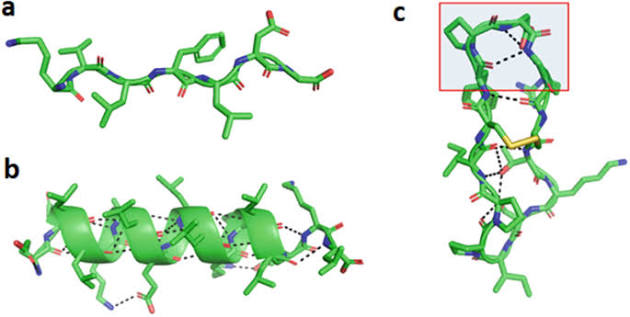
A peptide is a short chain of amino acids, and a protein is a longer chain that usually folds into a working shape. Peptides vs proteins comes down mostly to length. There is no single official cutoff, though around 50 amino acids is a common rule of thumb, and even the official naming rules admit that scientists disagree on the exact point.
What is a peptide?
Start with the building blocks. An amino acid is a small molecule with an amino group, a carboxyl group and a side chain, and the side chain is what makes each one different. Living things build their proteins mainly from 20 of them.
Now join two. When the carboxyl group of one amino acid reacts with the amino group of the next, they link and give off a molecule of water. That link is called a peptide bond.
Two amino acids make a dipeptide. Three make a tripeptide. In 1901, Emil Fischer and Ernest Fourneau made the first free dipeptide in the lab, glycylglycine, and by 1906 Fischer’s group had built about 65 different peptides of various lengths.
Where does a peptide end and a protein begin?
Nobody ever set one official number.
The closest thing to a rulebook is the naming guide written by the joint IUPAC-IUB commission on biochemical nomenclature. It says chains of fewer than about 10 to 20 amino acids may be called oligopeptides and longer ones polypeptides, and that chains of a specific sequence with more than about 50 are usually known as proteins. In the same passage, it adds that authors differ greatly on where they start using the word protein.
So 50 is a convention. Shape matters too, since a protein is usually long enough to fold into a specific three-dimensional form that lets it do its job.
Peptide or protein? Four examples
| Molecule | Amino acids | Usually called |
|---|---|---|
| Glutathione | 3 | Peptide (tripeptide) |
| Oxytocin | 9 | Peptide hormone |
| BPC-157 | 15 | Synthetic peptide |
| Insulin | 51 | Peptide hormone, and a protein |
Glutathione is made of glutamate, cysteine and glycine. Its first bond runs through the side chain of glutamate, an unusual spot that leaves some people asking whether glutathione counts as a peptide. The naming rules say it does. They even use glutathione as their worked example.
Oxytocin has nine amino acids, and two of them, both cysteines, are linked by a sulfur bridge. In 1953, Vincent du Vigneaud made oxytocin from scratch, and the 1955 Nobel Prize in Chemistry cited his first synthesis of a polypeptide hormone.
BPC-157 is a lab-made chain of 15 amino acids whose sequence comes from a protein in human gastric juice, and it has been studied almost entirely in animals, with guides such as BuyBPC157.org comparing the vials and capsules on the market.
Insulin sits right on the line. It has 51 amino acids split between two chains, 21 in the A chain and 30 in the B chain, held together by disulfide bonds. Frederick Sanger worked out that sequence during the 1950s, making insulin the first protein ever sequenced, and he won the 1958 Nobel Prize in Chemistry for it. Scientists call it a peptide hormone and also a protein. Both labels stick.
A quick classroom check
The table makes an easy review round. A true/false question set could ask whether insulin is shorter than oxytocin (false), whether a peptide bond gives off water as it forms (true), and whether there is one official cutoff between peptides and proteins (false).
FAQs
What is the difference between a peptide and a protein?
Length, mostly. Both are chains of amino acids joined by peptide bonds. Chains of more than about 50 amino acids are usually called proteins, though no single official cutoff exists.
Is insulin a peptide or a protein?
Both. With 51 amino acids it sits just past the usual line, and it is often called a peptide hormone.
What is the smallest peptide?
A dipeptide. That is two amino acids joined by a single peptide bond.
Sources
- IUPAC-IUB Joint Commission on Biochemical Nomenclature. Nomenclature and symbolism for amino acids and peptides, Recommendations 1983.
- Nobel Foundation. The Nobel Prize in Chemistry 1955: Vincent du Vigneaud.
- Nobel Foundation. The Nobel Prize in Chemistry 1958: Frederick Sanger.
- Nobel Foundation. Emil Fischer, biographical.
- Lu SC. Glutathione synthesis. Biochimica et Biophysica Acta, 2013.