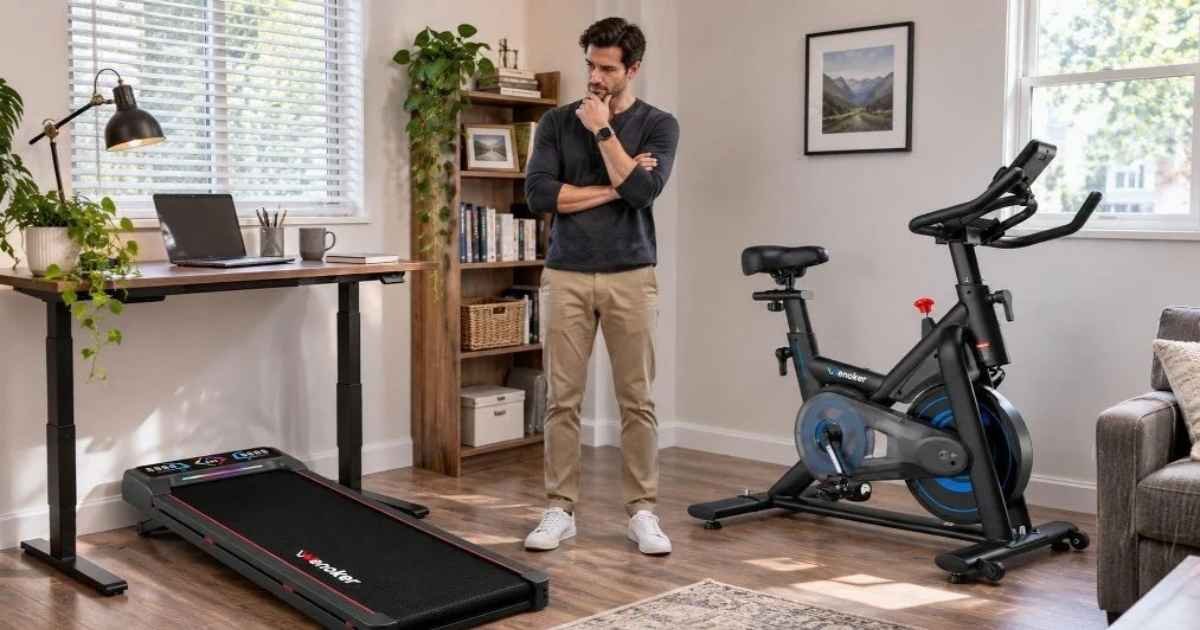
Remote and hybrid workers usually approach midday movement in one of two ways. Some want to keep walking during light tasks, while others prefer stepping away from the laptop for a short, focused break.
Choosing between a walking pad or exercise bike works best when you evaluate your tasks first, then check your room layout and daily setup routine. Following that sequence makes home cardio for busy schedules far easier to maintain.
Start With the Kind of Break You Actually Have
Before comparing hardware, separate your workday into two distinct windows: time when you still need to handle light work, and time when you can pause completely. A walking pad for work breaks can be worth considering during low-focus moments such as reading simple updates or listening to an audio briefing.
However, walking does not pair smoothly with every task, and not everyone can type comfortably while moving. Any work that calls for fine mouse control, deep concentration, or a steady camera frame should be handled while standing still or seated.
An exercise bike for home office spaces suits a different rhythm altogether. Seated cycling creates a clear start and finish, making it a natural fit when you want to step away from your desk and return refreshed. Neither format is a medical solution or a guaranteed weight-loss tool—the goal is simply choosing a movement that fits your actual workday.
Measure the Space You Will Use, Not Only the Space You Can Store
Compact equipment often looks effortless in a product photo, yet real apartment and office layouts are rarely that forgiving. Measure the active space each machine requires during use rather than focusing only on where it sits afterward.
For a walking pad, check the floor length you need for a natural stride, the clearance beneath your desk, and safe room to step on and off. You should also plan where the power cord will run and how you will slide the unit away without tripping hazards. Because desk heights and room layouts vary widely, never assume a walking pad will fit neatly under every workstation.
For an exercise bike, measure the space required to mount and dismount, adjust the seat and handlebars, and lay down a protective mat without brushing nearby furniture. Walk through a normal workday in your head before buying. Ask yourself whether starting a session would force you to haul away an office chair, shift a table, or clear your desk every single time.
Compare the Steps Between “I Have Ten Minutes” and Starting
Short breaks disappear quickly when preparation takes too many steps. Count everything required between deciding to move and actually starting: pulling the machine out, plugging it in, adjusting your posture, setting resistance, and restoring your workspace afterward.
Hardware details directly shape that daily flow. For example, the official product page for the Wenoker T10 lists remote control operation and built-in transport wheels, which can simplify repositioning and speed adjustments during brief breaks. Meanwhile, the official page for the Wenoker S20 lists an adjustable seat and handlebars, a physical resistance knob, and transport wheels for straightforward manual control.
Shared households add one more factor to check before ordering. Footsteps, motor hum, pedaling cadence, and frame vibration all behave differently depending on flooring, room acoustics, and how you use the equipment. Neither a walking pad nor an exercise bike can be promised as completely silent, so consider roommates, family members, and nearby calls when planning your routine.
Use a One-Week Test to Make the Choice
Instead of guessing, track your normal schedule for five workdays before placing an order. Note three practical details each day: how many real break windows appear, how long you can step away from your screen, and whether your planned workout spot stays clear.
At the end of the week, let your own log guide the decision:
- If you regularly have light tasks where gentle walking feels practical and your desk area stays open, focus your search on a walking pad.
- If you prefer stepping away from your laptop for a dedicated seated break with clear boundaries, focus on an exercise bike.
- If both patterns show up across your week, choose whichever option blends into your current schedule without forcing you to rearrange the room.
Readers comparing home cardio options can review the current range at www.wenoker.com.
Conclusion
Choosing between a walking pad or exercise bike comes down to three practical checks: the kind of tasks you handle, the active space your room offers, and the steps needed to start and stop. Let one realistic workweek guide your decision so your equipment supports your routine instead of competing with it.
Disclaimer: The information in this article is for general informational purposes only and does not constitute medical, fitness, or professional advice. Exercise equipment is not a medical solution or a guaranteed weight-loss tool, and individual results and suitability vary. Readers should consult a qualified healthcare professional before starting any new exercise routine, and verify all product specifications, space requirements, and safety details directly with the manufacturer or retailer before purchasing. Any mention of specific products or brands does not imply endorsement. The author and publisher disclaim any liability for decisions made based on this content.
Turn your everyday resilience into your greatest strength—our resilience-as-a-skill guides help you face whatever comes with steadiness and confidence.