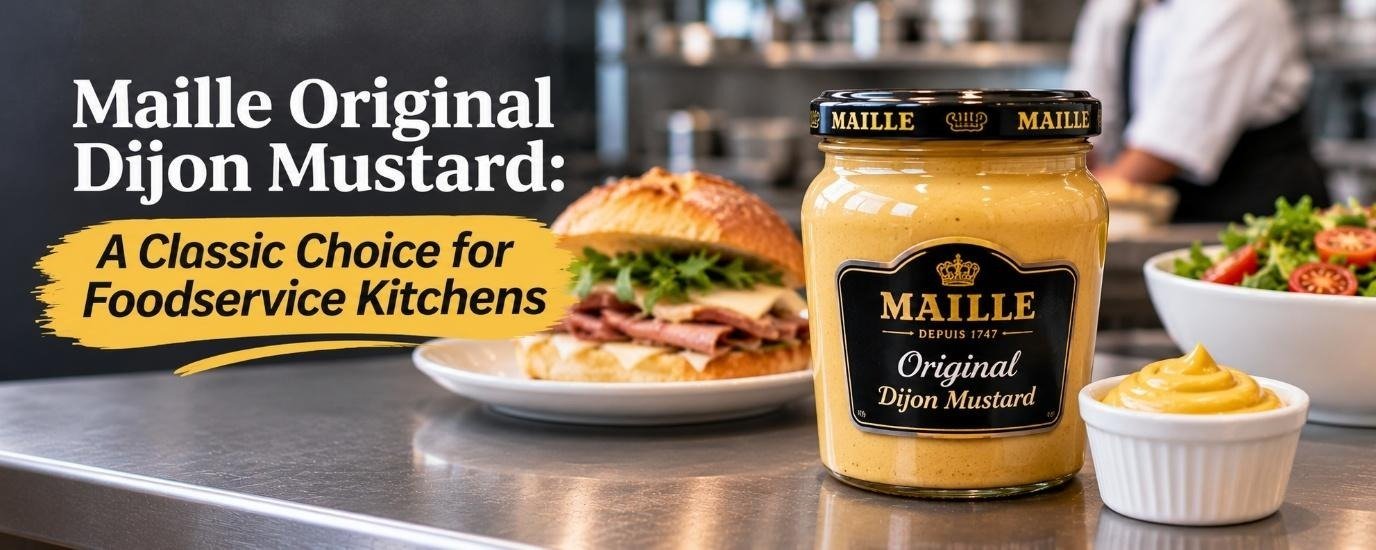
Some ingredients earn their place in a commercial kitchen by doing more than one job.
Maille Original Dijon Mustard is a good example.
A foodservice operator can use Dijon mustard as a straightforward condiment, but its applications extend much further. It can bring sharpness to sandwiches, add character to vinaigrettes, provide depth to sauces, complement meats and help create distinctive dips and spreads.
That versatility matters in a professional kitchen.
Restaurants are constantly balancing menu variety against inventory complexity. Ingredients that work across several dishes can make it easier to create new flavours without adding a separate product for every menu item.
Maille also brings considerable history to the category. La Maison Maille dates back to 1747, when Antoine-Claude Maille opened his first boutique in Paris.
For Canadian restaurants, cafés, hotels, caterers and institutional kitchens, Maille Dijon mustard can therefore offer a combination of recognizable flavour, culinary versatility and practical foodservice applications.
Here’s how operators can make the most of it.
What Is Dijon Mustard?
Dijon mustard is known for a sharper and more distinctive flavour profile than many mild prepared mustards.
That makes it useful when a recipe needs acidity, pungency and savoury depth without requiring a complicated preparation.
Maille describes its Dijon Original Mustard as having a creamy texture, spicy taste and smooth finish.
The manufacturer’s ingredient list for its traditional Dijon formulation includes water, mustard seeds, vinegar, salt, citric acid and sodium metabisulfite.
For restaurant operators, however, the most important characteristic may be versatility.
Dijon can work as:
- A condiment
- A sandwich spread
- A vinaigrette ingredient
- A sauce component
- A dip ingredient
- A glaze component
- A marinade ingredient
- A flavour base
One container can therefore support multiple sections of a menu.
Maille Has Been Making Mustard Since the 18th Century
Brand history can be useful when it is factual rather than simply promotional.
Maille’s documented history stretches back more than 275 years.
In 1747, Antoine-Claude Maille opened the brand’s first boutique on rue Saint-André des Arts in Paris and became an official supplier to the court of Louis XV.
The company later expanded its presence, and in 1845 a Maille boutique opened in Dijon, in France’s Burgundy region.
Maille says its Dijon mustards are produced using a process in which mustard grains are cut rather than crushed to achieve their fine texture.
That long association with mustard provides genuine culinary heritage behind the brand rather than a recently created marketing story.
Why Dijon Mustard Works Well in Foodservice
Commercial kitchens need ingredients that perform consistently across different applications.
A highly specialized condiment that works with only one menu item may be difficult to justify unless that dish sells in significant volume.
Dijon mustard is different.
It can move across:
Breakfast
Lunch
Dinner
Appetizers
Sandwiches
Dressings
Sauces
Catering
That makes it easier for operators to cross-utilize inventory.
The more useful applications an ingredient has, the easier it may be to maintain inventory turnover and reduce the number of single-purpose products occupying storage space.
1. Upgrade Sandwiches and Burgers
One of the simplest applications is also one of the most useful.
Dijon can add flavour to:
- Beef burgers
- Chicken sandwiches
- Turkey sandwiches
- Ham sandwiches
- Roast beef
- Grilled vegetable sandwiches
- Croissant sandwiches
- Paninis
It can be used by itself or combined with other ingredients to create a custom spread.
For example:
Dijon + mayonnaise
creates a creamy mustard spread.
Add herbs, garlic, horseradish or another complementary flavour and the same basic combination can become a signature condiment.
Unilever Food Solutions Canada demonstrates this versatility in its professional recipes. Its mushroom burger uses Maille Dijon Originale directly on the bun alongside portobello mushroom, smoked Gouda and herb mayonnaise.
This is a good example of using Dijon to provide contrast against richer ingredients.
2. Build Signature Mustard Sauces
Dijon mustard can serve as the starting point for numerous restaurant sauces.
Possible combinations include:
Creamy Dijon Sauce
Combine Dijon with a creamy base and complementary seasoning.
This can work with chicken, potatoes, vegetables and sandwiches.
Horseradish Dijon
Dijon and horseradish create a sharper sauce suited to burgers, beef and roasted vegetables.
Unilever Food Solutions Canada’s professional recipe library uses Maille Dijon Originale with mayonnaise and fresh horseradish to create a Horseradish Dijon Sauce.
Honey Dijon
Sweetness can balance mustard’s sharper flavour.
Honey Dijon can work as:
- A dipping sauce
- A sandwich condiment
- A salad dressing
- A glaze component
Herb Dijon
Fresh herbs can move Dijon in a lighter direction.
Depending on the menu, operators might experiment with herbs that complement the rest of the dish.
The advantage is flexibility.
The kitchen can use one core mustard to create several finished sauces.
3. Make Dijon Vinaigrette
Vinaigrette is one of the classic applications for Dijon mustard.
A basic version might combine:
- Dijon mustard
- Vinegar
- Oil
- Seasoning
Additional ingredients can create different flavour profiles.
Operators might incorporate:
- Herbs
- Shallots
- Garlic
- Honey
- Citrus
- Pepper
Maille itself recommends its Dijon Original for mustard vinaigrette.
For foodservice operations, a Dijon vinaigrette can potentially work across salads, grain bowls, roasted vegetables and other dishes.
This cross-utilization can make a house dressing more operationally useful.
4. Pair Dijon With Chicken
Chicken provides a relatively neutral canvas for stronger condiments.
Dijon can be used in:
- Chicken sandwiches
- Chicken marinades
- Creamy chicken sauces
- Chicken salad
- Glazes
- Dipping sauces
Maille specifically identifies chicken recipes as an application for its Original Dijon Mustard.
Operators can also combine mustard with herbs, honey, garlic or creamy ingredients to create different flavour profiles from the same base product.
That allows a kitchen to refresh chicken dishes without necessarily changing the core protein.
5. Use It With Beef and Other Red Meats
Mustard and beef are a familiar pairing.
Maille identifies red meat as one of the traditional applications for its Dijon Original.
Foodservice operators might use Dijon with:
- Roast beef sandwiches
- Burgers
- Steak
- Beef tenderloin
- Beef-based appetizers
The mustard can be served directly or incorporated into another sauce.
A creamy Dijon sauce, for example, provides a different experience from serving mustard alone.
This gives operators an opportunity to move between casual and more premium menu presentations using the same core condiment.
6. Add Character to Fish Dishes
Maille also recommends Dijon Original for fish recipes.
Mustard can provide acidity and sharpness that contrasts with richer fish preparations.
Depending on the recipe, Dijon might appear in:
- Sauces
- Marinades
- Glazes
- Sandwich spreads
- Dressings served with seafood
As with any seafood application, operators should test the balance carefully.
The goal is to complement the fish rather than overwhelm it.
7. Create Better Dipping Sauces
Dipping sauces continue to give restaurants a relatively simple way to offer customization.
Maille Dijon can become part of sauces for:
- French fries
- Chicken tenders
- Roasted potatoes
- Vegetables
- Sandwiches
- Appetizers
Consider combinations such as:
Dijon + mayonnaise
Dijon + honey
Dijon + horseradish
Dijon + herbs
Dijon + garlic
One mustard can therefore support several dipping options.
For operators, that can create flavour variety without stocking an entirely separate prepared sauce for every application.
8. Give Plant-Forward Dishes More Flavour
Dijon mustard does not have to be reserved for meat.
It can work particularly well with roasted vegetables and grain-based dishes.
Unilever Food Solutions Canada provides a useful professional example: its recipe collection uses Maille Dijon Originale in a Creamy Horseradish Dijon Sauce for a bowl featuring farro, roasted Brussels sprouts, butternut squash, parsnips, spinach and grilled cauliflower.
This demonstrates how mustard can contribute flavour to vegetable-centred dishes rather than simply serving as a burger condiment.
Foodservice operators can explore Dijon alongside:
- Roasted cauliflower
- Potatoes
- Mushrooms
- Grain bowls
- Vegetable sandwiches
- Roasted root vegetables
The best application will depend on the overall flavour profile of the dish.
9. Use Dijon to Balance Rich Foods
One reason mustard works across so many dishes is contrast.
Rich ingredients can benefit from acidity and pungency.
Think about:
Cheese + Dijon
Creamy sauce + Dijon
Beef + Dijon
Mayonnaise + Dijon
Roasted potatoes + Dijon
The mustard can prevent a rich dish from tasting one-dimensional.
This is particularly useful in sandwiches and sauces where several fatty or creamy components appear together.
10. Build a House Dijon Mayo
A restaurant does not necessarily need to purchase a separate flavoured mayonnaise for every menu concept.
Combining Dijon with mayonnaise can create a versatile spread for:
- Burgers
- Chicken sandwiches
- Wraps
- Deli sandwiches
- Fries
- Roasted potatoes
The ratio can be adjusted according to the desired mustard intensity.
Additional ingredients can then create variations.
For example:
Garlic Dijon Mayo
Herb Dijon Mayo
Spicy Dijon Mayo
Horseradish Dijon Mayo
This approach gives operators more menu flexibility from a smaller group of core ingredients.
11. Add Flavour to Potato Dishes
Potatoes provide another useful application.
Maille itself recommends Dijon for hot potato salad.
Foodservice operators can also explore it with:
- Roasted potatoes
- Potato salad
- French fries
- Potato-based appetizers
- Mashed potato preparations where appropriate
A Dijon dressing can help transform a familiar side dish into something more distinctive.
For catering, potato salads and roasted potato dishes can also provide opportunities to use mustard flavours at scale.
12. Support Breakfast and Brunch Menus
Dijon is not limited to lunch and dinner.
Breakfast sandwiches containing egg, cheese, ham or other savoury ingredients can benefit from a mustard-based spread.
Possible applications include:
- Croissant breakfast sandwiches
- Egg sandwiches
- Ham and cheese sandwiches
- Breakfast burgers
- Savoury brunch dishes
A Dijon-based sauce can add complexity without requiring another major preparation.
For operations serving several dayparts, this improves ingredient cross-utilization.
13. Use Dijon in Catering
Catering kitchens need ingredients that can work across multiple menu formats.
Dijon can potentially support:
- Sandwich platters
- Salad dressings
- Dipping sauces
- Meat entrées
- Vegetable dishes
- Cold salads
- Buffet condiments
One ingredient serving several catering applications can simplify purchasing.
It may also help operators maintain consistency between restaurant and catering menus.
14. Foodservice Formats Matter
The requirements of a restaurant kitchen are different from those of a household.
A small retail jar may work at home, but a high-volume operation needs packaging appropriate to its usage.
Unilever Food Solutions Canada lists Maille Dijon Originale Mustard in a 4 × 4.1 kg foodservice format in its professional recipe system.
That type of format can be useful for operations preparing sauces, dressings, sandwiches or other mustard-based dishes in volume.
But bigger is not automatically better.
Operators should match pack size to actual usage.
Consider:
- Weekly consumption
- Menu applications
- Storage
- Product rotation
- Supplier availability
A larger pack only creates value when the kitchen can use it efficiently.
15. Portion Control Protects Food Cost
Condiments may seem inexpensive compared with proteins or seafood, but uncontrolled portions can still affect food cost.
Suppose the recipe standard calls for 15 mL of mustard.
If employees regularly use 25 mL, the restaurant is using substantially more product than the recipe costing assumes.
Across thousands of sandwiches, that difference adds up.
Depending on the operation, portion control can involve:
- Measuring utensils
- Pumps
- Squeeze bottles
- Standardized recipes
- Pre-portioned sauces
The goal is consistency.
Customers should receive the flavour balance the recipe was designed to deliver.
16. Cross-Utilization Can Simplify Inventory
Every additional SKU requires:
- Purchasing
- Receiving
- Storage
- Inventory management
- Rotation
Ingredients that work across several dishes can therefore have operational advantages.
A foodservice kitchen might use Maille Dijon in:
Sandwiches
Burger sauces
Salad dressing
Chicken dishes
Beef dishes
Vegetable bowls
Dips
Catering
That versatility can make Dijon more useful than a condiment designed for only one dish.
It can also give chefs room to create new sauces without immediately introducing another purchased product.
17. A Familiar Ingredient Can Still Support Menu Innovation
Innovation does not always require an unfamiliar ingredient.
Sometimes the opportunity comes from using a classic ingredient differently.
Dijon can move from:
Condiment → dressing
Dressing → marinade
Marinade → glaze
Glaze → creamy sauce
Creamy sauce → dipping sauce
This allows chefs to create different menu experiences around a product customers already understand.
For restaurants concerned about introducing overly unfamiliar flavours, that familiarity can be valuable.
18. Menu Descriptions Can Communicate the Flavour
“Mustard” and “Dijon mustard” create different expectations.
Using accurate menu terminology can help customers understand what they are ordering.
Compare:
Chicken Sandwich with Mustard
with:
Grilled Chicken Sandwich with Dijon Herb Mayo
The second description communicates more about the flavour experience.
Similarly:
Roasted Potatoes
can become:
Roasted Potatoes with Creamy Dijon Sauce
when that accurately describes the dish.
Menu language should remain concise, appetizing and truthful.
19. Remember That Mustard Is a Priority Allergen in Canada
This is particularly important for Canadian foodservice.
Mustard is one of Canada’s priority food allergens.
The Canadian Food Inspection Agency identifies mustard among the priority allergens that can trigger allergic reactions in sensitive individuals.
Restaurants using Dijon mustard in sauces, dressings, marinades or recipes should therefore maintain accurate ingredient and allergen information.
This matters because mustard may not always be obvious to the customer.
Someone may expect mustard on a sandwich.
They may not expect it in:
- Vinaigrette
- Marinade
- Mayonnaise
- Glaze
- Cream sauce
Front-of-house and kitchen staff should know which recipes contain mustard and verify ingredient information when responding to allergy questions.
Never guess.
20. Check the Exact Product Information
Commercial product formulations and pack sizes can vary by market and format.
Operators should always consult the label and current supplier documentation for:
- Ingredients
- Allergens
- Nutrition information
- Storage instructions
- Product dates
- Preparation guidance
For example, Maille’s current traditional Dijon product information lists mustard seeds among its ingredients and includes sodium metabisulfite in the formulation shown on its North American product page.
Foodservice buyers should verify the exact Canadian SKU they purchase rather than assuming every Maille format has an identical formulation.
This is especially important when managing dietary or allergen information.
21. A Dijon Mustard Checklist for Foodservice Operators
Before adding or expanding the use of Maille Original Dijon Mustard, consider:
Applications: How many menu items can use it?
Volume: How much will the kitchen realistically consume?
Pack size: Does the foodservice format fit your operation?
Portion: How much belongs in each serving?
Cost: What does each portion contribute to recipe cost?
Flavour: Does the mustard complement the dish?
Versatility: Can it work in sauces, dressings and spreads?
Storage: Can the product be stored according to manufacturer instructions?
Allergens: Are staff aware that mustard is a priority allergen in Canada?
Menu communication: Are mustard-containing dishes described accurately?
Supplier: Can you obtain the required product consistently?
Thinking through these questions helps turn a familiar condiment into a deliberately managed foodservice ingredient.
A Classic Condiment With Modern Foodservice Potential
Maille has been associated with mustard since 1747, giving the brand a history that stretches back more than 275 years.
But history alone does not make an ingredient useful in a modern commercial kitchen.
Versatility does.
Maille Original Dijon Mustard can work as a straightforward condiment, but it can also become part of vinaigrettes, sandwich spreads, creamy sauces, dips, marinades and vegetable preparations.
Professional recipes from Unilever Food Solutions Canada demonstrate that versatility in applications ranging from mushroom burgers to creamy horseradish Dijon sauces for vegetable and grain bowls.
For Canadian foodservice operators, the opportunity is to think beyond mustard as something placed beside a burger.
Use it to create a signature sandwich spread.
Whisk it into vinaigrette.
Combine it with complementary ingredients for a dipping sauce.
Use it to add contrast to rich foods.
Cross-utilize it across lunch, dinner, brunch and catering.
And manage portions carefully so flavour and food cost remain consistent.
A strong commercial-kitchen ingredient does not have to be complicated.
Sometimes the most useful products are classics that can perform more than one job, across more than one part of the menu.
For restaurants looking for that kind of versatility, Maille Original Dijon Mustard remains a classic worth considering.
Explore Maille Mustard at FoodServiceDirect Canada
Bring more flavour and versatility to your commercial kitchen with Maille mustard products. From classic Dijon mustard to signature sauces, dressings, marinades, and sandwich spreads, Maille offers a range of culinary applications for restaurants and foodservice operators. Explore Maille products at FoodServiceDirect Canada to discover condiments and ingredients that complement your menu and support everyday kitchen needs.