You have watched students beg for one more round of Gold Quest. You have seen the memes. But when you actually try to answer a simple question, how old is Blooket, the internet gives you three different years. Some say 2018. Some say 2020. A few claim 2021. All three are technically pointing at something real, and none of them is the full story on its own. This guide breaks down the exact origin year, the public launch date, the founder story, and how the platform’s age compares to Kahoot, Quizlet, and Gimkit.
How old is Blooket? The direct answer
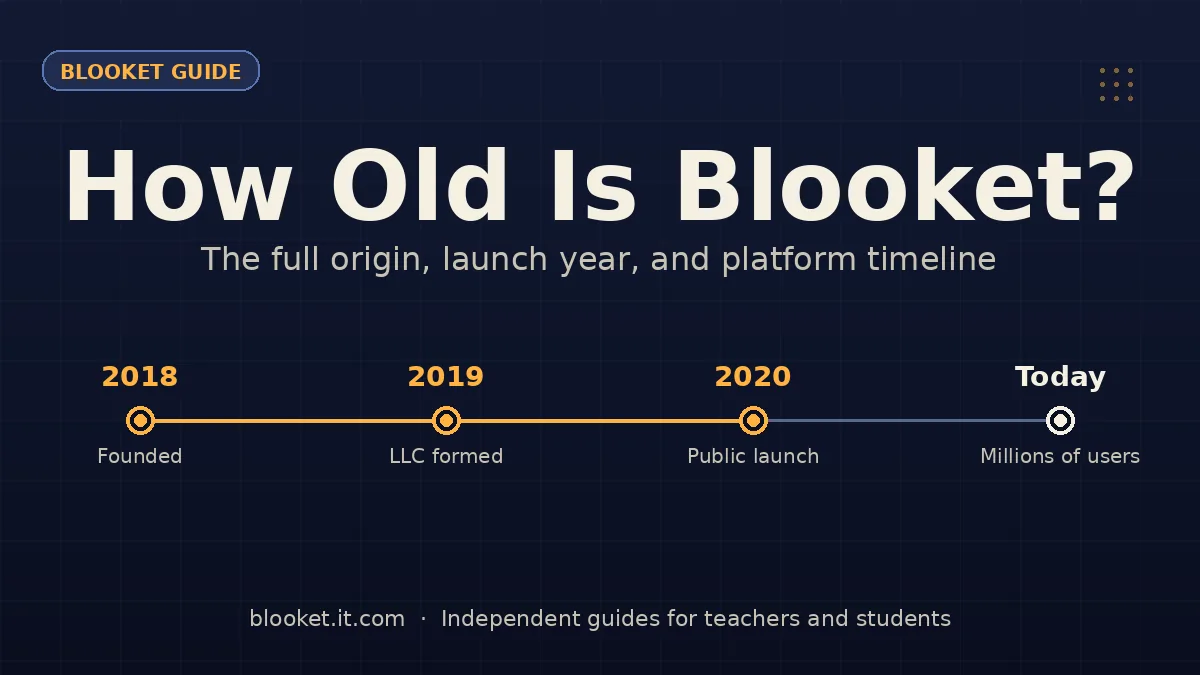
Blooket started as a private project in 2018 and launched publicly online in late 2020. Counted from the founding idea, it is around eight years old. Counted from the public launch, it is closer to six. Both answers are technically correct — they just measure different things.
The confusion between 2018 and 2020 is not a mistake or a conspiracy. It is the normal gap between a founding date and a launch date for a bootstrapped product. Most edtech tools spend a year or two in private development before teachers ever see them. Blooket followed that same pattern, only quieter than most.
For a fuller breakdown of the origin year itself, the Blooket creation date guide covers the exact domain-registration month and the earliest teacher-facing build.
The complete Blooket timeline: from a high school idea to millions of users
The Blooket timeline splits neatly into three phases: the private development phase (2018 to 2019), the public launch phase (2020 to 2021), and the growth phase that followed. Each phase answers a slightly different version of the age question, which is exactly why sources disagree.
2018: the high school origin
Ben Stewart was a senior at Appoquinimink High School in Middletown, Delaware when the first version of Blooket started taking shape. He was tired of the same handful of kids winning every classroom review game and thought randomness plus mini-game modes could fix it.
Stewart had no formal software background at that point. He taught himself web development in his spare time, worked on the platform during his last year of high school and into his first year of college, and paid for early hosting out of his own pocket. There was no team, no investors, no press.
2019: formal establishment as a company
Blooket was formally established as an LLC in 2019, according to the HundrED innovation database. This is when the project stopped being purely a personal experiment and started being run like a small business.
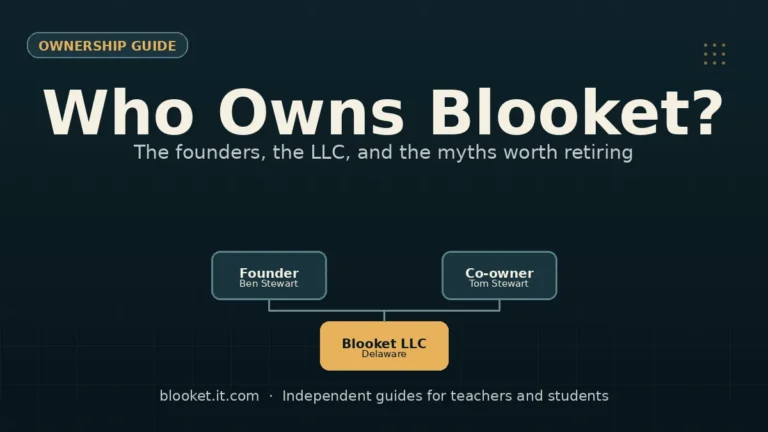
Ben’s older brother Tom Stewart came on board around this period to handle operations and business questions while Ben stayed on the product side. That two-brother split, developer plus operator, is still the structure of the company. If you want the full ownership picture, the who owns Blooket guide walks through it in detail.
2020: the official public launch
Blooket launched publicly online in late 2020. The timing was accidentally perfect. Schools were still deep in remote and hybrid learning, and teachers were burned out on the same three or four review tools. A new option that mixed quiz questions with actual game modes spread through teacher Facebook groups and Twitter almost immediately.
Within roughly a year of the public launch, Blooket had already signed up more than a million student accounts and started to appear in teacher recommendation lists alongside Kahoot and Quizizz. That growth happened without paid marketing.
2021 and 2022: rapid classroom adoption
The following two years turned Blooket from a promising newcomer into a common classroom tool across the United States. New game modes shipped steadily, including Tower Defense, Café, Racing, Battle Royale, and Fishing Frenzy, each with different pacing so teachers could match a mode to the length of a class.
In a 2021 founder interview, Ben Stewart put his design philosophy simply: he was tired of a game where getting one answer wrong effectively knocked a student out of the round. The mini-game layer was his fix. That interview is still one of the best on-the-record explanations of why Blooket looks the way it does.
Season updates and platform maturity
By the platform’s third year of public availability, Blooket had moved into a seasonal release model, with periodic Season updates adding new blook packs, market items, and limited-time collectibles. Season 5, for example, introduced a pirate-themed collection and roughly a hundred new blook parts.
The Blooket question bank guide covers how the question-set side of the platform grew during the same period. Sets became more shareable, teachers could import from Quizlet, and the library layer started to feel more like a community.
Accessibility focus and the ten million user milestone
Blooket passed ten million registered users during its post-launch growth phase, with reports also placing its valuation in the tens of millions of dollars. It has done all of this while remaining bootstrapped, with no public record of outside investment.
Around the same period the team added accessibility features that had been missing early on: text-to-speech for questions, keyboard-only navigation, and higher-contrast display modes. For students on assistive tech, these updates mattered more than any new blook.
Blooket vs. competitors: age comparison at a glance
Blooket is one of the younger platforms in the classroom-quiz space, but not by as much as people assume. Quizlet has been around for around two decades, Kahoot for over a decade, and Gimkit is almost exactly the same age as Blooket. The table below lines them up.
| Platform | Founded / launched | Age relative to Blooket | Key distinction |
|---|---|---|---|
| Blooket | 2018 concept, late 2020 public | The reference point | Quiz questions plus mini-game modes |
| Kahoot | Launched March 2013 | Roughly seven years older | Simpler quiz format, huge global user base |
| Quizlet | Launched October 2005 | Roughly fifteen years older | Flashcards first, quiz features added later |
| Gimkit | Built 2017 to 2018 as a school project | About the same age | Student-built, more team- and money-focused |
Blooket’s growth curve is what stands out more than its raw age. Kahoot took several years to reach millions of users. Blooket hit the same milestones in a fraction of the time, helped along by pandemic timing and a stronger game-mode variety. Kahoot shipped with roughly three to five modes in its early years. Blooket launched with more, and now offers over a dozen.
Common myths about Blooket’s age
Once a platform gets popular, the origin story starts collecting myths. Some are honest confusion between founding and launching. A few are outright fabrications repeated on unverified wikis. Here are the four that come up most often.
Myth 1: Blooket launched publicly in 2018
This is the most common mistake, and it comes from confusing the founding year with the launch year. 2018 is when Ben Stewart started building. Late 2020 is when the site went live for teachers and students. A few wiki drafts list 2018 as the launch year, which is where the myth spreads from.
Myth 2: the founders were former Google engineers
This one has no basis at all. In every founder interview and every database entry I have checked, there is no mention of the Stewart brothers working at Google. Ben taught himself to code as a high school senior. Tom moved from operations elsewhere into running Blooket’s business side. The “ex-Google” claim looks like something a random blog post invented and other blogs then copied.
Myth 3: Blooket raised millions in venture funding
Also false. Public startup databases such as PitchBook and Tracxn list no funding rounds for Blooket. There are no known institutional or angel investors on record. The company’s growth has been funded by its own subscription revenue, which is unusual for an edtech platform at this scale.
Myth 4: Blooket is too new to be trusted in a classroom
This one has a grain of truth but the conclusion is wrong. Blooket is younger than Kahoot and much younger than Quizlet. It is not younger than most tools teachers are actually comparing it to. The larger question is whether a platform has been stable long enough to trust with student data, and Blooket has now been running publicly long enough to have a clear track record.
Age restrictions: how old must students actually be to use Blooket?
This is a different question from “how old is Blooket,” but people ask both at the same time, so it belongs here. Blooket’s own terms do not permit children under thirteen to create an independent account without either parental consent or the direction of a school official.
Teacher-hosted games change the rule
The under-thirteen restriction applies to independent account creation, not to joining a game. In practice this means younger students can still join a Blooket session using a code from their teacher’s hosted game without creating an account themselves. If you have not walked a class through this before, the Blooket join guide covers the exact steps students see.
Best age range for the game itself
The platform tends to land best with students in roughly the eight-to-thirteen range, based on how most teachers describe it. Younger children usually need help with the interface. Older teens often find the cartoon-style rewards a bit young for their taste, though a well-timed round of Crypto Hack still gets attention. For a walkthrough of that specific mode, see the Crypto Hack Blooket guide.
Founded vs launched: why the year keeps getting quoted differently
There are three different dates floating around online, and each one measures a different thing. Sorting them out is the fastest way to stop the confusion.
| What is being measured | Date | Where the claim comes from |
|---|---|---|
| Company founded | 2018 | PitchBook, HundrED, interviews |
| Public launch of the site | Late 2020 | Site records, launch coverage |
| A specific fan-wiki date | May 16, 2021 | Unverified fan-wiki edit |
The first two are supported by real sources. The third one appears on a Blooket fan wiki without any citation and does not match either the domain history or the founder’s own quotes. When in doubt, use 2018 for founding and late 2020 for public launch and you will be lined up with the credible record.
Why the development gap matters for teachers
A platform that spent about two years in private development before opening to the public tends to arrive more polished than one that shipped its first version to schools within weeks of being conceived. That two-year gap is part of why Blooket felt fairly stable out of the gate compared to some of the rushed pandemic-era tools it competed with early on.
If pricing is your reason for asking about age (a lot of school procurement decisions link the two), the is Blooket free guide covers the current free vs paid split, including what the paid tier adds and what the free tier keeps.
How Blooket’s age shapes how you actually use it today
An eight-year-old company running a six-year-old public product has real advantages for classroom use. The interface has been through enough iteration that most rough edges are gone. The game modes are stable rather than experimental. The Blooket login flow has settled into a form that works with Google, Clever, and standard email accounts.
There are also predictable limits. A younger platform sees updates more often than an older one, which means occasional interface changes teachers have to relearn. A bootstrapped platform without outside funding also moves at the pace its own revenue allows, so major new features tend to ship in bursts rather than continuously. Both things are worth knowing before you build a whole review unit around a single mode.
FAQs
How old is Blooket in simple terms? Blooket is around eight years old counted from its 2018 founding and roughly six years old counted from its late 2020 public launch. Both numbers are correct depending on which starting point you use. Most teacher-facing coverage uses the 2020 launch date as the practical age.
When did Blooket first come out for the public? Blooket first came out for the general public in late 2020. Before that it existed only in private development and small tester groups. The public launch coincided with the widespread school shift to remote and hybrid learning, which is one reason it grew as quickly as it did.
Who created Blooket and how old was the founder? Ben Stewart created Blooket while he was a senior at Appoquinimink High School in Delaware, around age seventeen. His older brother Tom Stewart joined later to handle operations. Ben taught himself web development to build the platform and later took a year off from college to work on it full time.
Is Blooket older than Kahoot? No. Kahoot launched in March 2013, which makes it around seven years older than Blooket’s late 2020 public launch. Kahoot is the older, more established quiz platform. Blooket is the younger option with a stronger focus on varied game modes rather than a single core format.
Is Blooket older than Gimkit? The two are roughly the same age. Gimkit was built by a high school student, Josh Feinsilber, around 2017 to 2018, and Blooket was founded in 2018. Gimkit went public slightly earlier than Blooket, but the difference is small enough that treating them as the same generation is fair.
Why do some sources say Blooket launched in 2018 and others say 2020? The gap comes from mixing up “founded” with “launched.” 2018 is when Ben Stewart started building the project. Late 2020 is when the site went live for public use. Both dates are accurate, they just describe different points in the timeline.
Has Blooket ever raised outside funding? Public startup databases do not list any funding rounds for Blooket. The platform has grown on its own revenue, mainly its paid subscription tier. That makes it unusual among edtech companies at its user scale, most of which have taken venture money at some point.
Is Blooket still being actively updated? Yes. The platform has been running on a steady release cadence with periodic Season updates, new game modes, and blook collections. Access, account, and hosting flows are also occasionally refreshed. If you host regularly, the Blooket host guide covers what to watch for after platform updates.
Final thoughts
Blooket is younger than Kahoot and much younger than Quizlet, but not as young as its rapid growth curve might suggest. Founded in 2018, launched publicly in late 2020, and grown to millions of users without outside funding, it sits in the awkward middle ground where “how old is it” honestly has two right answers.
If you are picking a platform for a class, the age itself matters less than the fact that it has now been in public use long enough to be predictable. Try one round of a mode you have not run before, then browse more Blooket guides on blooket.it.com when you want deeper mode walkthroughs, hosting tips, or account help.
Fuel your mind with what’s next — explore underrated insights that matter now.