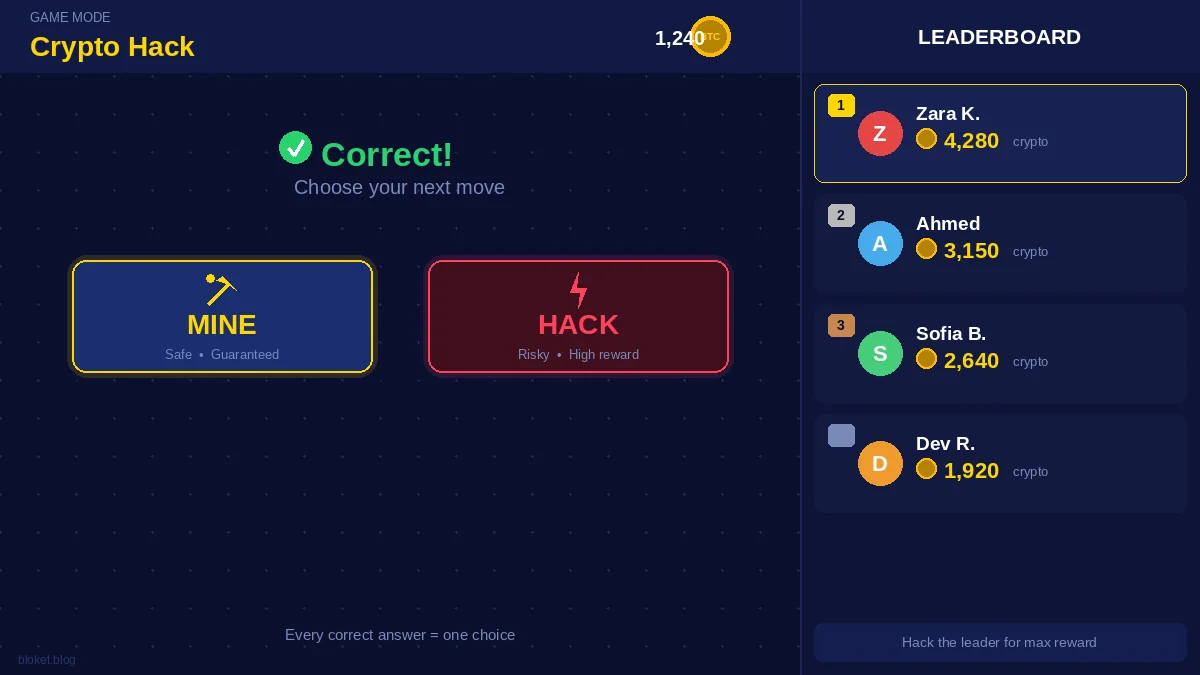
You answered a question correctly, then two buttons appeared on screen: Mine and Hack. You clicked Hack, selected the player sitting on the biggest balance, and watched your crypto total jump.
Crypto Hack mode in Blooket is a game format where players earn virtual cryptocurrency through correct answers and can steal it directly from each other. Whoever holds the most when the timer ends wins.
This guide explains how the mechanics work, which strategies win consistently, and how teachers can run it as a high-engagement classroom review tool.
What is Crypto Hack mode in Blooket?
Crypto Hack is a Blooket game mode where players earn virtual cryptocurrency by answering questions correctly. After each correct answer, a choice appears: mine crypto directly into your wallet, or attempt to hack another player and steal a portion of their balance. Whoever holds the most crypto when the timer expires wins.
The visible, real-time leaderboard is what distinguishes this mode from most Blooket formats. Every player’s crypto balance is displayed during the game, so you always know exactly who is ahead, by how much, and who is worth targeting. That transparency turns the game from a solo knowledge contest into a social, tactical competition.
The mode runs on any Blooket question set. Teachers do not need a Blooket Plus subscription to host it, and students join for free using a standard game code from desktop or mobile. Games with eight to ten or more players tend to generate the most compelling competition — a larger player pool gives the hacking mechanic real strategic weight. With fewer participants, the competitive dynamics shrink considerably.
The cryptocurrency framing resonates with many students, particularly older ones who connect the concept to news and popular culture. Blooket uses coin graphics and running balance counters that make each mine-or-hack decision feel more consequential than a generic point system would.
How Crypto Hack mode works, step by step
The mechanics are straightforward once you have seen a full round play out. Every correct answer feeds the same decision loop, and understanding each stage helps you act faster and more deliberately under time pressure.
- A question appears on screen. All players see it simultaneously. Read it and select your answer.
- Answer correctly to proceed. A wrong answer gives nothing — no crypto, no decision. Wait for the next question.
- Choose Mine or Hack. The choice screen appears immediately after a correct answer. You have limited time to decide, so knowing your approach before the game starts prevents costly hesitation.
- Mine. Choosing Mine adds a crypto payout to your wallet directly. This is guaranteed income — no risk, no dependency on other players.
- Hack. Choosing Hack opens a list of players showing all current balances. Select a target. A brief hack sequence runs to determine whether the attempt succeeds.
- Hack outcome. A successful hack transfers a portion of the target’s balance to your wallet. A failed hack returns nothing from that turn — the opportunity cost of choosing attack over a guaranteed mine payout.
- Leaderboard updates. Balance changes appear in real time. A successful hack against the leader causes an immediate visible shift that everyone in the game can see.
- The next question begins. The loop repeats until the host ends the session or the timer hits zero.
Mine vs. hack: the core tradeoff
Mining is the conservative play. Answer correctly, collect crypto, move on. Predictable income, zero risk, and it compounds steadily across many turns.
Hacking is the high-variance play. A successful attack on a player with a large balance can shift your leaderboard position by multiple spots in a single move. A failed attempt means that correct answer produced nothing.
From testing this mode across many sessions, the players who win most often are not pure miners or pure hackers. They mine early to build a stable base and hack selectively when the potential payout justifies the risk. Rigid approaches — always mine or always hack — consistently underperform against players who read the leaderboard and adjust as the game evolves.
What happens when you get hacked
If a hack against you succeeds, the crypto transfer is automatic and immediate. There is no opportunity to defend in real time. Your balance drops and the attacker’s rises, visible to everyone.
Being targeted is not a bad sign. It means your balance was large enough to make the attack worthwhile. Players at the top of the leaderboard get hacked most often precisely because they are winning.
Strategies that actually win Crypto Hack games
Most players understand the mine-or-hack mechanic but still lose because they apply it without reference to what the game is actually showing them. The following approaches reflect what works in practice, not just in theory.
Build your base before attacking
In the first quarter of any game, mine on most turns. Early balances across the board are small, so hack returns are minimal. Stealing a percentage from a player with 150 crypto is often no better than a single mine and carries real risk of returning nothing. Consistent miners build a growing base while aggressive early hackers waste turns on marginal gains.
Once balances have climbed and the top players have pulled ahead, the equation shifts. Hacking someone sitting on 1,500 crypto returns proportionally far more than attacking that same player at 200.
Target by balance, not by habit
The leaderboard shows every player’s current crypto in real time. Use it actively. Targeting the fourth-place player when the leader holds three times as much means leaving the highest available payout on the table. When you commit to a hack, go for the player with the most to steal.
Shift strategy based on game phase
The right approach in the opening minutes is not the right approach in the final two. Early game: mine for reliability. Mid game: mix mining and selective hacking. Late game: let your position on the leaderboard drive everything.
If you are in first place with time running short, mine. Guaranteed income cements a lead that a failed hack could compromise. If you are outside the top positions with the clock winding down, hacking is the only realistic path upward. Mining cannot close a 500-crypto gap in 90 seconds.
Answer more questions to earn more turns
Volume matters in Crypto Hack. More correct answers generate more mine-or-hack decisions, which creates more total income potential. Players who move through questions quickly and accurately get more turns than those who hesitate or rush into wrong answers.
Pace yourself enough to maintain accuracy, then push for speed. Also: decide your default strategy before the game starts so you are not deliberating from scratch on every turn.
Check the leaderboard every few turns
Players who answer without watching the board miss the information that makes this mode strategic. A quick glance every two or three turns shows whether your current approach is working, who is gaining on you, and whether it is time to switch. The board updates in real time — use it that way.
Mine or hack: a situational guide
| Game situation | Best choice | Reason |
|---|---|---|
| Early game, balances below 500 | Mine | Hack returns are too small to justify the risk |
| Mid game, you are leading | Both | Mine for safety; hack selectively for upside |
| Late game, you are in first | Mine | Lock in the lead with guaranteed income |
| Late game, outside the top spots | Hack the leader | Only realistic path to closing the gap |
| Top player has 3× your balance | Hack | Maximum return per correct answer |
| All opponents have low balances | Mine | No hack outperforms safe mining in this case |
Mistakes that consistently cost players the win
Crypto Hack has a deceptively simple structure, which means players often feel confident about it before identifying where their decisions are failing them. These are the errors that appear most often in both casual and classroom play.
Hacking when balances are still small
Theft returns scale with the target’s balance. At the start of a game when everyone holds little crypto, hacking is almost always a losing trade against mining. Players who attack aggressively from the first question are spending risky turns on returns that barely move the needle.
Targeting low-balance players
Some players target whoever stands out on the board, regardless of their balance. Stealing from a player near the bottom returns very little while the leader continues accumulating unchallenged. Always hack toward the top of the leaderboard.
Using a fixed strategy regardless of what the board shows
The player who always mines and the player who always hacks both forfeit the edge that comes from adapting. Crypto Hack rewards responsiveness. A strategy that was correct at minute five may be completely wrong at minute two.
Ignoring the timer
The value of every action in Crypto Hack depends on how much time remains. Players who never check the clock often mine conservatively when they should be hacking urgently, or hack recklessly when a comfortable lead only needed safe mining to hold.
Rushing questions and sacrificing accuracy
Some players try to earn more turns by moving faster, at the cost of answer accuracy. Wrong answers give nothing. Six correct answers at a steady pace outperforms ten rushed attempts where four are wrong. Get the accuracy right before pushing for speed.
How teachers can use Crypto Hack effectively
Crypto Hack sustains classroom engagement more reliably than modes built on novelty alone, because the competitive leaderboard creates ongoing pressure rather than just front-loaded excitement. In classroom settings I have observed, the real-time balance changes keep students watching the board and thinking between turns — not only during their own answering window.
Content types that suit the format
The mode works best with question sets that have a single unambiguous correct answer: vocabulary definitions, math problems, dates and events in history, scientific terms, grammar rules. Questions with nuanced or debatable answers create friction in a format built around fast, clear right-or-wrong feedback.
Sets of 20 to 40 questions are the practical sweet spot. Below 20, the deck repeats noticeably within one session. Above 40, many questions may not appear before the timer ends.
Session length
Ten to fifteen minutes produces the strongest results for most classes. Games shorter than eight minutes feel rushed before the leaderboard dynamics have time to develop. Games past twenty minutes risk losing energy once the eventual winner becomes obvious to the room.
Managing the competition dynamic
The hacking mechanic can frustrate students who feel repeatedly targeted. A short framing note before the game helps set expectations: being hacked means your balance was high enough to make the attack worthwhile. It is a design feature, not a personal attack.
This framing also redirects students from dwelling on lost crypto to focusing on the next question — which is where they can recover.
Running a debrief afterward
Because Crypto Hack moves fast, students frequently answer without processing why a response was correct or incorrect. A three-to-five minute debrief after the session — reviewing the two or three questions that most players got wrong — turns the activity from competitive entertainment into effective review. The game creates the engagement; the debrief captures the learning.
Class size considerations
The mode functions with as few as five players, but becomes tactically richer with ten or more. Larger groups produce more leaderboard movement and make target selection more meaningful. Very small groups may find other Blooket modes better suited to a lower-competition setup.
FAQs
What is Crypto Hack mode in Blooket? Crypto Hack is a Blooket game mode where players answer trivia questions to earn virtual cryptocurrency. After each correct answer, they choose to mine crypto (guaranteed gain) or hack another player (steal from their balance). The player with the most crypto when the game ends wins. It is available to all Blooket users, including free accounts.
Is Crypto Hack available on the free Blooket plan? Yes. Crypto Hack is available on the free Blooket plan. Teachers do not need Blooket Plus to host the mode, and students can join and play without any paid account. Any question set works with it.
Can you lose crypto in Crypto Hack? Yes. A successful hack from another player automatically transfers a portion of your balance to their wallet. Players near the top of the leaderboard get targeted most often because they have the most to steal. Losing crypto to a hack is a signal that your balance was high enough to be worth attacking — which means you were playing well.
Does hacking always succeed in Crypto Hack? No. Hack attempts can fail, which means the turn produces no crypto income at all. This is why mixing in consistent mining is smarter than hacking exclusively. A failed hack is the direct opportunity cost of choosing attack over the guaranteed return from mining.
How long does a typical Crypto Hack game last? The host controls session length. Classroom games most often run between ten and twenty minutes. Short warm-up reviews can work in eight to ten minutes. Competitive sessions can run longer, though most games settle into a clear outcome before the twenty-five-minute mark.
What makes Crypto Hack different from other Blooket modes? The live leaderboard and direct player-to-player theft are the defining features. Most Blooket modes involve competing through parallel accumulation — everyone earns separately. Crypto Hack makes competition explicit and social. You see exactly who is ahead and can directly take from them. That directness produces a different kind of competitive tension and replayability.
Is Crypto Hack suitable for younger students? The mode works well for middle school and high school students who can process the mine-or-hack decision quickly and understand basic leaderboard strategy. Upper elementary students can play it successfully, though the strategic layer may not be fully applied — younger players often choose between options more randomly. Teachers can let strategy develop naturally over repeated play sessions rather than front-loading the explanation.
Conclusion
Crypto Hack is the Blooket mode where answering questions correctly is only the starting point. The mine-or-hack decision that follows every right answer adds a competitive, strategic layer that keeps the leaderboard moving right up to the final second.
Mine early to build a stable base, track the board as balances grow, and shift to targeted hacking when the math justifies the risk. Teachers get a review format with sustained engagement. Students get a mode with enough tactical depth to stay interesting across multiple sessions.
Pick a question set, select Crypto Hack, and run a round. Watch whether your students stay with the leaderboard between their own turns — when they do, the mode is working exactly as designed.