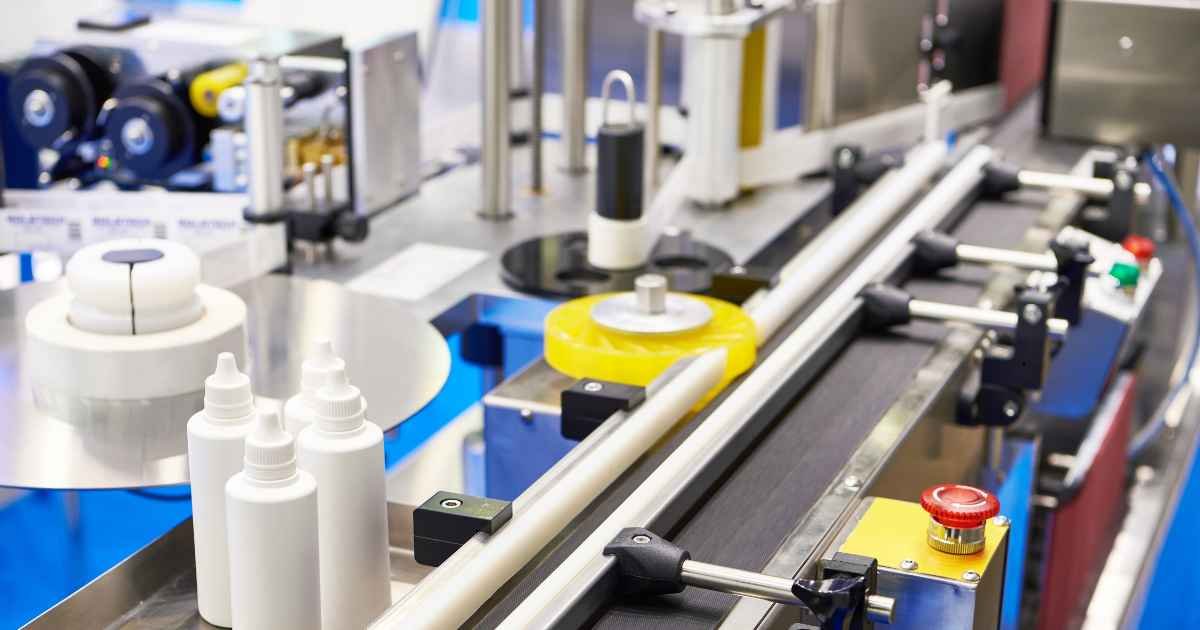
An automatic bottle labeling machine rarely operates in isolation. It sits between a filler and a capper, or a capper and a case packer, and how well it integrates with the rest of the line matters just as much as how well it labels a single bottle in isolation. A labeling station that’s technically excellent but poorly matched to the surrounding equipment becomes the bottleneck nobody planned for.
This article covers how to think about labeling machine integration within a full production line, what different industries actually require from their labeling equipment, and the planning mistakes that cause the most disruption after installation.
Labeling Doesn’t Happen in a Vacuum
The three stations most commonly linked with labeling are filling, capping, and case packing, and the labeling machine’s speed needs to be matched to whichever of these runs slowest — not the fastest station on the line.
If a filler runs at 200 bottles per minute but the labeler is rated for 150, the labeler becomes the constraint regardless of how fast the rest of the line could theoretically move. Conversely, an oversized labeler running well below its capacity isn’t wasted exactly, but it does mean the capital spent on speed capability isn’t being used, which is worth knowing before paying a premium for throughput the rest of the line can’t feed.
Getting this matched correctly means looking at realistic sustained speeds for every station — not rated maximums — since a filler’s real-world output accounting for changeovers and minor stoppages might be meaningfully below its spec sheet number too.
Where Labeling Fits in the Sequence
After filling, before capping is common for wrap-around labels on beverage and food lines, since the bottle is already stable and full, and any minor spillage during filling won’t affect a label that hasn’t been applied yet.
After capping is more common when the cap itself carries a label or tamper-evident band, or when the production sequence needs the bottle sealed before handling at the labeling station for contamination control reasons, which comes up more often in pharmaceutical and food production.
Before filling is unusual but does happen in some cosmetics and specialty beverage lines where the label needs to be applied to an empty, lighter bottle for handling or stability reasons specific to that product’s packaging design.
There’s no universal correct order — it depends on your specific product, container stability, and any regulatory sequencing requirements for your industry.
Industry-Specific Requirements
Food and Beverage
Speed and washdown compatibility tend to dominate decision-making here, since lines often run continuously at high volume and equipment needs to tolerate regular cleaning, sometimes with high-pressure washdown for food safety compliance. Label materials also need to handle condensation on refrigerated products and, for some beverages, resist ice bucket submersion without the label lifting.
Pharmaceutical
Labeling accuracy and traceability requirements are stricter, often requiring vision inspection systems that verify not just placement but that the correct label — matching lot number, expiration date, and product — has been applied to each bottle. Serialization requirements in some markets add another layer, where labels or printed codes need to be tracked and verified against a database in real time rather than just visually inspected.
Cosmetics and Personal Care
Bottle and jar shapes vary enormously, often intentionally for shelf differentiation, which pushes toward more flexible labeling systems — shrink-sleeve for contoured containers, or labelers with quick-change tooling for producers running many SKUs with relatively low volume per SKU compared to food and beverage.
Spirits, Wine, and Premium Beverage
Label presentation quality matters more here than almost any other industry, since the label is often a primary part of the product’s shelf appeal. Machines need tighter placement tolerances and gentler handling for glass, along with support for premium label materials like foil or textured stock that behave differently on the applicator than standard paper labels.
Planning Mistakes That Cause Integration Problems
Sizing the labeler independently from the rest of the line. Evaluating labeling machines purely on their own throughput, without checking against actual filler and capper output, leads to either an expensive mismatch or an unexpected bottleneck once everything’s connected.
Not accounting for accumulation and buffering. Between stations, bottles typically need some buffer capacity to absorb minor speed variations without the whole line stopping every time one station has a brief hiccup. Skipping adequate buffering between the labeler and adjacent stations means small, normal fluctuations cascade into full line stops more often than they should.
Overlooking floor space and bottle path changes. Adding or upgrading a labeling station often changes the physical bottle path, conveyor layout, or clearance needed for maintenance access. This is easy to underestimate on paper and expensive to fix after installation if the machine doesn’t actually fit as planned.
Ignoring changeover synchronization. If the filler, capper, and labeler are all part of the same production changeover — switching to a different product or package size — the changeover time for each station needs to be considered together. A fast-changeover labeler doesn’t help much if the filler next to it takes an hour to reconfigure for the same format switch.
Underestimating controls integration. Modern lines often need the labeler’s control system to communicate with upstream and downstream equipment — for stopping the line cleanly if the labeler jams, for instance, rather than continuing to fill or cap bottles that won’t get labeled. This integration work is sometimes treated as an afterthought rather than planned from the start.
Working With Suppliers on Integration
A few questions help surface integration issues before they become installation-day surprises:
- What’s the labeler’s realistic sustained speed, not just its rated maximum, and how does that compare to our filler and capper’s actual output?
- What buffering or accumulation is recommended between this labeler and our existing equipment?
- Can the machine’s controls integrate with our existing line control system, and what’s involved in that integration?
- What floor space, including maintenance clearance, does the machine actually require once installed?
- If we’re running multiple product formats, how does labeler changeover time compare to changeover time on our filler and capper?
A supplier willing to visit your facility or review detailed layout drawings before finalizing a machine recommendation is generally a better sign than one working purely from a general spec conversation.
Final Thoughts
An automatic bottle labeling machine performs only as well as its fit within the full production line, and industry-specific requirements — from washdown durability in food and beverage to serialization in pharmaceuticals — shape which machines are even appropriate candidates before speed or price become relevant. The integration questions, particularly around realistic sustained speed and buffering between stations, matter as much as the labeling technology itself.
Before finalizing a purchase, map out your full line’s realistic throughput at every station, not just the labeler in isolation, and involve your supplier in reviewing that full picture. Line-level planning catches mismatches that are far cheaper to solve on paper than after equipment is already installed on the floor.
Disclaimer: The information provided in this article is for general informational and educational purposes only. It does not constitute professional engineering, equipment purchasing, or production line design advice. Integration requirements and line speeds vary by specific products, packaging, and facility layout. Always consult qualified engineers and conduct thorough trials before installing new equipment. The author and publisher disclaim all liability for any operational issues, production delays, or financial losses arising from reliance on this content. This article does not endorse any specific machine manufacturer.
Take the first step toward mastery—our comprehensive guides make complex topics simple.