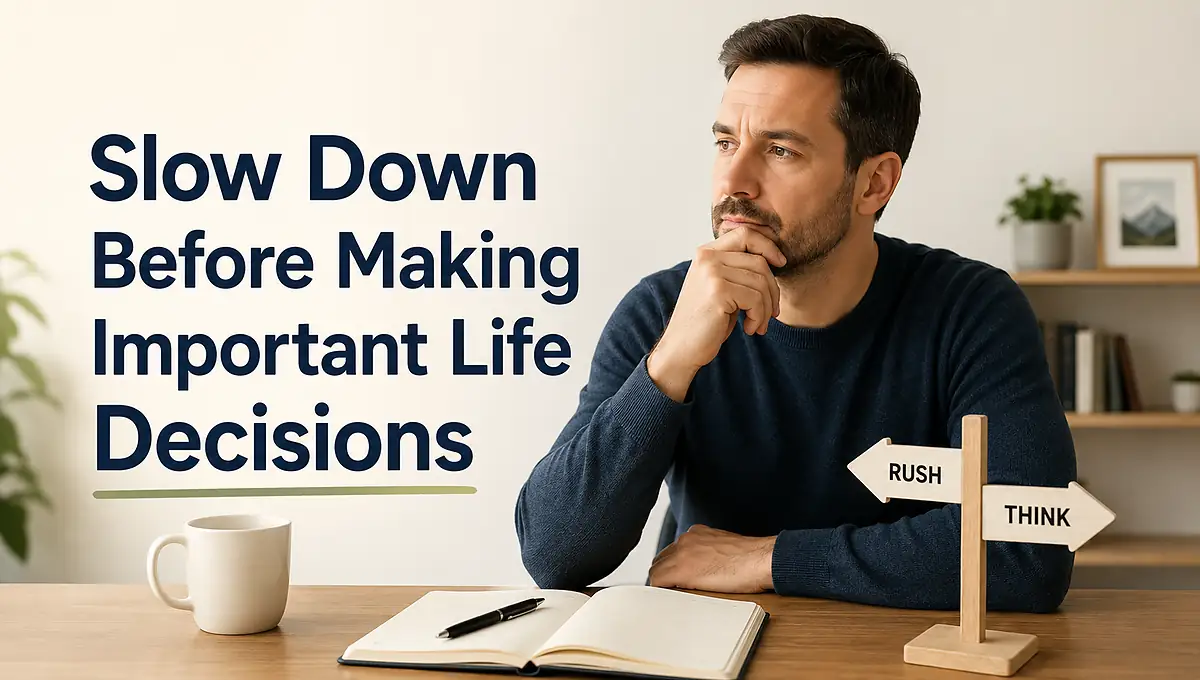
The Problem With Making Decisions Too Quickly
Every day, people make hundreds of decisions.
Some are insignificant, such as what to eat or which route to take. Others can influence careers, relationships, finances, education, business, and long-term personal goals.
Yet many decisions are made under the same conditions: limited attention, incomplete information, emotional pressure, and a desire to reach an answer as quickly as possible.
Speed feels efficient.
But faster isn’t always better.
Sometimes the most valuable thing a person can do before making an important decision is simply pause.
Slowing down doesn’t mean becoming indecisive. It means creating enough mental space to separate facts from assumptions, immediate emotions from long-term consequences, and genuine priorities from temporary pressure.
That small pause can change the quality of the decision.
Why Fast Decisions Can Feel Better Than They Actually Are
The human brain is remarkably good at making quick judgments.
This ability is useful. If someone suddenly sees danger, they don’t need to spend ten minutes analyzing every possible response. Fast reactions can protect us and help us function efficiently in everyday situations.
The problem begins when the same instinct is applied to complicated decisions.
A quick conclusion can feel satisfying because uncertainty disappears. Once a decision has been made, the mind no longer has to deal with competing possibilities.
But emotional relief isn’t proof that a decision is correct.
| What Feels Good | What May Actually Be Happening |
|---|---|
| Immediate answer | Uncertainty has temporarily disappeared |
| Strong confidence | Important information may be missing |
| Quick action | Consequences haven’t been considered |
| Familiar choice | Assumptions may be controlling the decision |
| Emotional certainty | Feelings may be mistaken for facts |
Recognizing this difference is an important first step toward better judgment.
Separate Urgent Decisions From Important Decisions
Not every decision deserves the same amount of thinking.
Some choices genuinely require immediate action. Others only feel urgent because someone is applying pressure, because an opportunity appears temporary, or because uncertainty feels uncomfortable.
Before acting, ask:
Does this decision actually need to be made right now?
If the answer is no, creating additional time can be surprisingly valuable.
A few minutes may be enough for a minor decision. A day or several days may be appropriate for a major personal or professional choice.
The goal isn’t to delay everything.
The goal is to give important decisions the amount of attention they deserve.
Ask Better Questions Before Looking for Answers
People often improve their decisions simply by changing the questions they ask.
Instead of asking:
“Which option should I choose?”
try asking:
- What problem am I actually trying to solve?
- What information am I missing?
- What assumptions am I making?
- What happens if I’m wrong?
- Which consequences will still matter six months from now?
- Would I make the same choice without outside pressure?
These questions force the brain to examine the decision rather than immediately defend the first option that appears attractive.
Good questions don’t guarantee perfect decisions.
They make careless decisions less likely.
The Difference Between Information and Useful Information
More information isn’t automatically better.
When facing an important choice, people sometimes collect endless opinions, reviews, statistics, videos, and recommendations. Eventually, the amount of information becomes another source of confusion.
Effective decision-making requires identifying the information that can actually change the outcome.
Consider choosing between two professional opportunities. Knowing every minor detail about both organizations may be unnecessary if the real decision depends on three things: long-term growth, financial stability, and location.
The objective isn’t to know everything.
It’s to know enough about the factors that matter.
Use a Simple Decision Framework
When a decision feels complicated, writing it down can make the situation easier to understand.
Start with four areas:
| Question | Purpose |
| What do I want? | Defines the desired outcome |
| What are my realistic options? | Prevents false either-or thinking |
| What are the risks? | Reveals possible consequences |
| What happens next? | Turns thinking into action |
Writing forces vague thoughts into visible information.
You may discover that the decision isn’t actually between two choices. There might be a third option that wasn’t obvious while thinking emotionally.
Be Careful With the First Explanation
One of the easiest mistakes in decision-making is accepting the first explanation that makes sense.
Suppose a project fails.
You might immediately conclude that the strategy was bad. But perhaps the execution was inconsistent, the timing was wrong, the resources were insufficient, or the original goal was unclear.
The first explanation is a hypothesis, not necessarily a fact.
Strong decision-makers investigate before assigning certainty.
This principle applies everywhere—from business decisions to personal problems.
Create Space Between Emotion and Action
Emotions aren’t enemies of good decisions.
They contain useful information. Anxiety may reveal uncertainty. Frustration may indicate that a boundary has been crossed. Excitement may signal genuine opportunity.
The mistake is allowing an emotion to become the entire decision.
When emotions are strong, try separating two questions:
What am I feeling?
and
What does the evidence suggest?
Both answers matter, but they serve different purposes.
This simple separation can prevent temporary emotions from controlling permanent choices.
Why Writing Things Down Changes Thinking
Thoughts inside your head can feel larger and more complicated than they actually are.
Writing them down creates distance.
You can see contradictions, missing information, unrealistic expectations, and unnecessary fears more clearly when they’re written in front of you.
A useful method is to create two short lists:
Reasons this could work
and
Reasons this could fail
Don’t use the exercise to prove one side is right. Use it to challenge your own thinking.
The strongest argument against your preferred option is often more valuable than another argument supporting it.
Practice With Low-Risk Decisions
Better decision-making is a skill, and skills improve through practice.
You don’t need to wait for a major life decision to practice thinking carefully.
Use ordinary situations.
Before purchasing something expensive, compare alternatives and identify what actually matters.
Before changing a routine, consider the likely benefits and costs.
Before accepting an opportunity, ask what you’re giving up by saying yes.
These small exercises build a habit of deliberate thinking that becomes increasingly useful when the stakes are higher.
Don’t Confuse Slow Thinking With Endless Thinking
There is an important limit.
Thinking longer does not automatically make a decision better.
At some point, additional analysis produces diminishing returns. You may continue searching for certainty that doesn’t exist.
A useful stopping point is reached when:
- You understand the main options.
- You know the most important risks.
- You have enough reliable information.
- You understand the likely consequences.
- Further research is unlikely to change your choice.
Then act.
Good decision-making isn’t about achieving perfect certainty.
It’s about making a thoughtful choice despite unavoidable uncertainty.
Make Reflection Part of the Process
One of the most effective ways to become better at decisions is to review them afterward.
Ask yourself:
What did I expect to happen?
What actually happened?
Which assumption was correct?
Which assumption was wrong?
What will I do differently next time?
This turns experience into feedback.
Without reflection, people can repeat the same decision-making mistakes for years without recognizing the pattern.
With reflection, even a poor decision can become useful.
Better Decisions Begin With Better Attention
The quality of a decision depends partly on the quality of attention given to it.
Constant notifications, multitasking, endless scrolling, and rapid information consumption make sustained thinking more difficult. Creating periods of uninterrupted attention can therefore be valuable, especially when a decision has meaningful consequences.
This doesn’t require completely disconnecting from technology.
It simply means choosing when to focus instead of allowing every incoming distraction to determine what receives your attention.
For people who enjoy learning through interactive challenges, structured activities can also provide useful opportunities to practice reasoning, problem-solving, and decision-making without turning every learning experience into passive information consumption. Resources such as gimkit demonstrate how interactive formats can encourage active participation rather than simple observation.
Final Thoughts
Making better decisions isn’t about becoming someone who never makes mistakes.
Everyone makes them.
The real advantage comes from developing a process that makes careless mistakes less frequent and useful mistakes more valuable.
Pause when the situation allows it.
Identify what actually matters.
Question your assumptions.
Separate emotion from evidence.
Consider consequences.
Then make the decision and learn from what happens afterward.
In a world that constantly rewards speed, the ability to slow down and think clearly can become a genuine advantage.
And sometimes, the smartest decision isn’t the one you make fastest.
It’s the one you make after giving yourself enough time to understand what you’re actually choosing.
When you want to reinforce these habits through active problem-solving and interactive experiences, interactive learning activities can offer another practical way to exercise reasoning, attention, and strategic thinking.
The objective isn’t to think about everything forever.
It’s to think carefully about the things that matter.
Disclaimer: The information provided in this article is for general informational and educational purposes only. It does not constitute professional psychological, financial, or life-coaching advice. Decision-making strategies and cognitive habits may vary by individual and situation. The author and publisher disclaim all liability for any decisions or outcomes based on this content. Always consider your own circumstances and, where necessary, consult a qualified professional. This article does not guarantee specific personal or professional results.
Build momentum for the long haul—our sustainable growth tools keep you moving forward.