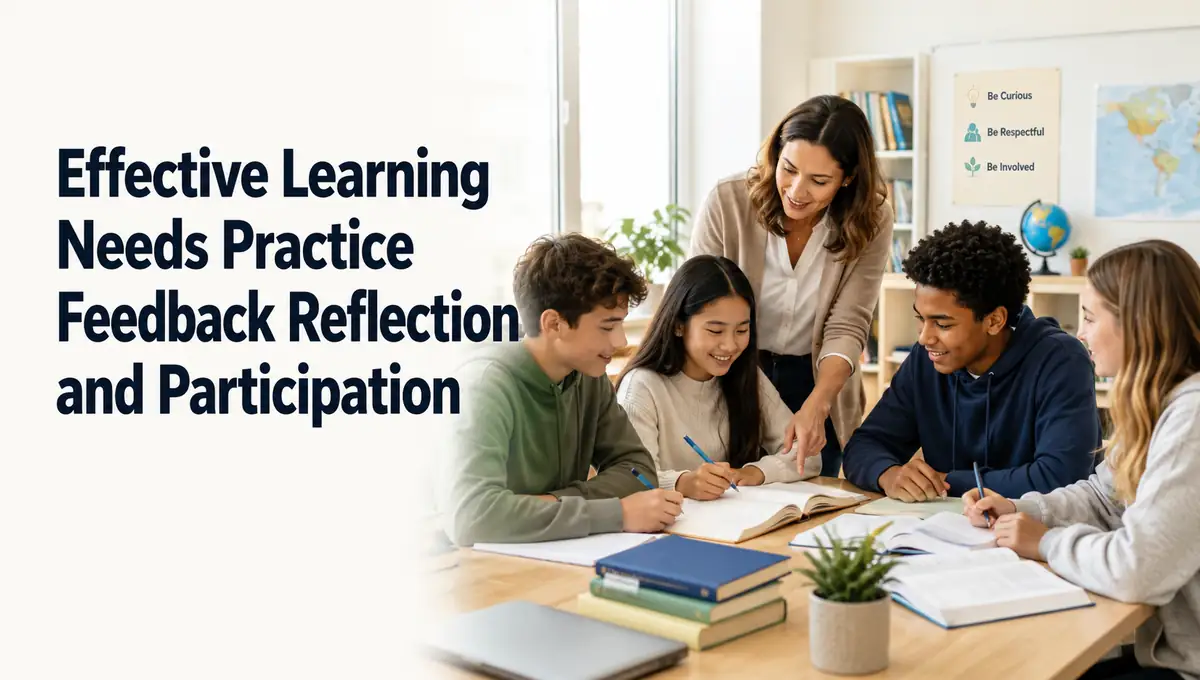
Education is most effective when students are given more than information. They need opportunities to understand ideas, practice them, make mistakes, receive feedback, and gradually become confident enough to use what they have learned independently.
A strong learning environment therefore depends on more than textbooks or technology. It depends on how lessons are structured and how consistently students are encouraged to think, participate, and reflect.
Active Learning Creates Deeper Understanding
One of the simplest ways to improve learning is to move students from passive listening toward active participation.
Instead of spending an entire lesson explaining concepts, teachers can regularly ask students to predict an outcome, explain an idea in their own words, solve a problem, discuss a question, or apply a concept to a realistic situation.
This matters because students are not simply receiving information. They are processing it.
| Learning Approach | What Students Practice |
| Explanation | Understanding concepts |
| Discussion | Communication and reasoning |
| Problem solving | Application |
| Reflection | Self-awareness |
| Practice | Skill development |
A lesson becomes more valuable when students have repeated opportunities to move between these different forms of learning.
Practice Should Have a Clear Purpose
Practice is important, but repetition by itself does not guarantee improvement.
Students benefit more when practice is connected to a specific learning objective. A teacher might identify one concept students frequently misunderstand and design several short activities around that particular difficulty.
For example, instead of assigning twenty similar questions simply because more practice seems better, a teacher can use a smaller set of carefully selected problems and ask students to explain how they reached each answer.
This reveals something a score alone may not show: how the student is thinking.
That information can help teachers identify misconceptions before they become persistent.
Feedback Turns Mistakes Into Learning Opportunities
Mistakes are an ordinary part of education. What matters is what happens afterward.
A student who receives only a mark may know that an answer was incorrect without understanding why. Useful feedback provides enough information for the learner to identify the problem and attempt a better solution.
Effective feedback often answers three questions:
- What was done correctly?
- What needs improvement?
- What should be tried next?
Timely feedback is particularly useful because students can immediately connect the guidance with the work they have just completed.
This creates a continuous cycle:
Attempt → Feedback → Adjustment → New Attempt
Over time, this cycle can be more valuable than simply accumulating grades.
Encourage Students to Explain Their Thinking
One powerful but often overlooked strategy is asking students to explain why they believe something is correct.
Consider the difference between:
“What is the answer?”
and:
“How did you reach that answer?”
The second question provides much more information.
A correct answer can sometimes come from guessing or memorization. An explanation reveals whether the student actually understands the underlying concept.
Teachers can encourage this by asking:
- What made you choose that approach?
- Can you solve it another way?
- What evidence supports your answer?
- What would change your conclusion?
- Can you explain this to a classmate?
These questions develop reasoning rather than simple recall.
Make Learning Connected to Real Life
Students often become more interested when they understand why knowledge matters outside the classroom.
Mathematics can be connected to budgeting, business, statistics, and everyday decision-making. Science can relate to technology, the environment, health, and everyday observations. Language learning can connect with communication, media, writing, and professional situations.
The objective isn’t to make every lesson entertaining.
It is to make the purpose visible.
When students understand where knowledge can be used, abstract concepts can become easier to appreciate.
Use Interactive Activities With Intention
Interactive learning can provide another way for students to practice concepts and remain involved during lessons. Short challenges, collaborative activities, knowledge reviews, and structured educational games can be useful when they reinforce the lesson rather than distract from it.
Teachers looking for practical digital activities can also explore gimkit as one example of an interactive learning resource that can support classroom participation.
The important principle is simple: the activity should serve the learning objective.
Build Reflection Into the Learning Process
Students don’t always recognize how much they have learned unless they stop to think about it.
A short reflection at the end of a lesson can ask:
- What did I understand today?
- What remains confusing?
- Which strategy helped me most?
- What should I practice next?
Reflection encourages students to become more aware of their own learning process.
It also gives teachers useful information about where additional instruction may be needed.
Create Opportunities for Collaboration
Academic learning and communication skills can develop together.
When students work in pairs or small groups, they have opportunities to explain concepts, compare approaches, challenge assumptions, and listen to alternative viewpoints.
However, collaboration works best when it has structure.
Teachers can assign specific responsibilities such as discussion leader, researcher, recorder, presenter, or reviewer. Clear roles make participation more balanced and reduce the possibility of one student completing the entire task.
Make Progress Visible
Students are more likely to remain committed when improvement is noticeable.
Instead of focusing exclusively on final grades, teachers can help students recognize progress through completed milestones, improved performance, stronger explanations, better organization, or increased participation.
A simple progress record can make development easier to see:
| Area | Earlier Performance | Current Progress |
| Understanding | Basic | Developing |
| Accuracy | Inconsistent | Improving |
| Participation | Occasional | Regular |
| Independence | Needs support | More confident |
This changes the conversation from “Am I good at this?” to “How much have I improved?”
That is a much healthier foundation for long-term learning.
The Most Effective Learning Environment Is Deliberately Designed
Strong academic results rarely come from one technique.
They develop when teachers consistently combine clear explanations, purposeful practice, meaningful feedback, active participation, collaboration, reflection, and opportunities to apply knowledge.
Students do not need every lesson to be extraordinary. They need learning experiences that consistently give them a reason to think, practice, question, and improve.
For additional interactive learning ideas and classroom-friendly activities, educators can explore best games to play and select activities according to the age group, subject, and learning objective.
The deeper principle remains the same: effective education is not about making students consume more information. It is about helping them do more with what they learn.
Disclaimer: The information provided in this article is for general informational and educational purposes only. It does not constitute professional teaching, curriculum, or pedagogical advice. Teaching methods and learning outcomes vary by age group, subject, and classroom environment. The mention of specific tools such as Gimkit or general game-based activities is illustrative and does not imply endorsement. The author and publisher disclaim all liability for any decisions or outcomes arising from reliance on this content. Always adapt strategies to your specific learners and consult qualified education professionals when needed. This article does not guarantee specific academic results.
See the world through new eyes—our refreshing perspectives challenge outdated thinking.