A mid-size home goods retailer installed an AI customer-service app and pointed it at every inbound message. Its monthly bill tripled in six weeks. Nothing was broken — the app was answering “where’s my order” questions with the same model it used to negotiate a damaged-item refund, priced at full rate every time.
That gap between what a request needs and what it gets billed for is the part app-store demos never show. It’s the real fault line between merchants who should keep buying apps and merchants quietly outgrowing them.
Key takeaways
Shopify’s Q2 fiscal 2026 disclosures show merchant solutions revenue up 37% against 22% for subscription solutions — the growth is concentrated in the tools layered on top of stores, not the platform itself.
Shopify reported gross merchandise volume of $115.57 billion in Q2 fiscal 2026, up 31.6% year over year, its fifth straight quarter of 30%+ growth, with the company attributing part of that growth to AI commerce features.
US Census Bureau data puts e-commerce at 17.1% of total US retail sales, meaning the volume routing through automated systems keeps compounding the cost of getting model choice wrong.
Three model tiers cover nearly every use case: a small model for classification and routing, a general-purpose model for drafting and conversation, a larger model reserved for long-form reasoning.
Shopify reports 97% merchant retention above $10 million in annual GMV — deep, correctly-scoped integration outlasts whatever app was trendy the year it was installed.
What’s changed is the buying decision, not the technology
The technology question — can AI handle customer service, product descriptions, forecasting — was settled years ago. What changed is that app marketplaces now list dozens of AI tools installable without writing code, making “should we use AI” the wrong question.
The live question is when an installed app stops covering what the business needs, and what moving past it costs. Most merchants never model that transition point before they’re already past it.
What is AI integration for eCommerce, in practical terms?
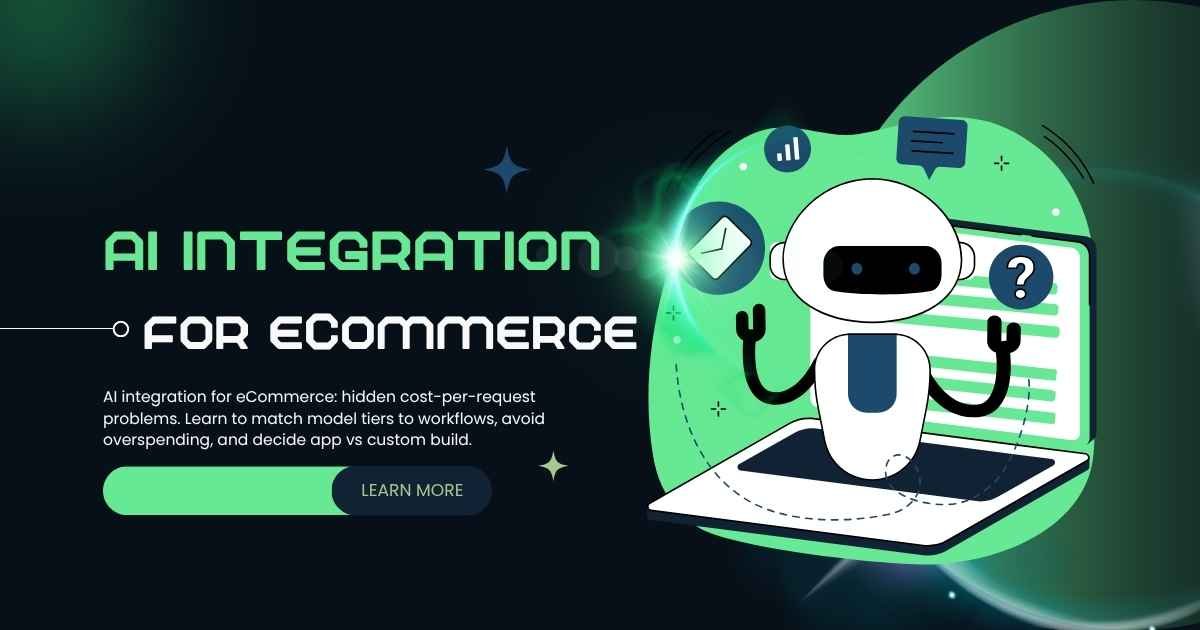
AI integration for eCommerce is the practice of connecting machine learning models — for classification, generation, or reasoning — into systems a store already runs: catalogs, order management, messaging, inventory. It ranges from a single installed app to a custom pipeline routing requests across models by task.
A review-summarization app and a proprietary pricing engine reading competitor feeds hourly are both AI integration for eCommerce in name, but they carry different cost structures, maintenance obligations, and risk. Treating them as one decision is where the arithmetic breaks down.
Why does picking the biggest model for everything cost so much?
Merchants default to the largest model because it feels safest and it’s usually the app default, but larger models cost meaningfully more per request than smaller ones tuned for a narrow task. Paying frontier rates for work a lightweight classifier handles just as accurately is the single most common waste in AI eCommerce spending.
Three tiers cover almost every workflow. A small, fast model handles classification and routing — sorting a ticket, tagging a product, flagging a return reason — where speed matters more than nuance. A general-purpose model handles drafting and conversation: descriptions, first-pass replies, copy a human still reviews. A larger, slower model is reserved for long-form reasoning — a policy exception, conflicting inventory signals, a multi-turn dispute. Running everything through tier three because that’s what shipped is the expensive default, not a safety margin.
When does installing an app stop being enough?
An app stops being enough when the business logic it needs is proprietary, when the data it touches can’t leave internal systems, when response time has to beat a third-party round trip, or when the workflow has no analog in any vendor’s roadmap. Each is a different ceiling, and they rarely arrive together.
Proprietary rules are the most common trigger: a wholesale pricing matrix, a fraud model trained on chargeback history, a fulfillment router weighing warehouses against carrier cost. No vendor builds for one merchant’s private rule set, because generalizing across customers is the business model of a marketplace app.
What actually pushes a merchant from app to custom build?
Data residency and latency are the other two triggers, and they show up less often but harder. A merchant handling health, financial, or minor-related data may be barred from sending it to a third-party AI vendor at all. A checkout-time fraud check has a latency budget measured in milliseconds, not the second-plus round trip a general-purpose app API often adds.
When any of those apply, the conversation shifts from which app to install to custom Shopify app development — a pipeline calling the right model tier for each internal step, inside systems the merchant controls, without routing sensitive data through a third party. That’s a materially bigger commitment than an app subscription, and it should be evaluated as one, with an internal owner named before a line of code is written.
Nobody signs up for that lightly, which is why it should stay rare. A build duplicating functionality a vendor is visibly about to ship goes obsolete within a release cycle or two, and the merchant pays twice: once for the build, once for maintenance nobody planned around.
Should most merchants actually build instead of buying?
No. Most merchants should exhaust marketplace apps, Shopify Flow, and Shopify Functions before commissioning custom code, because a monthly app fee ends the moment the merchant cancels, while owned code needs someone to maintain and upgrade against every quarterly API release. A custom build is the right call for a narrow set of merchants with a genuine ceiling, not a first move for anyone chasing a lower per-request bill.
The honest sequence: install and measure actual usage, push eCommerce automation as far as native platform tools allow, and only then evaluate a custom build against the specific rule, data constraint, or latency requirement no app addresses. Skipping straight to custom because a demo looked underwhelming usually buys a maintenance bill for a workflow an app update might have solved for free.
Frequently asked questions
Does AI integration for eCommerce always require a custom build?
No. Most stores are well served by installed apps handling narrow tasks like description generation or support triage. Custom builds earn their cost only when proprietary rules, data restrictions, or latency needs rule out third-party apps entirely.
How many AI models does a typical integration need?
Most workflows map to three tiers — a small model for classification and routing, a general-purpose model for drafting and conversation, and a larger model for long-form reasoning — rather than one model handling every request at the same cost.
What’s the biggest hidden cost in an AI eCommerce integration?
Routing every request through the largest, most expensive model available regardless of complexity. Matching request type to model tier is usually the highest-leverage cost decision in the integration, ahead of vendor selection.
Disclaimer: The information provided in this article is for general informational and educational purposes only. It does not constitute professional technical, financial, or business advice. The article references figures from Shopify Inc. and US Census Bureau data; readers should verify current data independently before making decisions. Cost structures, app capabilities, and AI model pricing evolve rapidly. The author and publisher disclaim all liability for any financial losses, technical issues, or operational outcomes arising from reliance on this content. Always assess your specific store needs and consult qualified professionals. This article does not guarantee specific cost savings or performance results.
Browse through content that inspires greatness—our greatness-inspiring wisdom elevates your journey.