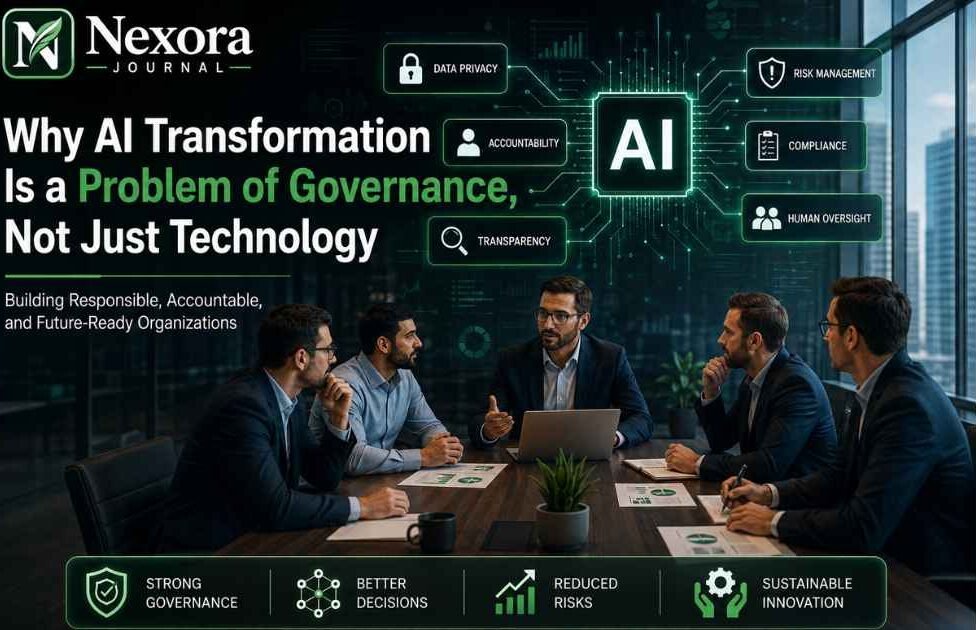
Artificial intelligence is moving from experimental projects into everyday business operations. Companies are using AI to analyze data, automate repetitive work, support customer service, generate content, and improve decision-making. But as these systems become more deeply connected to business processes, organizations face a challenge that goes beyond choosing the right technology. AI transformation is a problem of governance, because businesses need clear rules for how AI is selected, deployed, monitored, and used.
A strong governance framework does not prevent companies from adopting AI. Instead, it gives teams a structured way to innovate while managing risks around data, security, accountability, accuracy, and compliance.
Why AI Transformation Needs Governance
Many organizations begin their AI journey by focusing on technology. They compare different models, purchase software, build internal tools, and experiment with automation.
The problem starts when successful experiments move into real business processes.
An AI system that summarizes internal documents, for example, may initially be used by a small team. Once it becomes part of a company-wide workflow, questions immediately arise. Who can access the information? How should sensitive data be handled? Who reviews AI-generated decisions? What happens when the system produces an incorrect result?
These are governance questions rather than purely technical ones.
Without clear policies, different departments may adopt AI tools independently, creating inconsistent standards and unnecessary risks. A governance framework establishes the boundaries within which AI can be developed and used responsibly.
1. Define Who Is Responsible for AI Decisions
One of the first elements of an AI governance framework is accountability.
Businesses should identify who owns an AI system throughout its lifecycle. This can include business leaders, technology teams, security professionals, legal departments, data specialists, and end users.
Responsibility should not disappear simply because an algorithm is involved in a decision.
For example, if an AI system recommends which customer requests should receive priority, someone should remain accountable for reviewing the system’s performance and determining whether its recommendations are appropriate.
Clear ownership makes it easier to identify problems, approve changes, and respond when an AI system does not behave as expected.
2. Establish Rules for Data Usage
AI systems are often only as reliable as the data provided to them. Governance therefore needs to address how business data is collected, stored, accessed, and used.
Organizations should establish rules covering:
- What information can be entered into AI systems
- Which data requires additional protection
- Who can access sensitive information
- How long data should be retained
- Which external AI services employees can use
- How data usage should be documented
These policies become especially important when employees use publicly available AI tools for business tasks. Without clear guidance, confidential information can accidentally be exposed to systems that were never approved for organizational use.
3. Create an AI Approval Process
Not every AI application carries the same level of risk.
A tool used to generate internal brainstorming ideas is very different from an AI system involved in financial decisions, employee evaluation, customer eligibility, or security operations.
A practical governance model can classify AI projects according to their potential impact.
Low-risk applications may require a simple internal review. Higher-risk systems can require additional testing, security assessments, legal review, documentation, and executive approval before deployment.
This approach allows organizations to move quickly on low-risk experiments without treating every AI project as a major compliance exercise.
4. Monitor AI Systems After Deployment
Governance should not end when an AI system goes live.
AI systems need continuous monitoring because their performance can change as data, users, business processes, and underlying models change.
Organizations can establish regular checks for:
- Accuracy and reliability
- Unexpected outputs
- Security issues
- Changes in performance
- Bias or inconsistent results
- User complaints
- Data-quality problems
- Compliance concerns
Monitoring creates a feedback loop between deployment and improvement. If an AI system begins producing unreliable results, the organization can investigate the problem before it creates larger operational consequences.
5. Keep Humans Involved Where Necessary
Automation can reduce repetitive work, but that does not mean every decision should be completely automated.
For high-impact processes, businesses should determine where human review is required. A human-in-the-loop approach allows AI to provide recommendations while giving qualified employees the ability to review, question, or override those recommendations.
The appropriate level of human oversight depends on the application.
A marketing team may accept automatically generated headline suggestions with minimal review. A healthcare, financial, legal, or employment-related application may require substantially stronger oversight.
The goal is not to slow down AI adoption. It is to match human involvement with the potential consequences of an AI-generated outcome.
6. Train Employees on Responsible AI Use
Even a well-designed governance framework can fail if employees do not understand it.
AI training should cover more than how to write effective prompts. Employees should understand what information they can share with AI tools, how to verify generated information, when human review is required, and how to report unexpected behavior.
Training also helps reduce the risk of shadow AI, where employees independently adopt AI applications without organizational approval.
When employees understand both the benefits and limitations of AI, governance becomes part of normal business operations rather than a policy document that nobody follows.
7. Document AI Systems and Their Purpose
Organizations should maintain an inventory of the AI systems they use.
Basic documentation can include the system’s purpose, owner, data sources, users, model or vendor, risk classification, approval status, and monitoring requirements.
This becomes increasingly valuable as the number of AI applications grows.
Without an inventory, businesses may lose track of which tools are being used, what information they process, or who is responsible for them. Documentation creates visibility and makes future audits, reviews, and technology changes easier.
Governance Makes AI Transformation More Sustainable
AI transformation is not simply a technology implementation project. It changes how employees work, how information moves through an organization, and in some cases how important decisions are made.
That is why governance should be built into AI transformation from the beginning rather than added after problems appear.
A practical framework can give businesses a repeatable process for evaluating AI opportunities, approving applications, protecting data, monitoring performance, and assigning accountability.
The organizations that approach AI this way can experiment without losing control. They can encourage innovation while creating safeguards around the systems that eventually become part of everyday operations.
The future of business AI will depend not only on increasingly capable models, but also on how effectively organizations govern them. Strong governance gives AI transformation the structure needed to move from isolated experiments to reliable, scalable business capabilities.
Disclaimer: The information provided in this article is for general informational and educational purposes only. It does not constitute professional legal, compliance, or technology governance advice. AI governance requirements vary by industry, jurisdiction, and organizational risk profile; readers should consult qualified legal, security, and technology professionals before implementing any framework. The author and publisher disclaim all liability for any compliance issues, security incidents, or operational outcomes arising from reliance on this content. Always align governance practices with your organization’s specific needs and regulatory obligations. This article does not guarantee specific risk reduction or AI transformation results.
Explore strategies that build character—our character-building methods strengthen your inner self.