A customer folds a jumper into the wrong size of box, pushes down on the lid and reaches for more tape. That is where I would begin a returns explainer for a small online clothing shop. The difficult part of a return often arrives before somebody gets anywhere near a carrier. They have an item, a piece of packaging and several questions about what belongs inside. A short film can answer one of those questions while the customer’s hands are still free.
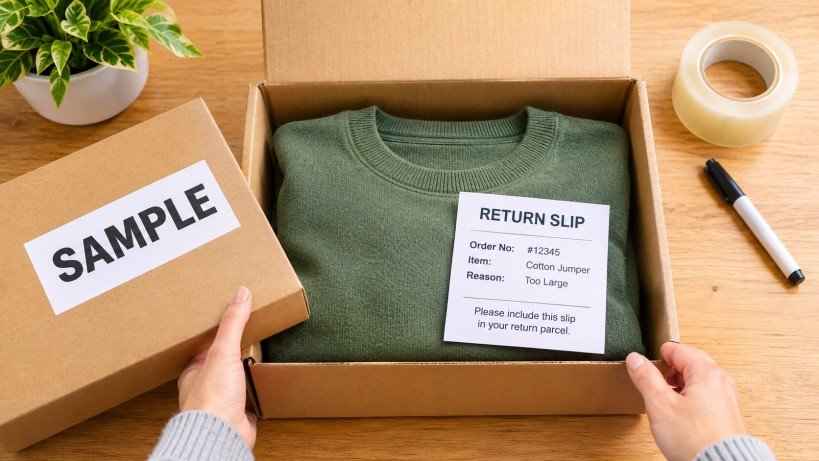
My imagined shop sells plain cotton jumpers and uses a simple paper returns slip. I would ask its owner to put a real order on a table and show me how they want it packed for return. The camera would watch the object, the slip and the box. I would photograph the empty box from above, then photograph the folded jumper sitting in it. The slip would have fictitious details printed in large, readable type. Nothing in the demonstration needs a real customer’s name or address.
Keep the box big enough to understand
The first composition I would try leaves a generous border of tabletop around all four sides of the box. The short sides sit parallel to the screen edges. A yellow dot on the inside of the lid gives the viewer a fixed point to follow when the lid moves. I would keep that dot in the reference image even if it disappears from the finished edit. It is a useful way to notice when a moving lid has quietly become a different piece of cardboard.
The job for Seedance would be to turn that reference into a brief illustration of the lid lowering over a neatly folded jumper. The customer should be able to see that the package closes comfortably. I would leave the slip insertion to a real close-up, because the shop needs the text on it to remain exact. Separating those two shots also gives the editor a natural place to hold the instruction about including the slip. The box can wait for the viewer to read it.
Follow one parcel all the way across the table
My shot brief would describe a locked overhead camera, a small brown cardboard box and a soft green jumper folded just below its rim. The lid lowers slowly from the top edge of the picture and stops with the two long edges aligned. The jumper stays inside. There are no hands, scissors or flying strips of tape. I would record the sound of the real box closing separately and put it under the moment the edges meet. A quiet cardboard rustle is enough to make the movement feel familiar.
If the first Seedance result squashes the jumper as the lid comes down, I would change the reference photograph rather than insist more forcefully on a gentle close. A high fold in the fabric tells the image a contradictory story. Refold the sleeves beneath the body, take a new picture with a visible gap below the rim and try again. The shop’s packaging advice should show a combination of item and box that actually works. Animation cannot make an overfilled parcel into a sensible example.
The next shot would show a real printed slip beside the open box. I would keep the shop’s actual return address out of this part and use an on-screen instruction directing customers to their current return label. Addresses and procedures can change. The durable instruction is about putting the required information in the parcel where the receiving team can find it. If the shop accepts a digital reference instead, the scene should follow that procedure. The owner’s real workflow decides what the film says.
Make the label legible after the movement stops
For the labelling shot I would use a practical overhead view of a hand placing a sample label on a flat lid. A large diagonal word reading “SAMPLE” would make it obvious that this is a demonstration. The edit would hold on the final frame while a caption explains where to find the customer’s own label. I would avoid asking Seedance to generate a barcode or a street name. Those markings are functional parts of the return, and the demonstration should point people towards the real ones.
There is a useful cut hidden in the label’s white rectangle. The last frame of the closing shot can leave an empty patch of brown card at the centre. The first frame of the practical shot brings the white label into exactly that patch. I would match the box size and rotation across the two images, then watch the join without sound. If the box appears to jump sideways, adjust the crop of the practical shot. Another generation is unlikely to solve an edit that only needs a few pixels of alignment.
Before spending more time on the Seedance movement, I would ask someone who has never returned an item to watch the rough cut. Give them a spare jumper, a blank slip and an empty box afterwards. See whether they place the slip inside before closing the lid. A viewer who remembers the beautiful fold but leaves the paperwork on the table has given us a specific correction. Hold the slip shot longer and shorten the closing movement. The useful action deserves the screen time.
Give the support team a film they can keep using
I would export a silent version with large captions for the returns page and a second version with a brief spoken description for people who prefer to listen. Both should end on the same simple image of the closed parcel. A separate final card can show the next step in the shop’s current process, such as booking a collection or taking the parcel to an approved drop-off point. Keep that card editable so the support team can update it when the service changes.
The Seedance section would take only a small part of the finished film. Its purpose is to make the transition from an open, orderly box to a closed parcel easy to follow. At the final check I would play the video on a phone with the captions turned on and the sound off. If the viewer can still identify the jumper, the slip and the label at the moment each matters, the sequence has earned its place on the page. A customer should be able to put the phone down and finish packing with one less question in their head.