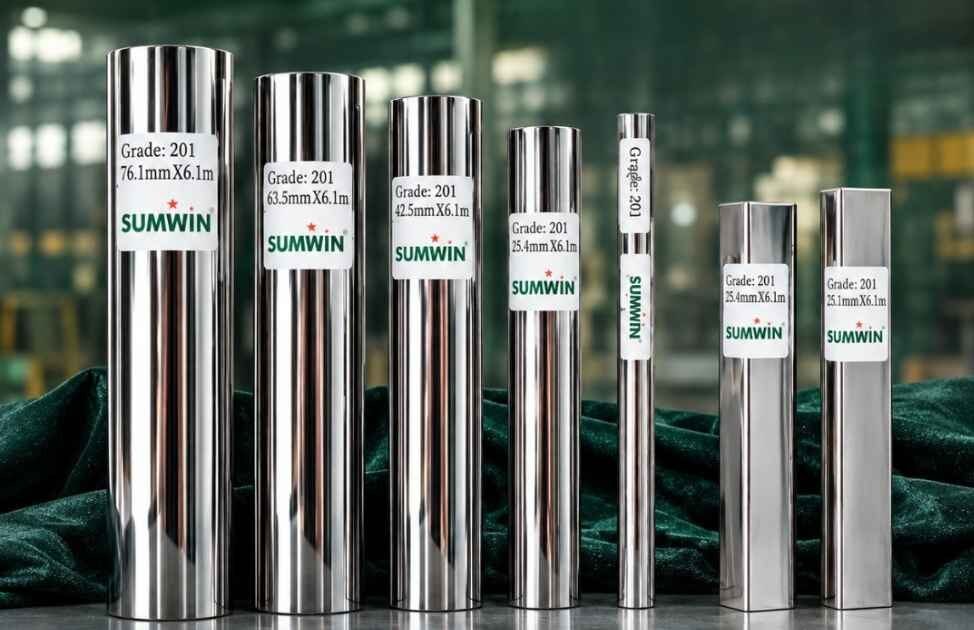
Why Size and Weight Matter
Choosing the correct steel pipe size is essential for fit, appearance, fabrication, structural design and—where the product is intended for it—fluid flow. A small difference in outside dimension or wall thickness can affect how a pipe fits into a bracket, sleeve, fitting or welded assembly. Weight also influences transport, handling, material costing and installation planning.
There is no single universal chart that covers every steel pipe product. Round pipe, nominal pipe sizes, structural hollow sections and stainless steel decorative tubes may use different dimensional conventions and standards. The examples in this article explain how dimensions are recorded; they are not a certified catalogue or a statement of SUMWIN stock. Confirm actual available sizes, tolerances and weights before ordering.
Understanding the Main Dimensions
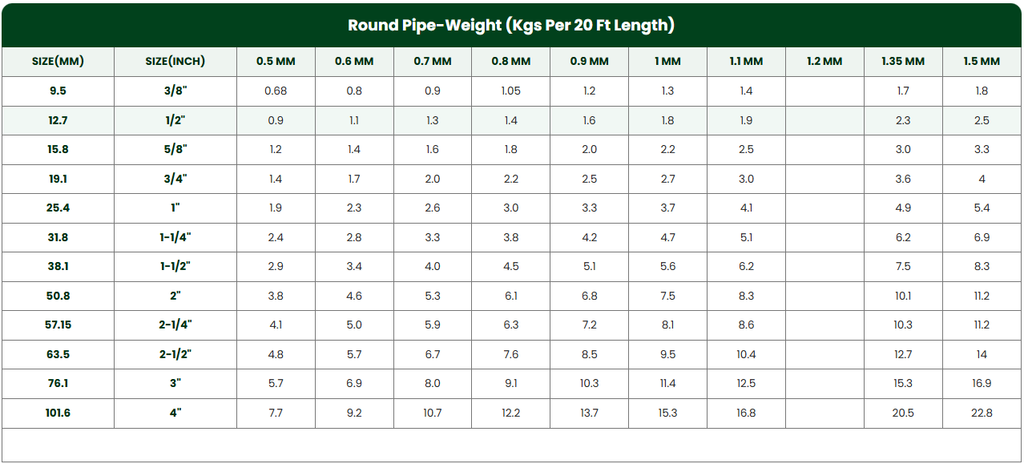
For round tube, outside diameter (OD) is measured across the external circular surface. Wall thickness (WT) is the thickness of the metal wall. Approximate inside diameter is OD minus twice WT: ID ≈ OD − 2 × WT. For example, a tube with an OD of 25 mm and nominal wall thickness of 2 mm has an estimated ID of 21 mm before tolerances.
Square tube is usually specified by outside width × outside height and wall thickness. A square section has equal outside dimensions, such as 25 × 25 mm, while a rectangular section might be 40 × 20 mm. Corner radii and manufacturing tolerances affect exact geometry, so use the manufacturer’s dimensional standard for detailed design.
Nominal pipe size (NPS) is a designation used in certain piping standards and is not always equal to measured outside diameter. Schedule designations refer to wall-thickness series within specified systems. Read the applicable standard’s table rather than assuming that nominal size equals OD.
Illustrative Round Tube Examples
The examples below show how a buyer might organize a preliminary comparison. They are examples for calculation practice only, not a statement of SUMWIN stock or a certified dimensional schedule.
· Example A: OD 21.3 mm, WT 2.0 mm → estimated ID 17.3 mm.
· Example B: OD 25.4 mm, WT 2.0 mm → estimated ID 21.4 mm.
· Example C: OD 33.7 mm, WT 2.6 mm → estimated ID 28.5 mm.
· Example D: OD 42.4 mm, WT 2.6 mm → estimated ID 37.2 mm.
· Example E: OD 48.3 mm, WT 3.0 mm → estimated ID 42.3 mm.
Actual sizes, tolerances and standards must be verified against the specific product being purchased.
Square and Rectangular Tube Dimensions
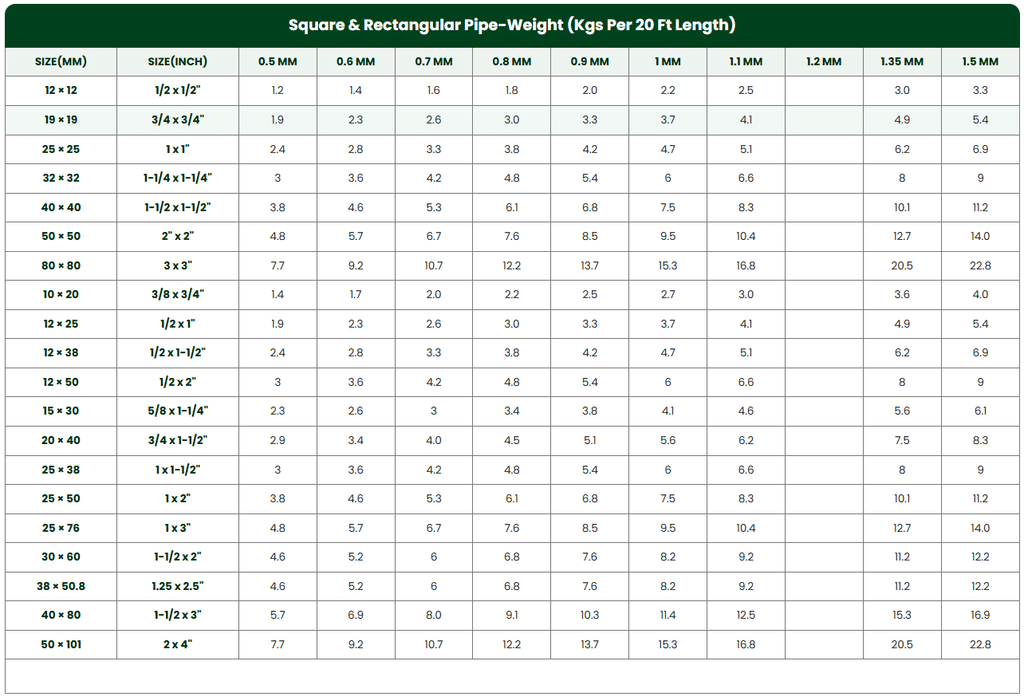
Square and rectangular tubes are commonly described by outside width, outside height and wall thickness. Examples of specification formats include 25 × 25 × 1.5 mm, 50 × 50 × 2.0 mm, 40 × 20 × 1.5 mm and 80 × 40 × 2.0 mm. These examples illustrate notation and should not be interpreted as guaranteed stock sizes.
When comparing rectangular sections, do not consider only the largest dimension. Width-to-height ratio affects orientation, stiffness and appearance. Structural performance depends on exact geometry, grade, wall thickness, length, support conditions, load direction and connections. Use a qualified engineer for load-bearing design.
How Steel Pipe Weight Is Estimated
Weight is estimated from cross-sectional metal area multiplied by length and material density. For a round tube, a simplified theoretical formula using millimetres is: kg/m ≈ 0.02466 × WT × (OD − WT), where OD and WT are in millimetres. This is an approximation based on typical steel density and idealized circular geometry. Actual weight can vary because of tolerances, density, corner geometry and manufacturing details.
For example, if OD = 25.4 mm and WT = 2.0 mm, the estimate is 0.02466 × 2.0 × (25.4 − 2.0) ≈ 1.15 kg/m. A 6-metre length would therefore be approximately 6.9 kg before packaging and tolerance variation. Treat this as a planning estimate, not a guaranteed dispatch weight.
Square and rectangular hollow-section calculations use the cross-sectional metal area. A simplified approach starts with outer area minus inner area and multiplies by density, but rounded corners make exact geometry more complex than a sharp-corner rectangle. Manufacturer tables are preferable when precision matters.
What Changes Pipe Weight?
Outside dimensions, wall thickness, length and material density affect theoretical weight. For the same outside diameter, increasing wall thickness generally increases metal area and weight. For the same wall thickness, a larger section usually contains more material. Actual weight per piece is theoretical weight per metre multiplied by length, adjusted for actual dimensions and tolerances.
Finish normally does not substantially change theoretical weight, but coatings, fittings, protective films and packaging can affect delivered bundle weight. If freight, lifting equipment or structural loads depend on weight, use supplier-confirmed figures and safe handling procedures instead of an approximate online calculation.
Choosing Dimensions for the Application
For decorative railings and furniture, appearance, grip, span, joining method, finish and cleaning requirements may guide initial selection. For structural use, section properties and design loads must be evaluated by a competent designer. For fluid transport, internal diameter, flow, pressure, temperature, corrosion allowance, joining method and code requirements matter.
Do not choose wall thickness based on appearance alone. Thin-wall tubes may be appropriate for some decorative applications but may not meet a structural or pressure specification. Likewise, a visually heavy pipe is not proof of compliance. Ask the engineer or equipment designer to state the required material and dimensional standard.
What to Send a Supplier
Provide profile type, outside diameter or width × height, wall thickness, material grade, length, finish, quantity and delivery location. State whether dimensions are metric or imperial and identify the governing standard if one applies. If you require cut lengths, specify permitted length tolerance and end preparation.
Attach drawings when the pipe must fit an assembly. Note critical dimensions, surface requirements, packaging instructions, certificates and inspection needs. Ask the supplier to confirm availability and quote the exact specification rather than selecting a near match without approval.
Frequently Asked Questions
Is nominal pipe size the same as outside diameter? No. In many standards, nominal pipe size is a designation; actual OD must be read from the applicable table.
How do I calculate round steel pipe weight? A common approximate formula is kg/m ≈ 0.02466 × WT × (OD − WT), with OD and WT in millimetres. Verify against manufacturer data for purchasing.
Does thicker pipe always mean stronger? Not for every failure mode or design. Thickness affects section properties, but grade, geometry, connections, length, loads and standards also matter.
Can I use an online chart for a final order? Use it for preliminary understanding only. Confirm exact dimensions, tolerances, availability and weight with the supplier.
To discuss your requirements, explore the SUMWIN website and contact the team with your product specifications.
Company: SUMWIN Pakistan
Address: 22 KM, Sheikhupura Road, Lahore, Pakistan
Phone number: +92 311 4099103
Email address: info@sumwin.com.pk
Disclaimer: This article is for general informational purposes only and does not constitute professional engineering, structural, or procurement advice. All dimensional examples, inside-diameter estimates, and weight calculations in this article are illustrative only—they are for calculation practice and do not represent SUMWIN stock, a certified dimensional schedule, or guaranteed dispatch weights. Theoretical weight formulas (such as kg/m ≈ 0.02466 × WT × (OD − WT)) are approximations based on idealized circular geometry and typical steel density; actual weights vary with tolerances, material density, corner geometry, coatings, and packaging. Nominal pipe size (NPS) and schedule designations are not the same as measured outside diameter and must be read from the applicable standard’s table. Load-bearing, pressure, and fluid-transport applications require evaluation by a qualified engineer against the governing standard. Readers must verify exact dimensions, tolerances, availability, and weights directly with the supplier before ordering. Details about SUMWIN Pakistan—including contact information and product offerings—are based on the company’s own statements and have not been independently verified; their mention does not imply endorsement. The author and publisher disclaim any liability for decisions made based on this content.
Discover posts that make learning feel like a pleasure, not a chore—our engaging guides turn reading into something you look forward to.