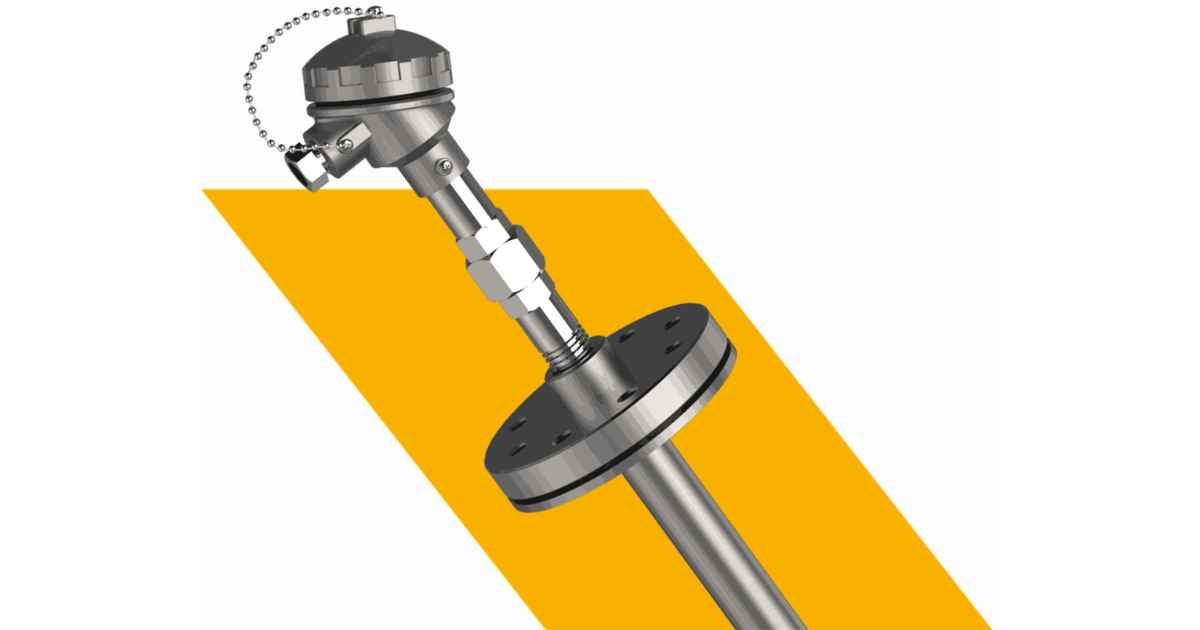
When an RTD is installed directly into a process line, the sensing element may face pressure, flowing media, vibration, corrosion, or mechanical damage. That’s where a thermowell for RTD becomes useful. A thermowell creates a protective barrier between the RTD and the process while allowing heat to reach the sensing element.
But choosing one isn’t simply a matter of matching the sensor diameter. The thermowell’s material, insertion length, tip geometry, process connection, flow conditions, pressure, and temperature all affect how well the measurement point performs.
What’s in the Design, Protection and Performance of a Thermowell for RTD?
A thermowell has a straightforward job: protect the temperature sensor while allowing it to measure the process temperature. In practice, however, its design involves several connected decisions.
1. Thermowell geometry
The basic geometry includes the shank, tip, bore, wall thickness, unsupported length, and process connection. Common shank profiles include straight, stepped, and tapered designs.
A straight shank offers a relatively simple and mechanically strong construction. A tapered shank can provide a useful balance between mechanical strength and response. Stepped designs can reduce drag and thermal mass in some applications.
Tempsens’ technical guidance also identifies straight, stepped, and tapered shank configurations and notes that geometry affects response time and resistance to flow-related forces.
The key point is that there isn’t one geometry that works equally well everywhere.
Consider a process line carrying a fast-moving liquid. A long thermowell projecting into the flow experiences forces that a short, well-supported installation may not. Increasing unsupported length can affect vibration behaviour, which is why thermowell dimensions should be checked against actual process conditions rather than selected from a generic drawing.
2. Material selection
The thermowell material needs to withstand the process environment, not just its nominal temperature.
For example, stainless steels are commonly selected for industrial temperature measurement, but the appropriate grade depends on corrosion conditions, temperature, process chemistry, and mechanical requirements. Tempsens’ catalogue lists materials including 304, 321, 316, 310 and 446 stainless steels, as well as Inconel grades for specific high-temperature environments.
A practical selection question is simple:
What will the thermowell actually be exposed to?
A process involving water at moderate temperature presents a very different material-selection problem from a chemical stream containing corrosive compounds at elevated pressure.
3. Mechanical protection
This is where thermowell design becomes more than a temperature-measurement accessory.
A thermowell installed in a flowing process can experience drag forces and vibration. Flow can create alternating forces around the thermowell. If the resulting excitation approaches the thermowell’s natural frequency, vibration can become a serious mechanical concern.
That’s why process velocity, density, pressure, temperature, insertion length, and thermowell geometry should be available when the design is reviewed.
4. Thermal performance
Heat must travel from the process fluid through the thermowell wall and into the RTD. The additional material adds thermal mass, which can increase response time compared with a sensor directly exposed to the process. Tempsens also describes this effect in its technical material on thermowells.
So, a thicker or heavier thermowell isn’t automatically better. It may offer mechanical advantages while producing a slower thermal response.
For a slowly changing storage tank, that delay may have little practical effect. In a rapidly changing control loop, it could matter much more.
5. Sensor fit and insertion
The RTD has to sit correctly inside the thermowell.
Poor dimensional matching can create excessive clearance or prevent proper contact at the sensing end. The sensing portion also needs to reach an appropriate position in the process rather than stopping too close to the pipe wall.
This is one of those details that’s easy to miss during procurement because the sensor and thermowell may be purchased as separate line items.
6. Process connection
Threaded, flanged, welded, and other connection arrangements may be used depending on the installation.
The connection has to suit the pipe, vessel, pressure class, maintenance requirements, and applicable plant specifications. A removable thermowell can also make sensor replacement easier because the RTD can generally be serviced without opening the process itself.
That’s the practical value of the design. The sensor can be maintained while process integrity is preserved.
What to Consider When Looking for the Best Thermowell for RTD?
There isn’t a universally “best” thermowell. The suitable design is the one that matches the actual measurement point.
Before specifying a thermowell for RTD, engineers should check these factors:
| Selection factor | Why it matters |
|---|---|
| Process temperature | Determines material and sensor suitability |
| Process pressure | Affects mechanical and pressure design |
| Fluid velocity | Influences drag and vibration |
| Fluid chemistry | Guides material selection and corrosion resistance |
| Insertion length | Determines where the sensing element sits |
| Thermowell bore | Must accommodate the RTD correctly |
| Tip and shank geometry | Affects strength, drag and response |
| Process connection | Must match piping or equipment requirements |
| RTD diameter | Ensures physical compatibility |
| Maintenance requirements | Determines how easily the sensor can be removed |
For higher-flow applications, don’t stop at temperature and pressure. A useful engineering practice is to collect the process data before asking a supplier for a quotation. At minimum, provide the operating and maximum temperature, operating and maximum pressure, fluid, density, velocity, pipe size, insertion length, connection type, and RTD dimensions.
That information can prevent a common procurement problem: receiving a thermowell that physically fits the pipe but isn’t appropriate for the actual process conditions.
Another point deserves attention during inspection. If an existing thermowell has developed cracks, deformation, unusual vibration, or repeated sensor failures, replacing the RTD alone may not solve the problem. The thermowell itself may need a mechanical and application review.
Final Words
A thermowell is a small component with a surprisingly large role in industrial temperature measurement. Its job isn’t just to protect an RTD. It has to withstand the process, transfer heat effectively, remain mechanically stable, and allow the sensor to be maintained without unnecessarily disturbing production.
That balance is why thermowell selection should begin with process conditions rather than a standard catalogue size.
For plants looking for application-specific temperature measurement solutions, Tempsens Malaysia provides access to temperature sensing technologies and related engineering solutions for industrial applications. Tempsens manufactures RTDs, thermowells and other temperature measurement products, with its technical catalogue covering different sensor, thermowell and material configurations.
FAQs
1. What is a thermowell for RTD?
A thermowell is a protective housing installed in a process line or vessel. An RTD is inserted inside it so temperature can be measured while the sensing element remains protected from the process medium.
2. Does a thermowell affect RTD response time?
Yes. The thermowell adds material between the process and the RTD, increasing thermal mass. Geometry, material, wall thickness and installation can therefore affect response time.
3. How is a thermowell material selected?
Material selection depends on process temperature, pressure, fluid chemistry, corrosion exposure and mechanical requirements. Stainless steels and nickel-based alloys are among the materials used for different industrial conditions.
Disclaimer: This article is for general informational purposes only and does not constitute professional engineering, technical, or safety advice. Thermowell design, material selection, dimensional requirements, and mechanical performance vary by application, process conditions, and industry standards, and may change without notice. Readers should verify all technical specifications, engineering calculations, and safety requirements directly with a qualified engineer and their chosen supplier before specifying or installing any thermowell. Any mention of specific manufacturers or products does not imply endorsement. The author and publisher disclaim any liability for decisions made based on this content.
Unlock a better way to learn at your own pace—browse our self-guided resources and grow without the pressure.