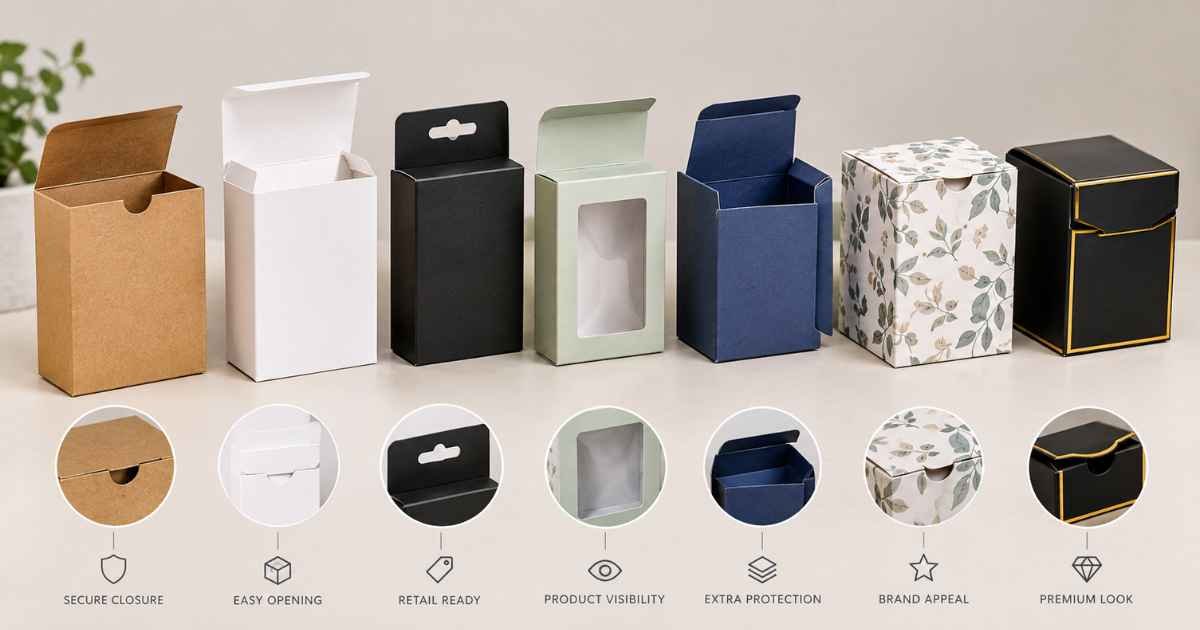
Designing a classic tuck box seems like a simple job. You just have to get the right dimensions for the four sides and add a top and bottom closure flap. However, try to take a closer look and you will find that not all tuck boxes are created equal. There is a smart piece of engineering and science in its structure and every flap that folds, tucks, and locks together is designed uniquely. That’s why there are more than one style of custom tuck boxes and choosing the wrong one can cost you real cash. If you pick a wrong design, your product may have to take the fall, unboxing can turn into an absolute disaster, or it takes a lot of time for assembling.
Therefore, before you design the logo and artwork for your custom tuck boxes, figure out the right style. It will save you from the hassle of experiencing issues with packaging’s functionality. Read further to explore how different tuck boxes impact your product’s safety, function, and shelf appeal.
Understanding the Core Tuck Box Styles
Based on the geometry and closure flaps, there are four different box styles of custom tuck boxes. Each design plays a specific role in assembly, speed, load strength, and retail presentation. Therefore, understanding the geometry of every tuck box is important as it will have different results on your packaging line. Let’s begin!
Straight Tuck End (STE) Boxes
A straight tuck end box is a common type of folding carton. It has two closure flaps, one at the top and other in the bottom that fold in the same direction toward the back panel of the box. Straight tuck end boxes provide a clean, professional look and a seamless front facade. They offer plenty of room for branding and you can even add window cutout for product display. The added feature will not compromise the structural integrity of the box. These boxes are a perfect solution for high-end retail and luxury cosmetic, skincare products.
Reverse Tuck End (RTE) Boxes
Visually they exactly look like STE boxes but there is a structural difference. In reverse tuck end boxes, the top flap folds towards the rear, whereas the bottom flap folds toward the front. The flaps fold in opposite directions so the designs can pack tightly together on the raw cardboard, keeping material waste to a minimum. Assembling RTE boxes is quick by hand. That’s why this design is considered cost-effective as it saves time and labor cost. Reverse tuck end boxes are the best packaging option for e-commerce business where durability and low packaging cost are the primary preference.
Auto-Lock Bottom Boxes
Auto-lock or crash-lock boxes are another type of tuck end folding carton. Their top has a standard tuck flap that either folds towards the front or rear side of the box. While the bottom is a pre-folded, pre-glued base. When you squeeze or expand the sides of the flat box, the bottom panels automatically pop and lock into a square, rigid base. Thus, offering the businesses with the fastest assembly time. Also, the pre-glued base provides extra strength for load bearing. Therefore, crash lock boxes are basically used for heavy weight items like candles, liquid bottles, and ceramic goods.
Snap-Lock (1-2-3 Bottom) Boxes
The entire structure of snap lock boxes is similar to the crash lock carton. The only difference lies in their base. The base has four unglued bottom flaps that overlap and friction-lock together manually without the need of a tape or adhesive. These boxes have a higher weight resistance compared to all the tuck end containers. And that’s why they are used for bulky items.
Impact of Tuck Boxes Design Variations On Packaging Functionality
The visual impact of design variations in tuck top boxes wholesale is minimal. You get the equal amount of space for branding and adding product details. But there is a great difference in structural strength and manufacturing cost. So, let’s take a look at how the different designs of custom tuck boxes affect functionality.
Offer High-End Product Protection & Tamper Resistance
What is the primary function of a packaging? It’s to prevent free movement, accidental opening during transit and ensure the product arrives in a flawless condition. A well-designed tuck box prevents friction lids from slipping open during movement. You can even add structural add-ons like small notch cutouts on the main tuck flap. This creates a firm catch that resists vibration during shipping. Furthermore, internal dust flaps create a tight seal that keeps out debris and avoids product tampering.
Guarantee 100% Structural Integrity by Increasing Weight Capacity
A box is only as reliable as its base. Standard friction-tuck bottoms rely solely on board tension to stay closed. Therefore, they are susceptible to accidental opening under dense loads. Upgrading to a snap-lock or auto-lock bottom creates an interlocking base that distributes vertical load evenly. As a result, you can safely ship heavy items like glass jars or tech accessories without the bending or tearing of the box.
Provide Quick Assembly & Enhance Labor Efficiency
Rigid styled custom printed packaging boxes save big on labor cost as they eliminate assembly work. However, folding cartons require manual assembly which is a time consuming process. With custom tuck boxes you can cut packing times in half. Want to know how? A STE and RTE box takes 5 to 8 seconds in manually folding the top, bottom, and side flaps. Whereas an auto-lock bottom box just takes 2 seconds to pop into its shape. So, if you upgrade to auto-lock boxes you can save 5 seconds per box which concludes of 13 hours of saved labor. Thus, you can reduce the assembly time and labor cost both.
Besides the product safety and packaging efficiency, there are other functional benefits too. For instance, buying tuck end boxes in bulk offer endless customization options. There is always room for addition and you can integrate die-cut hang tabs into your tuck boxes. So, when the shelf space is limited, you can easily display your products on pegboards.
Matching the Tuck Box Styles To Product Categories
Here is a list of products and the right tuck box styles for them.
| Product Type | Recommended Tuck Box Style | Key Functional Reason |
| Cosmetic & Skincare | Straight Tuck End | Premium front visual appeal, clean edges |
| Heavy Goods (Candles & Liquids) | Auto-Lock or Snap-Lock Bottom | High load-bearing safety and fast setup |
| High-Volume E-commerce Items | Reverse Tuck End | Cost-effective and quick manual assembly |
| Pharma & Retail Products | Tuck Top Auto Bottom | Rapid restocking and integrated hanging and display options |
Conclusion
A well-designed box balances form, function, and budget. So, whether it’s a quick to assemble auto-lock bottom or a beautiful, user-friendly straight-tuck box, think carefully, focus on what your product needs are and then make pick your box. Because your structural choices can make or break your packaging functionality. Don’t let poor structural design be the weak link in your supply chain. Invest in a tuck style that looks great, protects reliably, and functions effortlessly.
FAQs
What is a tuck end box?
It’s one of the most common folding cartons you’ll see on store shelves, the kind used for lipsticks, serums, and vitamin bottles. The box is made from a single sheet of paperboard, and the flaps at the top and bottom simply tuck inside to close. No tape or glue is needed, because the friction of the flap against the side panels holds it shut.
What is the difference between straight tuck end and reverse tuck end boxes?
In a straight tuck end box, both the top and bottom flaps close toward the back of the box. In a reverse tuck end box, the top flap closes toward the back and the bottom flap closes toward the front. When the box is sitting on a shelf, most people can’t tell them apart. The main differences are in the price and the finish of the front panel.
Why are reverse tuck end boxes cheaper than straight tuck end boxes?
Reverse tuck boxes use less paperboard. Because the flaps face opposite ways, we can fit more boxes on one printing sheet. This means less waste for us and a lower price per box for you. If you’re ordering thousands of boxes, the savings are worth considering.
Why do premium brands prefer straight tuck end boxes?
On a reverse tuck box, the bottom flap folds toward the front, so you can see a small cut edge at the bottom of the front panel. With a straight tuck box, that edge sits at the back where nobody sees it. The front stays completely clean. Luxury skincare, perfume and makeup brands usually pick this style because their front panel is where the branding has to look perfect.
Disclaimer: The information in this article is for general informational purposes only and does not constitute professional, technical, or business advice. Packaging specifications, material performance, assembly times, and pricing may vary by manufacturer, product, and project requirements. Readers should verify all structural details, load capacities, and customization options directly with their packaging supplier before placing an order. Any mention of box styles or suppliers does not imply endorsement. The author and publisher disclaim any liability for decisions made based on this content.
Uncover tips that feel like a soft breeze—dive into our light-touch resources and let stress drift away.