For decades, work instructions have lived in binders, laminated sheets, and PDF files pinned to a station wall. They tell an operator what to do — step 1, step 2, step 3 — but they have no idea whether any of it actually happened. A torque spec gets skipped, a fastener gets missed, a part gets assembled out of sequence, and the instruction sheet just sits there, silent. It did its job on paper. It did nothing on the floor.
This is the core weakness of static documentation: it’s a reference, not a safeguard. And in a manufacturing environment where a single missed step can trigger a recall, a warranty claim, or a safety incident, “reference only” isn’t good enough anymore.
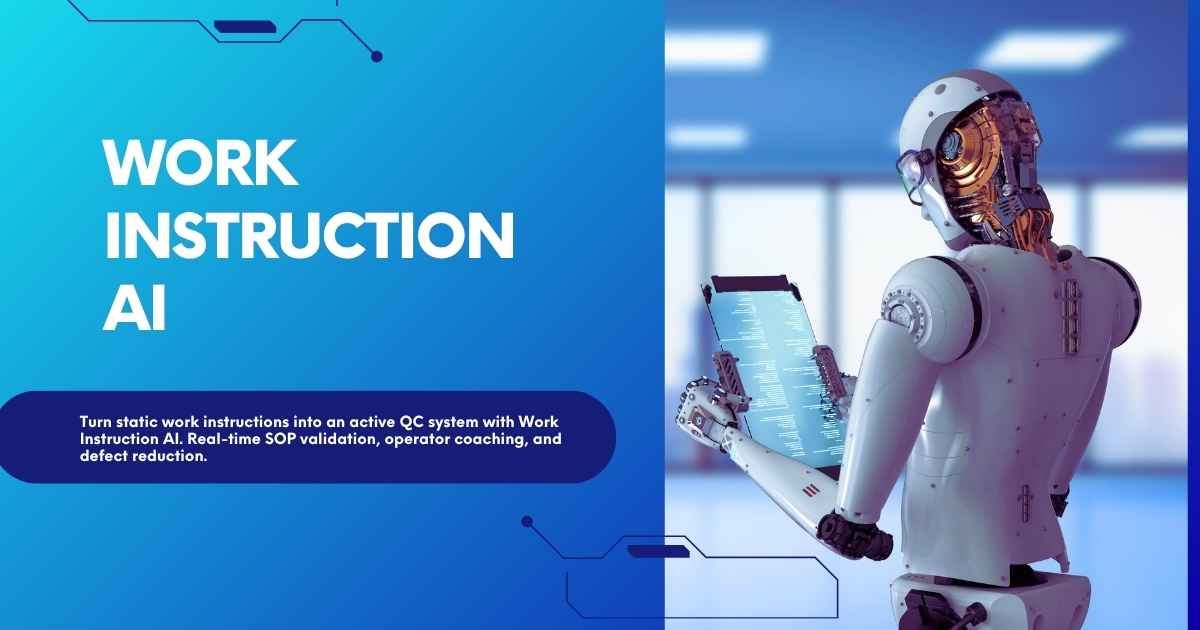
The shift happening across modern plants right now is the move from static, passive instructions to active, intelligent ones — instructions that watch, verify, and respond. This is the promise of Work Instruction AI: turning a document into a system that participates in quality control rather than just describing it.
The Problem With “Set It and Forget It” Documentation
Traditional work instructions were built for a world where variation was rare and training was thorough. Neither assumption holds anymore.
Operators change constantly. Turnover on many production lines now exceeds 30-40% annually. New hires and temporary workers are frequently expected to follow the same multi-step SOPs as operators with years of tenure, often with only a few hours of onboarding.
Products change constantly. Mixed-model lines, frequent engineering changes, and shorter product lifecycles mean the “correct” sequence of steps for a station can shift multiple times a quarter. Keeping paper or PDF instructions current becomes a losing battle against version control.
Oversight doesn’t scale. A quality engineer or line supervisor can physically watch one station at a time. On a line with twenty stations running three shifts, that’s a coverage gap measured in thousands of unsupervised hours every week.
The result is predictable: deviations happen, and nobody knows until the defect shows up downstream — or worse, in the customer’s hands. Static instructions describe the ideal process. They cannot tell you when reality diverges from it.
What “Active Quality Control” Means with AI Agent
Active Quality Control goes beyond simply documenting the correct process. AI Agents actively participate in the quality process by:
- Monitoring the process in real time as the work is being performed.
- Verifying each step against the defined SOP, identifying deviations as they occur.
- Guiding the operator immediately, helping correct the issue before it leads to a defective part or moves to the next station.
This is the foundation of AI-powered work instructions for the shop floor. An AI Agent can continuously observe the workstation, compare the operator’s actions with the defined process, and provide timely guidance through a display, visual alert, or other connected interface.
Instead of relying on a static SOP that operators must remember and follow, the AI Agent turns the instruction into a live quality-assurance layer — helping operators stay on the right process, at the right step, every time.
How the Transformation Actually Works
Moving from static to active isn’t about throwing out existing SOPs — it’s about giving them a nervous system. Here’s the general architecture underpinning modern Work Instruction AI deployments:
1. Digitizing and structuring the SOP
The existing work instruction — steps, torque values, fastener counts, orientation requirements, safety checks — is broken down into discrete, machine-readable checkpoints. This is the foundation the AI agent validates against.
2. Station-level visual monitoring
Cameras or existing vision hardware at the station give the AI agent a live view of the work area. The agent isn’t just recording video for later review; it’s interpreting the scene in real time — hands, parts, tools, sequence, presence/absence of components.
3. Real-time SOP validation
As the operator works, the system continuously checks: Was this step completed? Was it completed in the right order? Was the right part used? Did the torque wrench cycle the correct number of times? Each checkpoint from the digitized SOP gets validated against what the camera actually observes.
4. In-the-moment coaching
When a deviation is detected — a skipped step, a wrong-part pick, an out-of-sequence action — the system alerts the operator immediately, at the station, before the part moves on. This is the difference between catching an error in three seconds and catching it three days later in a customer complaint.
5. Closed-loop data for continuous improvement
Every validated step, every flagged deviation, and every correction becomes a data point. Over time, this generates a live picture of where a line struggles, which steps cause the most deviations, and where retraining or process redesign is actually needed — grounded in real observed behavior, not anecdote.
What This Means for Operators, Not Just Metrics
It’s worth being clear-eyed about a common concern here — that this kind of system is really about surveillance, not support. In well-designed deployments, it’s the opposite. The AI agent isn’t there to catch operators doing something wrong for a disciplinary record; it’s there to catch the process drifting before a defect happens, and to make sure every operator — new hire or twenty-year veteran — has the same expert-level guidance available at the moment they need it.
For new employees, this dramatically shortens the ramp-up period. Instead of shadowing a trainer for weeks, an operator gets real-time correction built into the workflow from day one. For experienced operators, it removes the burden of memorizing every variant of every SOP across a mixed-model line — the system handles the version control and step tracking, while the human handles the actual craft.
Choosing the Right Approach
Not every station needs the same level of intervention, and a thoughtful rollout usually starts with the highest-risk points in the process — safety-critical fastenings, high-warranty-cost assemblies, stations with frequent operator turnover, or steps that have historically driven the most defects. From there, expanding coverage becomes a matter of proving ROI station by station rather than attempting a plant-wide overhaul on day one.
The technology also needs to fit into existing infrastructure rather than demanding a rip-and-replace. Solutions built around Work Instruction AI are typically designed to layer onto existing cameras, existing SOPs, and existing MES/quality systems, so the transformation is additive rather than disruptive.
The Bigger Shift: From Documentation to System
The underlying shift here is bigger than any single tool. It’s a move away from treating quality as something you document and audit, toward treating quality as something you actively maintain, station by station, second by second. Static work instructions were never designed to do that — they were designed to inform, not to intervene.
AI-powered work instructions close that gap. They keep the institutional knowledge that lives in a well-written SOP, but give it eyes, judgment, and a voice on the floor. The result isn’t just fewer defects — it’s a quality system that catches problems where they start, instead of where they’re discovered.
If your plant is still relying on a document that can’t see what’s happening on the line, the next step isn’t a better document. It’s a system that can watch, validate, and coach in real time. That’s the practical difference between a paper trail and an active quality-control system — and it’s where manufacturing quality is headed next.
Disclaimer: The information provided in this article is for general informational and educational purposes only. It does not constitute professional manufacturing, safety, or compliance advice. AI-powered quality control systems vary in capability and implementation; readers should assess their own operational requirements and consult qualified specialists before deployment. The author and publisher disclaim all liability for any production issues, defects, or losses arising from reliance on this content. Always ensure any monitoring system complies with workplace regulations and respects employee privacy. This article does not guarantee specific quality improvements or defect reductions.
Browse through wisdom that guides—our guiding principles light the way through uncertainty.