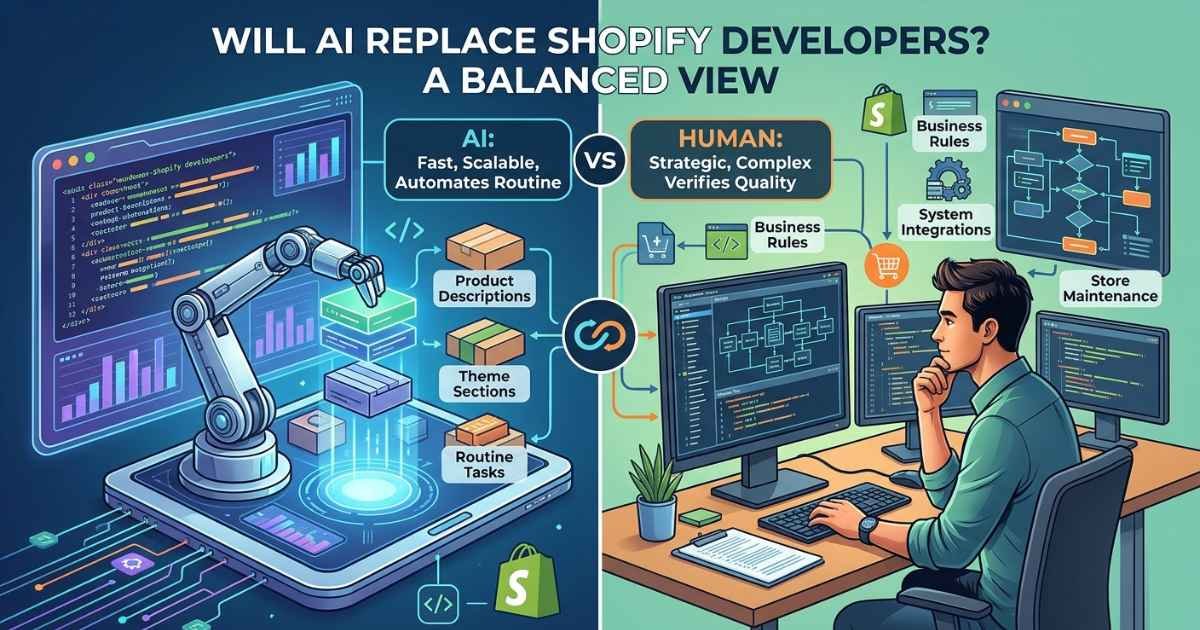
AI can now help merchants create store content, generate theme sections, and handle routine tasks. However, an expert shopify developer remains valuable when a business needs reliable integrations, complex functionality, or help diagnosing problems. The distinction is between producing a feature and making sure it works correctly within a live store.
Some straightforward development work may require less professional involvement as these tools improve. That does not mean every store can operate without technical expertise.
Can AI Replace a Shopify Developer?
AI can handle parts of Shopify development, particularly clearly defined, repetitive tasks. It does not consistently replace the judgment needed to plan complex systems, verify business rules, investigate failures, and maintain integrations. Whether a merchant needs a developer depends on the store’s requirements and the consequences of something going wrong.
What Can AI Already Do?
Shopify’s AI tools support tasks such as generating content, creating theme blocks, and building certain administrative apps. These capabilities give merchants more ways to make changes without starting every task from scratch.
Practical uses include:
- Drafting product descriptions.
- Producing an initial layout or theme block.
- Suggesting code changes.
- Helping explain unfamiliar code.
- Automating suitable administrative tasks.
For a simple requirement, this may reduce the need to commission a separate development project. The output still needs checking against the intended result.
What Does Developer Feedback Suggest?
In its published early-access review of Shopify Canvas, agency Ask Phill described working with Sidekick as fast and natural and reported improved responsive control. This supports the view that AI can accelerate storefront work. It is one agency’s experience with a specific tool, rather than evidence that developers are no longer needed.
Shopify’s own guidance also identifies limits. Generated theme blocks can contain errors or fall short of accessibility and performance practices. Merchants remain responsible for reviewing and testing them.
The practical lesson is to judge the finished behavior, not simply how quickly the first version appears.
Where Does Human Expertise Still Matter?
Understanding the Business Rules
A request such as “add wholesale ordering” leaves many questions unanswered. Who qualifies for trade pricing? Are minimum quantities required? What happens when customers combine different products?
A developer turns those requirements into clear rules before implementation. AI can assist, but incomplete instructions can still produce an unsuitable solution.
Checking Connections Between Systems
A store may depend on inventory software, payment services, shipping tools, and email platforms. A feature that works alone may fail when these systems interact.
For example, a merchant researching wp mail smtp mailchimp may need help distinguishing WordPress email delivery from email marketing. WP Mail SMTP supports email sending from WordPress, while Mailchimp offers marketing functionality and a Shopify integration. They are not interchangeable Shopify components.
Choosing the correct system is part of the work, before any code is written.
Testing Failure Scenarios
A successful demonstration does not establish that a feature is ready for customers. Developers also check what happens when stock changes, a request fails, or a customer submits incomplete information.
These cases matter because they can affect orders and staff workload. Tests should reflect the business process, including cancellations and corrections.
How Will the Developer’s Role Change?
AI may reduce the time spent writing routine code and preparing initial versions. Developers can then spend more attention on requirements, testing, troubleshooting, and maintenance.
An expert shopify developer should be able to explain why a proposed feature is needed, how it will be verified, and what support it requires. The value lies in delivering dependable functionality, regardless of which tools helped create it.
The long-term effect on developer employment remains uncertain. Easier store building may reduce demand for some basic tasks while creating different technical support needs.
What Should Store Owners Do?
Use AI for manageable tasks whose results you can inspect. Seek technical review when changes involve important business rules, customer data, or several connected systems.
Describe the actual problem when requesting help. Instead of submitting only a phrase such as wp mail smtp mailchimp, explain which website sends the messages, what type of email is involved, and what is failing.
AI can make Shopify development more accessible. Store owners still need a clear owner for testing, maintenance, and fixing problems after launch.
Disclaimer: This article is for general informational purposes only and does not constitute professional, technical, or business advice. AI capabilities, Shopify platform features, third-party tools, and integration requirements vary by provider and may change without notice. References to specific agencies (Ask Phill), tools (Shopify Canvas, Sidekick), and platforms (WP Mail SMTP, Mailchimp) are illustrative and do not imply endorsement or an affiliation with Shopify. AI-generated code and theme blocks may contain errors or fall short of accessibility and performance standards, and merchants remain responsible for reviewing and testing all output. The long-term effect of AI on developer employment is uncertain. Readers should verify all technical details, integration requirements, and platform policies directly with qualified professionals and the relevant providers before making development or hiring decisions. The author and publisher disclaim any liability for decisions made based on this content.
Build a mindset that works for you—our positive thinking strategies help you reframe challenges and stay optimistic.